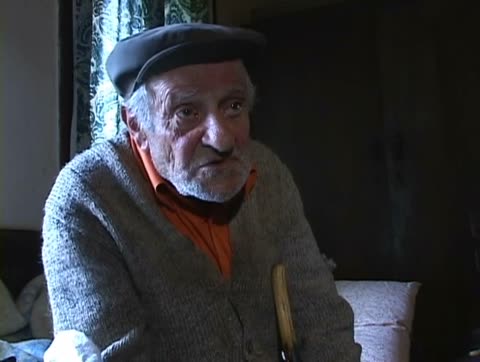
The interview with Lipovici begins. He provides personal information and talks about his family. His father, who worked at a mill, passed away when Lipovici was nine years old. He grew up with six brothers and three sisters.
From the machine transcript
Lipovici's interview begins with a remark about his pension. He gives his name in Romanian form, Lipovici, and his father's name, Shalom. His father worked at a big mill in Dorohoi and died when he was nine. He names his seven brothers and three sisters in part. He says his grandfathers lie in the old cemetery in Dorohoi and mentions Rădăuți and Siret. He also says he studied four classes of primary school and then three of commercial school.
Lipovici talks about his prewar education. He attended a primary school for four years and a religious school (cheder).
From the machine transcript
Lipovici gives his birth year as 1921 and says he studied in cheder. He remembers the bearded melamed and a prank in which the boys glued his beard while he slept. Kerler and Lipovici also exchange some chat about where Kerler was born, and Lemster joins in.
The primary school is actually mentioned in the previous passage; here the focus is cheder and the beard prank.
Lipovici addresses his life today and mentions a robbery at his house.
From the machine transcript
Lipovici says he remembers little of his childhood. He tells at length of an episode in which bandits broke into his house, held him down and went through the rooms, after which the police came. The year is unclear. He says the present house was built after the war, and he and Kerler talk about the kerosene lamps of earlier times. Lemster then asks about his trade.
The robbery appears here as a long story of bandits breaking in and the police coming.
Lipovici talks about his work as shepherd, which he began in 1949. Currently, he owns two sheep.
From the machine transcript
Lipovici says he worked with animals and sheep. He now keeps two sheep, though Lemster has heard three, and a lamb is mentioned as something to buy. Lemster asks about the work and its partners. He offers coffee and the interviewers decline.
The year 1949 is not clear in this passage.
Lipovici talks about prewar Jewish life and his family.
From the machine transcript
Asked about Jewish Dorohoi, Lipovici mentions a Jewish bath, a synagogue and a Jewish hospital where the community office now stands. He says there were many synagogues, though the number is unclear, and that they were plundered. He repeats that his father worked at the big mill and died when he was nine. Lemster asks why he became a shepherd, and he answers briefly, apparently because of a livelihood.
Adds the Jewish bath, hospital and synagogues in Dorohoi.
Lipovici speaks about his life during World War II. He was in the forced labor unit of the army.
From the machine transcript
Lipovici speaks about the war years in Dorohoi. He recalls Germans arriving and being put to work, and says Jews worked in a labor unit, about two hundred according to the transcript. Lemster asks whether he has married and Lipovici, apparently, is still a bachelor. Kerler asks what language he spoke with his siblings and he answers Yiddish and Romanian. Kerler also asks whether he prayed.
Adds the question about marriage and the languages spoken in the family.
Lipovici talks about his family. He has never been married. He then talks about his life and family during World War II. In particular, he mentions when his sister fell ill.
From the machine transcript
Lipovici talks about prayer and meals in his youth. Kerler asks about Purim customs and whether he took part in a Purim play. He then gives a hard-to-follow account of his mother's illness and of his younger sister during the war. It involves sending for a rebbe, soldiers, a priest and doctors.
Adds Purim questions and the illness of his mother and sister.
Lipovici talks about his work as shepherd with his four brothers. He then addresses contemporary Jewish education.
From the machine transcript
Lipovici says the sheep belonged to the family, who had four brothers working with them. Lemster asks which language he used with the sheep, Yiddish or Romanian. Lipovici says he knows some French, learned at school. He says he did not study at a Jewish school, but remembers a Jewish teacher. He repeats the story of gluing the melamed's beard in cheder and Kerler asks about the burrs thrown at Tisha b'Av. He also says he does not remember his grandparents.
Adds Lipovici's schooling and cheder memories.
Lipovici answers questions about cultural terminology and talks about contemporary religious life.
From the machine transcript
Lipovici and the interviewers go through terms: burrs (berlekh) that catch in the beard, his role as the youngest brother and synagogue attendant, and the lack of a minyan today. Lemster asks about the words dybbuk and golem, which Lipovici does not explain. They then talk about how long the interviewers will stay in Dorohoi and a nearby Jewish town (name unclear, perhaps Săveni).
Adds the terms dybbuk and golem and the absence of a minyan.
Lipovici talks about his work as shepherd. He then talks about his family. One sister lives in Israel.
From the machine transcript
Lipovici answers questions about his work as a shepherd, how far he took the sheep and where he grazed them. He says he worked as a shepherd for most of his life. He lists his surviving family, including a sister in Israel and brothers who have died. He says there are no Jews left in Mihăileni (?) and no shoykhet now, and that a lamb goes with Purim and Passover.
Adds the details about a sister in Israel and the lack of a shoykhet.
Lipovici addresses prewar Jewish life in Dorohoi, including the Ştefăneşti rebbe. He then talks about his life today.
From the machine transcript
Lipovici tells of a shoykhet-rabbi with four daughters and two sons, and a story of miracles connected with the Ştefăneşti rebbe, including a wolf found in a pit. Kerler asks him about a Purim greeting and song and about wine at Passover and Purim. He then speaks about life today: community leaders, no pension, and smoking.
Adds Purim and Passover wine customs and the question of pension and smoking.
Lipovici addresses food customs and recalls the local kosher butcher.
From the machine transcript
Lemster and Kerler ask Lipovici about songs he sang as a shepherd and in what language. He talks about what he ate in the field and about Sabbath food. He recalls a local kosher butcher, Moshe Yankl(?), who was found alive after a shooting and later taken to Israel by his son.
adds the questions about songs sung in the field and the butcher's later fate
Lipovici speaks about religious customs.
From the machine transcript
Lipovici answers questions about his prayer and where he learned to pray, the cheder, and the fact that there are no children to send to cheder now. Kerler says when he himself goes to synagogue, on Purim, the High Holidays and Simchat Torah. Lipovici also gives an answer to the question of the best time in his life, which is hard to follow.
adds Kerler's own synagogue attendance and the question about the best time of life
Lipovici talks about his family's life before the war. He then addresses his life today.
From the machine transcript
Lipovici talks about earlier times, apparently family and a brother-in-law, and about the present: health, relatives abroad and the lack of a pension. Kerler asks about a Yiddish theater before the war. The interviewers ask for an address to send material.
adds Kerler's question about prewar Yiddish theater and the request for an address
Lipovici talks about his work as shepherd and life during the postwar Soviet period. He also addresses Jewish life in the region during the war.
From the machine transcript
Lipovici discusses the Ceaușescu period and the shooting of Jews during the war. Lemster and Kerler ask about his life with sheep in the field. They also ask whether kosher certification was needed for cheese and milk, and how cheese is made from lamb's rennet.
adds the discussion of Ceaușescu and of kosher certification for milk and cheese
Lipovici explains part of his work as shepherd. He also describes how to get Passover milk.
From the machine transcript
Lipovici explains how cheese and brinza are made from milk and rennet from lambs, and how Passover milk and cheese were obtained under supervision. Lemster and Kerler ask about foods allowed on Passover (potatoes, cornmeal). They ask whether he ate lamb, and whether Jewish robbers also existed in the area.
adds the terminology questions about Passover foods and the question of robbers
Lipovici speaks about his Jewish neighbors who were killed by robbers. He then talks about his life today.
From the machine transcript
Lipovici tells how an elderly Jewish couple, neighbours, were killed by a robber. He tells of trouble with a local official over selling sheep, and of the power of the dead. Kerler asks whether he has seen miracles of the dead; he says he felt them. Romanian is mixed in.
adds the killing of an elderly couple by a robber and the talk of miracles of the dead
The team concludes the formal part of the interview with Lipovici and the camera collects footage of his house and records family photographs.
From the machine transcript
Kerler and Lemster thank Lipovici and close the formal interview. A few remarks follow about a dybbuk and about eating well at night. Then a stretch of footage follows with no clear speech.
adds the closing remarks and the exchange about a dybbuk
The team chats with Lipovici outside his house. He talks about his life today.
From the machine transcript
The team and Lipovici chat outside his house about health, rheumatism, old age and life today, and the state of Yiddish. They talk about a brother-in-law from Bessarabia and about lamb meat. They arrange a photograph with Lipovici.
adds the talk of health, Yiddish and a Bessarabian relative
The camera collects footage, driving from Dorohoi to Saveni.
From the machine transcript
Footage of the drive from Dorohoi to Săveni. In the car Lemster, Kerler and another man speak mostly Russian and a little Yiddish about directions and stopping for coffee.
The team arrives in Saveni and informally chats with an unidentified man in Romanian.
From the machine transcript
In Săveni the interviewers talk informally with an unidentified man, mostly in Romanian with some Yiddish and Russian. He mentions relatives in Dorohoi and another town, and the group discusses a telephone number and a former barber named Marcus(?), who emigrated to Israel.