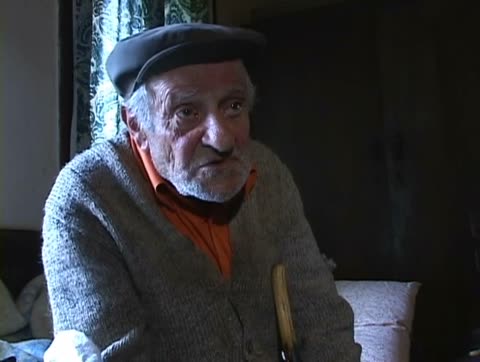
Lemster and Kerler ask Lipovici about songs he sang as a shepherd and in what language. He talks about what he ate in the field and about Sabbath food. He recalls a local kosher butcher, Moshe Yankl(?), who was found alive after a shooting and later taken to Israel by his son.
adds the questions about songs sung in the field and the butcher's later fate
Lipovici answers questions about his prayer and where he learned to pray, the cheder, and the fact that there are no children to send to cheder now. Kerler says when he himself goes to synagogue, on Purim, the High Holidays and Simchat Torah. Lipovici also gives an answer to the question of the best time in his life, which is hard to follow.
adds Kerler's own synagogue attendance and the question about the best time of life
Lipovici talks about earlier times, apparently family and a brother-in-law, and about the present: health, relatives abroad and the lack of a pension. Kerler asks about a Yiddish theater before the war. The interviewers ask for an address to send material.
adds Kerler's question about prewar Yiddish theater and the request for an address
Lipovici discusses the Ceaușescu period and the shooting of Jews during the war. Lemster and Kerler ask about his life with sheep in the field. They also ask whether kosher certification was needed for cheese and milk, and how cheese is made from lamb's rennet.
adds the discussion of Ceaușescu and of kosher certification for milk and cheese
Lipovici explains how cheese and brinza are made from milk and rennet from lambs, and how Passover milk and cheese were obtained under supervision. Lemster and Kerler ask about foods allowed on Passover (potatoes, cornmeal). They ask whether he ate lamb, and whether Jewish robbers also existed in the area.
adds the terminology questions about Passover foods and the question of robbers
Lipovici tells how an elderly Jewish couple, neighbours, were killed by a robber. He tells of trouble with a local official over selling sheep, and of the power of the dead. Kerler asks whether he has seen miracles of the dead; he says he felt them. Romanian is mixed in.
adds the killing of an elderly couple by a robber and the talk of miracles of the dead
Kerler and Lemster thank Lipovici and close the formal interview. A few remarks follow about a dybbuk and about eating well at night. Then a stretch of footage follows with no clear speech.
adds the closing remarks and the exchange about a dybbuk
The team and Lipovici chat outside his house about health, rheumatism, old age and life today, and the state of Yiddish. They talk about a brother-in-law from Bessarabia and about lamb meat. They arrange a photograph with Lipovici.
adds the talk of health, Yiddish and a Bessarabian relative
Footage of the drive from Dorohoi to Săveni. In the car Lemster, Kerler and another man speak mostly Russian and a little Yiddish about directions and stopping for coffee.
In Săveni the interviewers talk informally with an unidentified man, mostly in Romanian with some Yiddish and Russian. He mentions relatives in Dorohoi and another town, and the group discusses a telephone number and a former barber named Marcus(?), who emigrated to Israel.