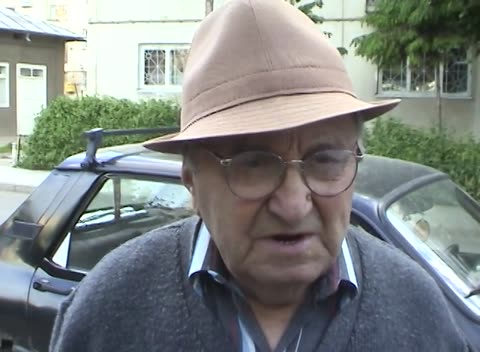
The team greets Chajim and sets up the interview with him. He speaks about his life today and compares to life before the war. Chajim then provides personal information and speaks about a friend whom he helped in Auschwitz.
From the machine transcript
Kerler greets Chajim, who says he is almost a hundred (a few months short). He sets up the interview with talk of his operation and memory, and compares prices and shopping now with long ago. Chajim says he was born in Podu Iloaiei and learns Kerler is from Israel, born in Moscow. He recalls helping a Jewish friend (Shmuel, whose parents were sent to Auschwitz) and mentions a cemetery near Bat Yam; Kerler asks the Yiddish word for cemetery, and Chajim recalls being shut in train wagons.
Chajim speaks about his life during World War II. In particular, he mentions the transportation to do forced labor in Vyzhnytsya, Ukraine. He also speaks about his musical interests and states that he played in the military band in Botoșani.
From the machine transcript
Chajim says he was held and made to work in Vyzhnytsya (Ukraine) during the war, in transports and wagons. He tells of a young friend whose father was taken to a camp and mother to Auschwitz, where she was killed, and the boy died at about eighty in Rădăuți (Bukovina); the rabbi there sent a letter and Chajim said kaddish for him. He says he played trumpet in the military band and used to sing, and Kerler asks about a Purim play.
Adds the story of the young friend and the kaddish; the band is said here to be military but its town is not clear in this passage.
Chajim remembers a song about flirting. He then recites the Rabbis' Kaddish, before talking about his family. Chajim has a sister, who lives in Israel. Chajim mentions that he blows the shofar on Yom Kippur and he attended religious school (cheder).
From the machine transcript
Chajim sings a short verse about flirting, says he is ninety-nine, a few months short of a hundred, and tries to say the Rabbis' Kaddish at Kerler's request. He has a sister three years younger who lives in Botoșani, nearly blind and trembling, and he is himself half-blind and hard of hearing. He still blows the shofar at synagogue on Yom Kippur. He recites a cheder alphabet rhyme and Kerler asks about modeh ani.
Adds the sister in Botoșani, the shofar blowing and the cheder rhyme.
Chajim speaks about Yiddish literature, including writings by Sholem Aleichem and Sholem Asch.
From the machine transcript
Chajim retells a Sholem Aleichem story about why it is hard to be a Jew and the tale of the arendar who needed a ninth man for a minyan, and a story of a man who could not reach the synagogue for Kol Nidre. He says Sholem Aleichem died poor while Sholem Asch had better luck. Kerler and others then urge him to pray, and a garbled kaddish or kiddush follows, with the Romanian-speaking bystander moving the chair.
Names the Sholem Aleichem story and anecdotes.
The camera records Chajim reciting kaddish for several people.
From the machine transcript
Chajim recites kaddish, mostly unintelligible in the transcript, for several people, with the woman Shifra and a Romanian-speaking bystander supplying names. The names heard include Malbin, Ben-Tsvi, Avraham, Leyzer, a Simon ben Khayim and Khayim Itsik. Kerler also asks that a tallit be put on him.
The camera collects footage of the synagogue and briefly interviews Feyge.
From the machine transcript
Informal moments outside the interview: Kerler greets Feyge, who says she grew up in Hîrlău, and the others talk about songs and the old Jewish residents. There is banter about coffee and some Russian talk. Chajim says a few words about hunger and blindness and starts repeating Sholem Aleichem's line about being a Jew.
Shows Feyge's introduction is brief and the passage mixes coffee talk, Russian remarks and Chajim returning to Sholem Aleichem.
Chajim speaks about Yiddish literature.
From the machine transcript
Chajim repeats the Sholem Aleichem story about why it is hard to be a Jew: circumcision, tefillin and studying in the Jewish and Romanian schools. He retells the arendar and minyan anecdote, and notes that kaddish cannot be said with fewer than ten. Lemster asks where he is from, and the others look for another bench.
Chajim talks about his time as forced laborer in the Romanian army during World War II. He also speaks about his friend with whom he worked in Poland.
From the machine transcript
Chajim tells of working as a forced laborer in the Romanian army during the war, in and around Edineț, building bridges and doing other labor. He recalls Jews shot and buried in a pit there, among them his uncle. Lemster asks how many Jews lived in Hîrlău before the war. Chajim also mentions his friend Shmuel (whose father was sent to Auschwitz), with whom he worked in a Poland-related place, and that the boy later died in Rădăuți.
Adds the killing and pit at Edineț, the uncle shot there, and the question about Hîrlău's Jewish population.
Chajim provides personal information and speaks about observance. He got married in Hîrlău.
From the machine transcript
Asked where he was born, Chajim says Podu Iloaiei; he settled in Hîrlău, married there and worked with Hîrlău Jews. He says it was a happy wedding. He recites kaddish for Moses and says he played trumpet in the military band at the wedding.
Chajim recites his own songs about old times. He also recalls a saying from his father.
From the machine transcript
Asked for a Yiddish song, Chajim says he remembers only verses he composed himself, comparing earlier times with the present, as he did earlier. He repeats that he lacks five months to reach a hundred, says he knows no Purim play, and recalls a saying from his father about not taking back what one spits out and keeping silent about what one gives.
The team and Chajim walk to his home and the camera records footage.
From the machine transcript
Camera-side talk as the team arrives at Chajim's home. Kerler and Lemster talk in short, garbled exchanges, mixed with Russian crew remarks about filming. The content is hard to follow.
Chajim shows his family's hanukiah. He maintains that it is older than 200 years.
From the machine transcript
Chajim shows the family hanukiah, and the interviewers ask how old it is. He says it is about two hundred years old, inherited from his grandfather and father. He recalls blessing and lighting the candles himself and, in the past, his father and brothers lighting them, and the interviewers help repair the object.
adds the memory of his father and brothers lighting the lights, and the repair of the hanukiah
Chajim talks about his life today. The team then concludes the formal interview with Chajim, before the camera collects footage of his house and courtyard.
From the machine transcript
Chajim says an American once offered money for the old hanukiah and he refused to sell. He describes living alone in a house with furnished rooms, which came from his father-in-law, and recalls having worked in Yedinets (?). The interviewers thank him and say goodbye, and the crew then discusses footage and repeats a line for the camera.
adds the house inherited through his father-in-law and the American's offer for the hanukiah