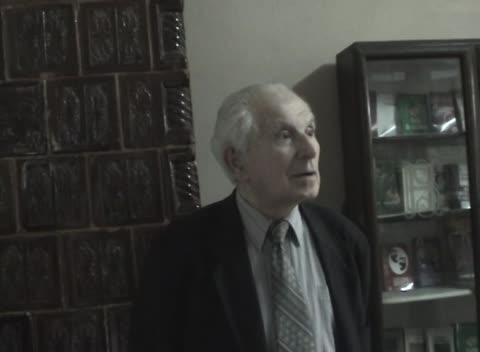
The team chats with community members. Beno (Berl) Hoyshe, born in Cerviceşti 00:05, talks about prewar Jewish life, including holiay celebration, in his hometown. According to him, seventeen Jewish families lived there. The interviewee attended a Romanian primary and secondary schools and received religious education through a private tutor.
From the machine transcript
Chat with Hoyshe about the village where he grew up, with several families and a minyan on the holidays. A mill owned by a Jew is mentioned. He attended a Romanian school, not a cheder, and had a private teacher of Hebrew. Others explain that Hoyshe is the family name and that his given names are Beno and Berl.
Gives his given names and the family name, and mentions the mill and the number of families.
Hoyshe speaks about his family. He grew up with one brother. Hoyshe's son is the Romanian ambassador to Austria and his father was a baker. He then speaks about his life after the war. Hoyshe attended medical school in Iaşi. He moved to Iaşi in 1949. Hoyshe served in the military and left with the rank of colonel.
From the machine transcript
Hoyshe talks about his family: his father was a baker and he had one brother, Leybele. He studied medicine in Iași, and served in the Romanian military after the war. A community member says his son is a Romanian ambassador in Vienna.
Mentions Hoyshe's son as ambassador and his military rank.
The community members talk about the local university, which also offers courses in Jewish Studies.
From the machine transcript
Community members discuss the Jewish studies section at the University of Iași and a professor who works on Jewish culture and knows several languages. They also discuss a larger program planned for several days.
Hoyshe speaks about his family and discusses his childhood memories.
From the machine transcript
Hoyshe recalls his father's trade as a baker and speaks about the lyceum, which he began at eleven. He answers questions about his bar mitzvah but does not remember the portion. A recogniser loop and chatter end the chat before the formal interview begins.
The formal interview with Karuel begins. He provides personal information and speaks about his family. Karuel's father was born in Podu Iloaiei and worked as cobbler. His mother was born in Ştefăneşti. Karuel also touches upon prewar religious life in Podu Iloaiei. Karuel grew up as an only child.
From the machine transcript
The formal interview with Karuel begins. He gives his Yiddish name and his birth in Iași on 6 September 1929. His father Yisroel, a shoemaker, came from Podu Iloaiei, and his mother Reyzl was born in Ștefănești. He recalls his grandparents in Podu Iloaiei, where the grandfather, also a shoemaker, attended synagogue regularly.
Karuel speaks about his life during World War II. His family was confined to the Iaşi ghetto. He then speaks about his chilhood, including his education. Karuel attended a Romanian school and received his religious education through a private tutor.
From the machine transcript
Karuel recalls the war years in Iași with his parents, when food was scarce. His father was taken for forced labor. He attended Romanian lyceum in Iași and learned Yiddish and prayer-book reading from a private teacher at home. He mentions childhood games and holiday customs.
Adds father's forced labor and the private teacher.
Karuel speaks about holiday celebration at home. His parents passed away at the age of twelve. Karuel then speaks about the pogrom in 1941, during which he lost his father.
From the machine transcript
Karuel describes synagogue attendance at holidays and his saying kaddish for his father after the 1941 pogrom. He recalls Jews being rounded up and beaten, and searching for his father at the police station. He says he and his mother survived by his working, as a salesman, during the war.
Gives details of the rounding up and the police station.
Karuel speaks about his life during and after the war. He worked as salesman during and as cashier and then engineer at a factory after the war.
From the machine transcript
Karuel talks about his work after the war: he was a cashier and studied at night, then at the polytechnic, and worked as an engineer for forty years at the same factory. The interviewer starts to ask about cheder and talmud torah.
Karuel speaks about prewar Jewish life in Iași, including schools and organizations. He then talks about holiday celebration, including Passover, Shavuot and Sabbath, as well as food customs at home. Karuel also remembers how his mother koshered meat.
From the machine transcript
Karuel recalls prewar Jewish schools, Zionist organizations and Sabbath foods. He describes Purim masking and music, koshering for Passover, Shavuot dairy dishes, Simchat Torah, and Hanukkah gelt. He also mentions how his mother salted meat to make it kosher.
Adds Purim, Hanukkah and Simchat Torah.
Karuel talks about his life after World War II. He served in the Romanian army. The conversation returns to holiday celebration, before addressing organizations. Karuel recalls Sukkot celebrations at his grandfather's home. He then mentions Jews who converted to Christianity and non-Jews who spoke Yiddish. Karuel also addresses literature and prewar and postwar Jewish culture, including Yiddish theater performances.
From the machine transcript
Karuel talks about his postwar studies and his service in the Romanian army, where he met both antisemitism and decent people. He recalls Sukkot at his grandfather's, and speaks about Yiddish-speaking non-Jews. He lists Jewish organizations, including Maccabi sports clubs, and discusses libraries and books. He also recalls Yiddish theater before and after the war.
Adds army antisemitism, Maccabi sport and Yiddish libraries.
Karuel speaks about theater performances in the Iaşi ghetto. He also addresses local Jewish life during World War II.
From the machine transcript
Karuel speaks about Yiddish amateur theater during the war, in the Iași ghetto, with a Jewish troupe that also performed in Romanian. He gives population figures before the war and mentions Jews killed in the pogrom and sent to Transnistria. He also says there was Jewish life in the war years, including synagogue attendance, and is asked about Yiddish cinema.
Adds Transnistria, pogrom deaths and population figures.
Karuel talks about Yiddish film showings, before addressing cultural life and his traditional wedding.
From the machine transcript
Karuel recalls Yiddish films shown after the war and singers who performed at weddings and bar mitzvahs. He describes his own wedding, with a huppah, food and klezmer, and a dance in which grandparents danced a mitzvah dance. He is then asked about Hasidim and rebbes.
Adds the wedding dance.
Karuel speaks about contemporary religious life and prewar Hasidic life.
From the machine transcript
Karuel answers questions about Hasidism in Iași: consulting rebbes, a Ștefănești rebbe, and the Hasidic expression for a good Jew. He is asked about other sayings and about Jews from Lithuania, and says he has not heard them. He also answers about Jewish drinking.
Karuel speaks about drinking customs and answers questions about cultural terminology. He then addresses folk remedies to avert the evil eye.
From the machine transcript
Karuel answers questions on drinking customs and on terms such as dybbuk and golem. He speaks about cemetery customs, including kaddish and prayers for health and livelihood. He describes the folk remedy of pouring molten lead or coals into water against fright and the evil eye.
Karuel talks about his life after the war and addresses his observance.
From the machine transcript
Karuel talks about life after the war as an engineer, saying it was better than before. He mentions the number of synagogues in Iași before and after the war. He answers questions about Jewish jokes and wise sayings, and mentions his own son and his observance.
Adds the synagogue numbers and jokes.
Karuel talks about his family. He raised a son. Karuel then answers dialectological questions from the AHEYM Yiddish linguistic questionnaire.
From the machine transcript
Karuel mentions that his son is an engineer in Iași. He then answers questionnaire items on how words were said in Iași Yiddish, such as congratulate, thank you, book, window and tree, with some Romanian interference.
Adds the son as an engineer.
Karuel addresses food customs and then continues to answer dialectological questions from the AHEYM Yiddish linguistic questionnaire.
From the machine transcript
Karuel talks about a meat dish his mother prepared and then answers further questionnaire items on Yiddish vocabulary, such as foods, birds and adverbs. The transcript is garbled and includes Russian and other noise.
Adds the meat dish.