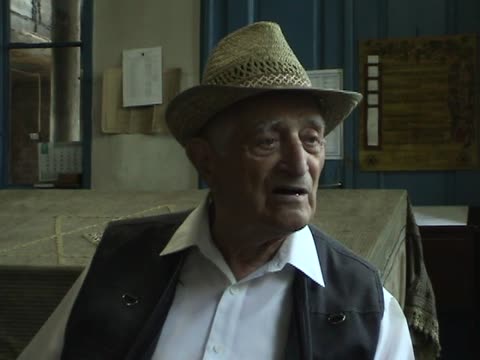
Shwartz provides personal information and talks about his life before the war. He lived in Valumihei until 1960 and worked as tombstone engraver.
From the machine transcript
Shwartz gives his name, the year of his birth (1913) and his birthplace, a village near Oradea whose name is hard to catch; Kerler repeats it several times. He explains that the place was Hungarian at his birth and became Romanian after the First World War. He says he lived there until 1960 and worked as a tombstone engraver; Kerler works to clarify the term for the craft.
The informant first says he does not understand Romanian, and the birthplace name is problematic.
Shwartz discusses his childhood memories, including his education at a religious school (cheder) and prewar religious life in his hometown. Shwartz's father passed away when he was thirteen years old. He states that he entered a yeshiva at thirteen in Mikhailvolva 6:13.
From the machine transcript
Shwartz recalls starting cheder at five or six and his melamed, Reb Shlomo Itskovitsh(?), who had a beard. He mentions two houses of study and a rabbinic synagogue in the town. After his father died when he was thirteen he went to a yeshiva of over a hundred students in a nearby town. He names the yeshiva's rabbi and says that Hungarian was spoken at home. He recalls a children's verse his grandmother taught him.
Language spoken at home and a childhood verse from his grandmother; the father's name is given at the end.
Shwartz talks about his family. His father was a grain and food merchant and studied at the Pressburg yeshiva. Shwartz's father was born in Vác, Hungary.
From the machine transcript
Shwartz talks about his parents and grandparents. His father was a student at the Pressburg yeshiva and then a dealer in wheat, potatoes and other foodstuffs, and his father's family was Hungarian. He names his grandmother, a Schlesinger and a relative of a Kaliv/Warsaw rebbe(?), and his mother, Perl Hirn, daughter of Mordkhe Hirn. At home the family spoke Hungarian, while his grandmother spoke Yiddish.
Names of the grandmother and mother and the languages spoken in the household.
Shwartz speaks about his life before the war. He recalls his private tutor Mordkhe. He also addresses his memories of World War I.
From the machine transcript
Shwartz explains that after his father's death a yeshiva student named Mordkhe was assigned to study Talmud with him. He recalls a soldier billeted in their yard during the First World War who gave him sugar, and Kerler works out his age at that time. He describes the mixed Hungarian and Yiddish of the cheder children, depending on whether they were Hasidic or Ashkenazi, and says that his father was Ashkenazi and Orthodox.
A First World War memory and the languages spoken in cheder.
Shwartz talks about prewar Jewish life, in particular prayer houses and occupational structure, in Valumihei. According to Shwartz, approximately two thousand Jews lived there. He then talks about the Kaliver rebbe.
From the machine transcript
Shwartz describes the Jewish community of his village: over two thousand Jews, nine prayer houses including a large Ashkenazi synagogue, a Zionist one and a few craftsmen's houses of study. The Jews were mostly merchants plus craftsmen, with about half Hasidim and half Ashkenazim. Hungarian was the general language, with Yiddish in the prayer houses. He mentions a house of study of the Kaliver rebbe and a young cantor named Yosef Meir. The large synagogue stands now but has no Jews; he cannot recall songs.
Population figures, languages spoken, the town's prayer houses and its trades.
Shwartz speaks about his yeshiva education, which he graduated after three years at the age of sixteen. He then addresses Purim celebrations and Purim shpiels before the war. Shwartz states that he participated in a Purim shpiel.
From the machine transcript
Shwartz says he studied at the yeshiva from thirteen to sixteen and talks about a song about the hardships of a yeshiva student, which he does not remember. He describes Purim: as a child he took gifts of food (shalakh-manes), and he recites a short verse he used. He says he took part in a Purim play once at twenty and played in Hungarian-worded Yiddish. He does not recognize the Joseph play Kerler asks about, and he starts to mention his work in a matzo bakery.
Yeshiva song, Purim gifts and the question about the Joseph play.
Shwartz speaks about his work as ovenman on Passover when he was seventeen years old. Beforehand, Shwartz explains, he worked as matzo carrier.
From the machine transcript
Shwartz speaks about his work at the matzo bakery before Passover, at seventeen or eighteen, when a great many matzos were made for the large community. Before that, until sixteen, he carried the dough, and afterwards he learned another trade (unclear in the transcript). At the end he begins a story about work near a priest.
Shwartz speaks about his life in the 1970s and encounter with a priest before the war. He explains how he organized his visit of his brother in Canada. Shwartz then talks about his work as tombstone engraver. He learned the profession from his uncle.
From the machine transcript
Shwartz tells how a priest saw him praying in the synagogue and later helped him get a passport to visit his brother in Canada, in the 1970s. He worked as a stone engraver on tombstones and other objects in Yiddish, Hungarian and Romanian. He made many monuments for a man from America (named as Gras(?)) and earned over ten thousand dollars. He learned the craft from an uncle who was a stone carver.
The uncle as his teacher, the work for a man from America and the passport story.
Shwartz speaks about his yeshiva education and life during World War II. He got married in 1939 and his wife and three year-old child did not survive Auschwitz. Shwartz served in the army and was assigned forced labor in the Mauthausen concentration camp.
From the machine transcript
Shwartz speaks about his yeshiva years and then about his wartime losses. He married in 1939 and had a three-year-old child; his wife Khaye bas Binyomin and the child were killed at Auschwitz. He was in a labor detachment at the time and kept the cards his wife sent him. He names the child Menashe.
Details of his wife's and child's arrival at Auschwitz and his labor detachment.
Shwartz speaks about his life after the war. He returned home in 1945. He married again in 1950 and did not have any children.
From the machine transcript
Shwartz says he returned home in October 1945 from Mauthausen and found no family left. In 1950 he married again and has lived with his second wife until now. They have no children; he gives reasons that are hard to follow. He describes receiving his first wife's card and a sleepless night, and adds that he returned to find antisemitism. Kerler asks him about the Purim play.
Shwartz describes the Purim shpiel he participated in before the war. Shwartz then provides personal information and the team concludes the interview with him.
From the machine transcript
Shwartz describes the Purim play he performed in, a wedding play in which he played the master of the house and another young man played his wife. Kerler recalls a play about a chimney sweeper looking for a bride. He states the town's name in Hungarian and Romanian and that no Jews live there now; the Yiddish name is unclear. Kerler thanks him, and the interview ends with a Russian aside to the staff.
The play's wedding plot and the town-name discussion.