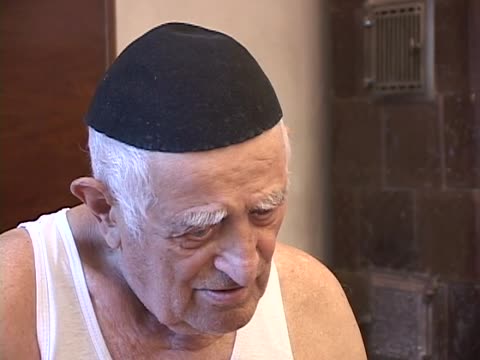
Shwartz talks about his life before the war. He got married for the first time in 1930 and left his hometown Valumihei in 1942. Shwartz explains that he returned to Valumihei in 1945 and continued in his profession as tombstone engraver.
From the machine transcript
Shwartz says he lived in his hometown (given as Valumihei, Hungarian before and Romanian after) until the war and worked there as a tombstone engraver. He married in 1930 (?) and had a child, left the town in 1942 (?), and returned after the war in 1945 to work in the same trade.
Also mentions a child, and gives the town's later name.
Shwartz speaks about his after the World War II. He moved from Valumihei to Oreada in 1966. He then discusses his childhood memories, education at a yeshiva until the age of sixteen and work before the war. Shwartz worked odd jobs, including ovenman and winemaker.
From the machine transcript
Shwartz recounts how, on doctors' orders, he gave up heavy work, left his town in 1966 (?) and began working in Oradea. He recalls attending the local yeshiva until about sixteen and eating at his mother's table, and says he did various jobs, including making kosher wine at a vineyard. He mentions that he had six sisters and a brother.
Gives the siblings' numbers and the mother's table.
Shwartz speaks about his family and their fate during the war. One of his brothers moved to Canada in 1926, Shwartz explains. His father, who was born in 12:05 in Hungary, was a grain merchant.
From the machine transcript
Shwartz describes his family and what became of it. A brother went to Canada and died in the 1990s; an older brother was shot in the war, as was a younger brother, a soldier on the Ukrainian front whose frozen foot meant he could not retreat. A sister who lived in Krasznadorda (?) with two children died in Auschwitz, and the mother Perl also perished there. His father, who was Hungarian-born, a grain dealer and ill after the First World War, died in the 1920s.
Details of the brothers' deaths, the sister and mother in Auschwitz, and the father's trade.
Shwartz speaks about his life and family after the war. He also touches upon holiday celebration at a local prayer house.
From the machine transcript
Shwartz speaks about being alone after the war, since his brothers had been shot and a sister had died. He mentions another sister who survived Auschwitz and emigrated to Israel, and a brother in Canada. He also recalls attending holiday prayers in the prayer house and the reading of the Megillah on Purim before the war, in a Zionist prayer house.
Adds the Purim reading in the Zionist prayer house and the sister in Israel.
Shwartz talks about his performance at a Purim shpiel before the war.
From the machine transcript
Shwartz recalls playing a householder in a Purim play once before the war, in a house; he cannot say who gave him the text or the source of the piece. Kerler asks about its plot and about a chimney sweep, which Shwartz denies, and asks where the words came from. Shwartz says he is hard of hearing.
Shwartz shows a contemporary document to honor his activities in the community. He then speaks about Passover celebrations before the war, specifically the seder led in Hungarian.
From the machine transcript
Shwartz shows a recent diploma recognising his activity in the community. He then recalls the Passover seder before the war with his parents' and two families, at which he asked the four questions as the eldest, all in Hungarian, with the Haggadah also read in Hungarian. Yiddish he spoke only in the study house and yeshiva. He names the local rebbe Schönfeld, says the town had over two thousand Jews and nine minyanim on Sabbath, and mentions wishes of going to Palestine.
Adds the language question, the rebbe, nine minyanim and the number of Jews.
He also addresses his childhood memories and prewar Jewish life in his hometown. According to Shvartz, approximately 2,000 Jews lived there.
From the machine transcript
Shwartz says the family on his side lived in Hungary and that he hardly knew his grandparents. Kerler then asks about his work today as a kashrut supervisor, and Shwartz begins to say that he checks that no blood remains.
Only partly covers the childhood and prewar life and mostly the talk about grandparents and his job today.
Shwartz speaks about his life and responsibilities as Mashgiach in the community today. He then explains how to kosher meat.
From the machine transcript
Shwartz describes his work today as mashgiach in the Oradea community: a shochet comes and the meat is brought from Bucharest for koshering. He explains the process of koshering meat: soaking, salting, rinsing, leaving for about an hour, and rinsing again. He adds that he came to Oradea in 1966.
Gives the steps of koshering, the shochet and the arrival in 1966.
Shwartz speaks about his life, after he moved to Oradea in 1966. He visited Israel and America in the 1970s. He then speaks about his work as tombstone engraver with orders from America and Israel.
From the machine transcript
Shwartz talks about his work in Oradea after 1966, saying he was the first workman there and received permission to travel to Canada, America and Israel in the 1970s (?). He worked for a priest and later a bishop, and says Jewish customers from America, Israel and elsewhere ordered tombstones. He says he made old stones new and worked in many kinds of stone, including marble and granite, with lettering and decoration, and says he lost count of how many he made, for Jews and Christians alike.
Adds the work for a priest and bishop and the types of stone.
Shwartz speaks about prewar Jewish life, in particular different denominations and prayer houses. He also explains how he became a yeshiva student, after his father passed away in 1926.
From the machine transcript
Shwartz discusses the prewar Hasidic and non-Hasidic communities of his town, its rebbe Benjamin Schönfeld and its various study houses, including the Baker, Wiznitz and Kalev ones, and says the groups lived in peace. He explains how he came to the yeshiva after his father died, when a yeshiva student who ate at their table was the reason. Kerler asks him about a song of the Kalever rebbe and Hasidic melodies; he says he cannot sing but that his voice returns in prayer, and begins to sing.
Adds the Hasidim and non-Hasidim and Kerler's questions about songs.
Shwartz sings the liturgical song Lekha Dodi.
From the machine transcript
Shwartz sings Lekha Dodi, and Kerler remarks on his voice. He says he never sang before, and Kerler asks about a Hungarian song about the Messiah. Kerler then thanks him and ends the interview.
Adds Kerler's request for a Hungarian song and the closing thanks.