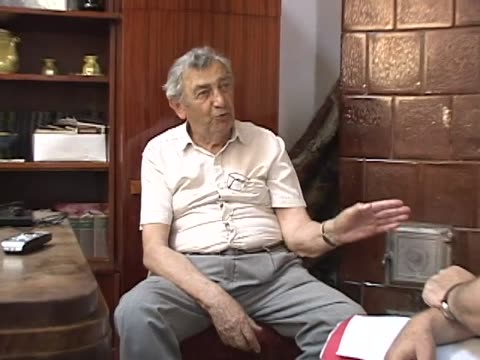
Macarie provides personal information and talks about prewar Jewish life in Cardo. According to Macarie the majority of the population was Jewish.
From the machine transcript
Opening exchange. Kerler explains the project and mentions that he has spoken with a relative of Freundlich's in Cluj. Freundlich says he spoke Yiddish in childhood and that there were many Jews in his town in the past. The rest is a garbled exchange about how long the interview will take.
The transcript shows Kerler explaining the project and arranging the interview rather than a clear account of prewar Jewish life.
Macarie speaks about her family. Her father, who was born in Cardo, was a businessman and her mother, who was born in Slatina, then Czech Republic, was a seamstress. She grew up with eleven siblings. Macarie states that she and three of her siblings survived the war. Two of her brothers moved to America and Austria and one sister to Israel.
From the machine transcript
Kerler notes the date and their arrival in Oradea. Freundlich states he was born in 1921 in Baia Mare and that the town had no separate Yiddish name. He gives a number of Jewish families that is unclear in the transcript. He lived there until about seventeen or eighteen, in a family of seven children. His father, a Torah scholar who had studied in Vienna, could not earn a living. Freundlich studied in yeshiva until about fifteen and then went to work, because the family was poor.
The transcript gives a poor scholar father and seven children, not a businessman father and eleven siblings.
Macarie speaks about her siblings and their fate during World War II. Her parents and most of her siblings died in Auschwitz.
From the machine transcript
Freundlich describes his yeshiva studies in several small yeshivas and a more important one in Maramureș. He explains the two terms of the year, between Passover and Sukkot and from Sukkot to Passover. In reply to Kerler, he says the term did not end with a special celebration. He describes the daily study system: the rebbe assigned pages of Gemara, and younger students needed a partner. Older students attended the rebbe's lectures.
The passage is about yeshiva study and its terms; the transcript does not show the fate of his parents and siblings in Auschwitz.
Macarie discusses her childhood memories, including education. She attended a Romanian school for four years. Macarie explains how her father provided her a religious education at home.
From the machine transcript
Freundlich continues on yeshiva life, saying he could not pay for a study partner and so asked others for help. He reflects that his youth consisted mainly of hardship. He recalls being taken out of study before Passover to help in a matzo factory, carrying matzo to the oven. He also mentions work around Sukkot and Purim.
The transcript shows yeshiva study and child labor in a matzo factory, not a Romanian school of four years.
Macarie talks about her work after the war as pharmaceutical technician.
From the machine transcript
Freundlich says again that his young years were very hard and compares the strict heder and yeshiva system with how others remember their youth. He says he studied well. He adds that other children, from somewhat richer families, were in a different position.
The transcript does not show any postwar work as a pharmaceutical technician.
Macarie discusses her childhood memories, including holiday celebration. She then addresses food customs, particularly fish dishes. Macarie then shares her mother's recipe of gefilte fish.
From the machine transcript
Freundlich describes his heder years and the rebbe, who beat the children. He says richer children paid for the talmud-torah while his family could not. He recalls the daily schedule, the long hours, and playing football with stones on the way to school. He says he was taught in Romanian at school but spoke Hungarian with his brothers and Yiddish with his mother. His father was proud of Hungarian culture. His mother was very pious, wore a head covering but no sheitl, and spoke Yiddish.
The transcript shows heder, school, and the languages spoken at home, not holiday celebration or a gefilte fish recipe.
Macarie describes her childhood home. She then addresses holiday celebration and childhood games.
From the machine transcript
Freundlich talks about his parents. His father Moshe studied in Vienna and spoke good German. His mother Rivke came from a small town near Baia Mare, and her parents were deported. He describes summers with relatives, with a large orchard and a mill, and also an aunt and uncle in Jibou (?). He recalls a relative's harsh manner and speaking Hungarian there. Kerler asks how to say 'poor relation' in Yiddish.
The transcript shows his parents' names and origins and summers with relatives, not the childhood home.
Macarie discusser her childhood memories and mentions her father's observance. She then speaks about her family.
From the machine transcript
Freundlich says he took no part in Purim plays because he had no talent and went around only for the money. He recalls his father telling of performing and singing songs while studying in Vienna. With Kerler he discusses whether Jewish Purim plays in German existed.
The transcript shows Purim play talk and the father's Vienna student days, not so much the father's observance.
Macarie answers questions about cultural terminology. She then addresses food customs and speaks about her life and family after the war. She remarried a non-Jewish man. Macarie's son from her first marriage is a school director in Oradea.
From the machine transcript
Freundlich reflects that he did not have a youth and that younger people see these years differently. He says that in the years before the war he joined a Zionist organization, first Bnei Akiva and then a left-leaning one (name unclear). The beginning of the passage is garbled.
The transcript shows no remarriage or son as school director; it shows Zionist youth activity instead.
Macarie speaks about her first traditional wedding at her cousin's home in Oradea. She then addresses Hanukkah celebrations and food customs.
From the machine transcript
Freundlich tells of becoming a Communist and being imprisoned. He then describes the end of the war: Horthy's proclamation, escaping with a friend, walking home through the mountains, and meeting a man who warned them the Germans were near. He and others were gathered by the Russians as prisoners and taken by train through Baia Mare. Kerler asks whether he hid in the mountains.
The transcript shows his political activity and wartime flight, not a wedding or Hanukkah.
Macarie mentions Purim celebrations and answers dialectological questions from the AHEYM Yiddish linguistic questionnaire.
From the machine transcript
Freundlich continues his wartime story: a group of 47 men held by Russian soldiers, including Jews from the Carpathians who spoke Yiddish and Russian, and an officer who was Jewish. He calls his escape a miracle. Kerler asks about Purim plays and theater, and Freundlich recalls a Yiddish touring actor in Maramureș. He says there were few Hasidim in Baia Mare. He speaks of newcomers and rebbes, a dispute among rabbis, and a visit to a rebbe in Sighet. A passing question about the meaning of a word appears, but a clear dialectological questionnaire is not evident.
The transcript shows the end of the wartime story and talk of Hasidim, rebbes and theater, with no clear questionnaire.
Macarie addresses literature and songs. She then talks about her life after the war, after her return in 1945, including her visit to Sighetu Marmaţiei.
From the machine transcript
Freundlich speaks about his siblings: of seven brothers and sisters five survived, an elder brother died in Israel and a sister in Argentina. Kerler asks about relatives, including a woman in Cluj. Freundlich talks about her family, children in Canada, and a relative's son whose fingers were injured. He mentions a relative named Lustig, a committed Communist.
The transcript shows his siblings and relatives abroad; it does not show talk of literature and songs or of a 1945 visit to Sighetu Marmației.
Macarie speaks about her life before the war and visits to Sighetu Marmaţiei. She then speaks about prewar traditional weddings.
From the machine transcript
Freundlich tells about a boy who was taught to swim by a trainer despite a heart condition. This became a reason he became a doctor and not a musician, though whose son this is, his own or a relative's, is unclear. Kerler then thanks him and ends the session, saying they are heading to Cluj.
The transcript shows closing thanks and a story about a son and swimming, not prewar weddings.
Macarie shows family photographs.