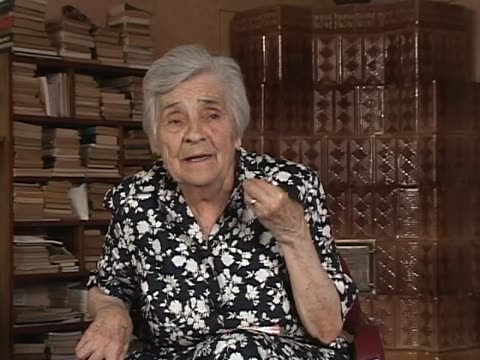
The team chats with Kraus and Grunfeld informally and then the camera collects town footage, including the Jewish Studies department of the university. The team is headed to the next interview with Freundlich and informally chats with Grunfeld.
From the machine transcript
Informal chat among the team and the two men, with much overlap and some Russian. It touches on the aims of the project and the interviewers' own Yiddish. The second man mentions a son who visited from Israel and found Cluj a cultured city, and there is mention of the central post office. Lemster says they would like to speak with a woman, since they have met only men. Large parts are garbled or looped, and the camera's town footage is not visible in the transcript.
The transcript shows only conversation, with a visiting son from Israel; the footage of the Jewish Studies department is not visible.
The team greets Freundlich in her apartment and sets up the interview with her.
From the machine transcript
The team arrives at Freundlich's apartment. Kerler introduces himself as Berl and Lemster as Moshe, saying they have come to do an interview in Yiddish. Greetings are exchanged and the photographer is introduced. They discuss how to enter the apartment and the practice of holding weddings there.
Freundlich briefly mentions how she secretly hosted traditional weddings in her apartment during Soviet times.
From the machine transcript
Freundlich briefly says that quiet chuppahs were held: people came to a religious family, took a tallit and made the chuppah. Lemster comments on the wedding connection and offers help, and she thanks him.
The Soviet-period setting named in the catalogue is not clearly stated in the transcript.
Freundlich speaks about hosting traditional weddings in her apartment after the war. She also addresses the involvement of the local kosher butcher Adler, who secretly held circumcision ceremonies.
From the machine transcript
Freundlich talks about Jewish ceremonies held in her Cluj home under communism. She tells how the shochet Adler would perform a wedding blessing but not a circumcision without a minyan, and how the mohel and the family were afraid. She says she was not afraid herself, and that a mezuzah was always on her door.
Adds a mohel's fear and a circumcision held with no minyan.
Freundlich discusses her family. Her father owned a shop. She raised a daughter and a son. Freundlich's brother and sister live in America.
From the machine transcript
Freundlich says she is from Satu Mare and describes her father as a merchant with a shop there who did not want his children to eat Communist bread. She names her daughter and her son, a doctor with a music diploma who performs internationally. She mentions her husband, her siblings in America and her father's standing in Cluj after the war.
Adds her son's musical career and her father's standing after the war.
Freundlich speaks about contemporary Jewish life in Germany.
From the machine transcript
Freundlich recalls speeches by Jewish public figures at a Munich event about Jewish continuity. She says that, unlike under the Communists, Jews elsewhere are free to practise. She mentions a brother and sister in America and says that no one in her family married out. She is then asked her surname.
Freundlich provides personal information and talks about her family.
From the machine transcript
Freundlich gives her name as Elizabeta (Elza), née Weiss, with the Yiddish name Rivke after her grandmother. She says she is proud to be a Jewish grandmother and speaks of her father, a learned man, and her cousin in California. She mentions having been in camp, Auschwitz and Geislingen.
Adds her names and her relatives in America.
Freundlich briefly addresses her life during the war. She was imprisoned in several Nazi camps, including Auschwitz and Geislingen and had to leave her hometown in 1944. She states that thirty-six of her family members were killed during the war.
From the machine transcript
Freundlich briefly refers to the war years, saying that she counted at least thirty-six murdered relatives, among them her parents and grandparents. She recalls a slogan displayed in the factory where she worked in camp. She says she was born in Satu Mare, where all her father's family lived.
Freundlich provides personal information and speaks about contemporary Jewish life in her hometown Satu Mare. She then talks about her family. Her mother was born in Hungary. Her maternal grandfather was a Beltser hasid, Freundlich explains.
From the machine transcript
Freundlich says she lived in Satu Mare until 1944 and that no Jews remain there. She names her parents and their approximate age at death in Auschwitz. She says her mother's family came from Hungary and her maternal grandfather from Nirmada was a wealthy Belzer hasid. She also mentions that the grandfather's house carried a reminder of the Temple's destruction and describes an incident with a visiting rabbi.
Adds her parents' names and the Belzer grandfather, and her view of the few Jews in Satu Mare today.
Freundlich remembers Hasidic visitors. She then talks about her family. Freundlich was a homemaker after the war. Her daughter lives in Canada. Freundlich then shares family photographs. She also provides family episodes. Her maternal grandfather was a wealthy merchant, according to her. Freundlich grew up with three sisters and one brother.
From the machine transcript
Freundlich recalls a visiting rabbi who ate nothing in a Jewish home. She says she stayed at home with her children while her husband worked and shows photographs of her children and a Torah dedication in Canada. She names her grandfathers, a wine merchant and a grain merchant from Nirmada, and describes the wealth and death of her maternal grandparents. She also says she grew up with several siblings.
Adds a grandmother deported to Auschwitz and a Torah dedication involving her son and daughter.
Freundlich talks about prewar religious life in Satu Mare. She then talks about her education. Freundlich attended a Hungarian school for ten years. She also received religious education from the brother of the chief rabbi of Budapest (after the war).
From the machine transcript
Freundlich talks about the prayer house built in Satu Mare for the Bixad rebbe and his family in America. She says she attended school for ten years, in Hungarian after the Hungarians took over, and had a religion teacher who was the brother of the chief rabbi of Budapest. She also mentions Satu Mare's graves and her last visit there in 2004.
Adds the Bixad rebbe and her last visit to Satu Mare.
Freundlich talks about her recent visit to Satu Mare. She then talks about her husband, who was a passionate soccer player and singer. Freundlich then describes how she met her husband in a Nazi camp after liberation. Freundlich returned to Cluj-Napoca in 1946, because her husband was born there.
From the machine transcript
Freundlich talks about her last visit to Satu Mare, a monument she set up there for her parents, and a memorial in Florida. She describes her husband Chaim Yosef Tsvi as a ladies' tailor, football referee and soloist, and mentions his well-attended funeral. She tells how they met in a hospital after liberation, and that they came to Cluj, his birthplace, in 1946.
Adds the memorial to her parents and the funeral of her husband.
Freundlich discusses her childhood memories and family. In particular, she addresses her son's successful musical career. Her son moved to Canada in 1985.
From the machine transcript
Freundlich says Yiddish was spoken at home in her childhood, and especially on Sabbath, while her husband's family mixed languages. She shows press clippings and pictures of her son, who has travelled to many countries. She says her son and daughter emigrated, to Canada in 1985, and that her daughter, a piano teacher, spent two years in Israel.
Adds the Yiddish spoken at home and the son's press clippings.
Freundlich discusses her childhood memories in an observant home. She also addresses prewar Jewish life, including kosher butchers. She then explains how to kosher meat. She then recites the prayer "Got fun Avrum."
From the machine transcript
Freundlich describes her observant childhood home and her mother's blessing over the candles. She recalls the kosher butchers, the shochet and the rabbi in Satu Mare, and describes how meat was salted and soaked. She talks about taking challah and recites the Saturday-night prayer to the God of Abraham, in Yiddish, at Kerler's request.
Adds how meat was salted and the Saturday-night prayer.
Freundlich speaks about Purim celebrations before the war. In particular, she describes how her father observed the holiday. Freundlich also touches upon well-known Purim shpiels.
From the machine transcript
Freundlich describes how her father kept Purim, working between meals and eating the festive meal late. She says Purim players came dressed up, sang and performed small plays, and were given gifts and money, and she recalls the megillah being read at home. She also mentions that the plays were done in Hungarian.
Adds her father's own Purim observance and the megillah reading at home.
Freundlich discusses her childhood memories and friends. She also talks about the Satmar rebbe, Yoel Teitelbaum. Freundlich maintains that her father did not want to be part of his court. She then talks about her father.
From the machine transcript
Freundlich says her childhood neighbours were Jewish, with one Christian family on the street, near the Bixad rebbe. She says her father respected but did not follow the Satmar rebbe and refused to kiss the rebbe's hand, and describes the kapores slaughter at home. She also tells of her grandfather's modest death on Sabbath eve in a snowy winter and his instruction to his son-in-law to say Kaddish.
Adds her neighbours, kapores, and her grandfather's death and burial.
Freundlich talks about her family, in particular her grandmothers and sisters. She also remembers how they ate cake every Sabbath morning during her childhood. Freundlich then addresses her son's circumcision.
From the machine transcript
Freundlich names her grandmothers and says she is named for one. She names her sisters, the eldest killed with children, and says one sister lives in Miami. She says her maternal grandfather went to the Belzer rebbe, and recalls cake delivered to her grandfather on Sabbath mornings. She is then asked when her son was born, and speaks of his circumcision.
Adds her sisters' names and fates and the Sabbath cake.
Freundlich speaks about her family and postwar Jewish life in Cluj-Napoca and surrounding communities. In particular, she addresses different religious authorities before and after the war.
From the machine transcript
Freundlich speaks about the absence of a circumcision in her family and about rabbis and rebbes known in the region. She names the Shaprana rabbi who came in 1946, the Bixad (Bixad) rebbe who was her neighbor, and his piety and death in Auschwitz. Kerler asks about the Hasidim who came to him and about tsadikim who slept on a couch. She also remembers her father's holiday and Sukkot piety.
Also names a rabbi who was her teacher of religion and describes the Bixad rebbe's practices.
Freundlich talks about his father's teachings. She maintains that her father bought a house in order to establish a Talmud Torah school. Freundlich explains how the community collected money to set up the school.
From the machine transcript
Freundlich speaks of her father's learning and the rabbinic offers he received from Pressburg (?) and New York, which he declined. He gave a house for a Talmud Torah in 1932. She explains that a woman organized a fundraising dinner for the school, with some seventy people. The passage ends with talk of a diploma and preparations for the interviewers' departure.
The catalogue sentence about teachings lacks the rabbinic offers and the departure talk.
Freundlich speaks about contemporary Jewish life. She then shares several documents and shows a photograph of herself.
From the machine transcript
Freundlich speaks about Jewish life in Cluj today, with a few Jews and mixed marriages. Documents including a diploma of a family member are shown. She begins to speak about her sister's print shop.
Names a diploma of Andrei Freundlich (?) and intermarriage.
Freundlich speaks about her family. Her sister owned a print shop and book store. According to her, her sister printed journals with Hebrew letters. Freundlich then addresses books she read.
From the machine transcript
Freundlich speaks about her sister's print shop and bookstore, where books were printed in Gothic type and in Hebrew letters for prayer books. She recalls reading books from the shop, including Cronin's. She also mentions a book by Lea Lieberman about the second generation, and Kerler asks about languages she learned.
Freundlich speaks about prewar and postwar cultural life. She recalls performances by Sidi Tal and other artists. Freundlich also talks about her son.
From the machine transcript
Freundlich recalls prewar and postwar cultural life: visits to the theater in Cluj with the women of her family, and the actors and singers who performed, such as Sidi Tal, Maly Pick and Lea Konig (?). Kerler asks about a Purim play. She also talks about her son, a musician.
Adds a Purim play and her son in Vienna.
Freundlich sings a Yiddish lullaby about love and longing. Freundlich learned Yiddin songs from her babysitter, she explains.
From the machine transcript
Freundlich explains that she learned Yiddish songs from a nanny of Maramureș background in Satu Mare, and a second voice sings a lullaby about longing for a lover. The nanny was illiterate, and the rebbe had said Jewish families should hire orphans. Kerler asks about the word for a nanny and requests more songs.
Adds the identity of the Maramureș nanny and the word for a nanny.
Freundlich sings a Yiddish song about remembering the mother, before she sings a Yiddish song about a happy childhood. She then sings a song about the mezuzah.
From the machine transcript
Songs: a Yiddish song about longing for the mother, a song of nostalgic childhood memories, and one about the mezuzah. Freundlich says she learned these from her nanny and sang solo in the synagogue choir. She notes that she can no longer sing.
Freundlich discusses Yiddish songs. She then sings a Yiddish song about departing for a long journey.
From the machine transcript
Freundlich talks about Yiddish songs and a klezmer from the USA who recorded songs from them for a CD. A song about taking food on a journey is sung, and Kerler asks where her nanny got her songs.
Freundlich speaks about her family, in particular her mother. She then sings a religious song her mother taught her, as well as a snippet from a messiah song.
From the machine transcript
Freundlich says the nanny from Satu Mare taught her songs and that her mother knew Hungarian songs, among them one by the Kalev tsadik, with some Hebrew phrases. A fragment of a song about the Temple is sung. Kerler asks about a messiah song, of which she sings a snippet. There is a break about someone leaving the door open.
Freundlich discusses Sabbath songs (zemirot) and Passover songs. She then sings Passover songs.
From the machine transcript
Freundlich discusses Sabbath table songs (zemirot, Shalom aleichem) and the Passover songs, and recalls her father singing at home. Kerler asks about a Passover song, about Hasidic melodies and whether the songs were sad. She mentions her two brothers, one buried in Satu Mare, and reflects that Jewish joy is never complete in exile.
Freundlich speaks about prewar traditional weddings in Satu Mare. She then sings a wedding song, she recalls from a postwar wedding in Dej. Freundlich also addresses her own wedding.
From the machine transcript
Freundlich speaks about traditional prewar weddings in Satu Mare, including the mitzvah dance, her sister's wedding and her own. She sings a wedding song heard at a postwar wedding in Dej with a badkhn. Her own wedding was quiet, with the seven blessings only, and Kerler asks about singing in the camps.
Freundlich sings the well-known song "Vi nemt men parnuse?" (How do you make a living?). She then sings again the wedding song.
From the machine transcript
A woman sings a humorous Yiddish song about making a living, and Kerler asks Freundlich to repeat the lyrics so that he can understand the words. She then sings the wedding badkhn's song again, more slowly.
Freundlich sings a Yiddish song about the rebbe's home and when the messiah comes. She then speaks about life today.
From the machine transcript
A song about the rebbe's house and the messiah's arrival is sung. Kerler explains the archive project, and Freundlich speaks about a Hungarian radio program on religion and Jewish matters. She talks about Jews in town today, with mixed marriages and a bar mitzvah.
Also covers the archive explanation and a Hungarian radio program.
Freundlich talks about her family and life today.
From the machine transcript
Freundlich talks about her family and life today. Her children and grandchildren keep in touch, and she mentions relatives in Florida, Flushing and California. Her limited eyesight means she listens to the radio. She recalls conditions of Jewish life in the postwar years and her uncle who was a bank director.
Mentions relatives abroad and the bank-director uncle.
Freundlich speaks about Jewish life in the region during World War II. She then speaks about life after the war and academic conferences.
From the machine transcript
Freundlich recalls women from Auschwitz and a household with a governess who was deported with them. She then describes a woman from Budapest who came to the synagogue wanting a conference on why Jews do not keep Jewishness, and her own reaction, with reflections on Jewish history and fate. Kerler interjects with a Yiddish saying about being born a Jew.
Includes her reflections on Jewish history and an interjection by Kerler.
Freundlich shows documents from her family and family photographs. She then speaks about her life in the 1970s and today.
From the machine transcript
Freundlich shows photographs, including a birthday picture of her son and the grave of a Jewish actor. She recalls declaring Yiddish her mother tongue to an official in 1977 and mentions her daughter, a piano teacher in Satu Mare, and her son the professor. She also talks about Christians who spoke Yiddish, answering questions from Kerler and Lemster.
Covers the 1977 episode about declaring Yiddish her mother tongue and Christians who spoke Yiddish.
The camera records footage of the Oradea synagogue. The team then meets Gershun Shwartz and sets up an interview with him. He has lived in Oradea (Yiddish: Groysvardeyn) for forty years. The team then chats with community members about prewar Jewish life in Oradea.
From the machine transcript
Camera work and chat at the Oradea synagogue. Kerler and Lemster speak with a visitor who lives in the United States and was born in Budapest; they trade birth years and places, talk about Satu Mare, Moscow, Cluj and Budapest, and the Jewish community of Cluj. They arrange to meet and exchange contact details.
The transcript shows the chat is mostly with an American visitor and does not clearly show an interview set up with Gershun Shwartz.
The formal interview with Freundlich, who is the cousin of Elizabeta Freundlich's late husband, begins. He speaks about Oradea and then provides personal information, before talking about his family. His father was a wood merchant. He grew up with three brothers and three sisters. Freundlich also addresses his family's fate during World War II. His mother was born Baia Sprie and his father near Jibou.
From the machine transcript
The formal interview with Mihai Freundlich begins. He explains the Yiddish name of Oradea and its fortress, gives his name, birth in 1921 near Baia Mare, and his Yiddish name Avrum-Khayim. He describes his parents (father a poor wood dealer, mother Rachel), his siblings, grandparents and the deportation of relatives. He says he and some siblings survived deportation and two brothers died in a camp.
Gives the Oradea fortress etymology, the names and birth years of siblings, and the grandparents' occupations and deportation.
Freundlich speaks about his life before the war. He was an employed merchant. Freundlich worked at an egg factory after the war, after he moved to Oradea. He also worked as secretary for the local Jewish cultural organization. Freundlich then speaks about his yeshiva education until he was fifteen years old. He attended three yeshivot in Şomcuta Mare, Tîrgu Lăpuş and Copalnic-Mănăştur. He also studied with a rabbi in Baia Mare.
From the machine transcript
Freundlich lists his work: before the war an employee of a merchant, after the war a partner in a factory until nationalisation, secretary of the Jewish cultural association, and an oil factory worker. He then describes his yeshiva study up to age fifteen in three small yeshivot and with a rabbi in town, and recalls a teacher named Polak.
Freundlich talks about his work as merchant and then speaks about prewar Jewish life in Baia Mare. According to him, eight hundred Jews lived there. Freundlich also recalls enmity between Hasidim and Ashkenazim. He then talks about his father and different Yiddish dialects.
From the machine transcript
Freundlich recounts working for a merchant after yeshiva, then describes Jewish life in the town near Baia Mare, with several hundred Jewish families, the arrival of Hasidim in the 1930s and the new Hasidic beys-medresh and their rivalry with the Ashkenazic Jews. He discusses the languages spoken at home, his father's literary Yiddish and German, Hungarian among the children, and differences between the Yiddish of Transylvanian, Polish and Moldavian Jews, in answer to Lemster's questions.
Adds the languages spoken at home and dialect differences among Jews.
Freundlich discusses his childhood memories before the war. In particular, he recalls the difficulties to reach religious school (cheder) every day and shares his daily routine. On Sundays, Freundlich explains, he attended cheder all day.
From the machine transcript
Freundlich recalls his childhood daily routine from age six: cheder before dawn, prayer, the non-Jewish state school in the morning, back to cheder and school again in the afternoon, with Sundays spent all day in cheder. He describes the long way, the lack of electricity and the children singing under windows.
Freundlich speaks about prewar Sabbath celebrations at home. He remembers how his family sang zemirot and their Christian neighbors would listen outside. Freundlich explains how the cheder boys were quizzed by the rebbe on Sabbath afternoons. He also recalls visits of a cantor twice a year.
From the machine transcript
Freundlich describes the Sabbath of his childhood: the family sang zemirot while Christian neighbours listened under the window, and in the afternoon the community rabbi examined the children on what they had learned. He mentions the shoykhet as prayer leader and a cantor who visited a couple of times a year, whom his father imitated.
Freundlich sings a Sabbath song (zemirot) and addresses contemporary Jewish life. He then addresses prewar Purim celebrations. Freundlich explains how he participated in Purim shpiels and went from house to house.
From the machine transcript
Freundlich sings a Sabbath zemer, then speaks about hearing Yiddish songs on a car and how a Yiddish language requires living among Jews. He addresses prewar Purim: he and his brother prepared a Purim play and went from house to house for money, and he begins an episode about his brother.
Freundlich talks about his family, in particular his father. Freundlich maintains that his father was an unsuccessful businessman and took the money Freundlich earned as youngster.
From the machine transcript
Freundlich talks about his father, who was deported at about sixty-four, was strong despite a First World War injury, and was always an unsuccessful businessman. He tells how his father took the money he earned as a teenage employee, and recalls a confrontation with him.
Freundlich shares a family episode on Tisha B'Av before the war.
From the machine transcript
Freundlich tells a family episode in which his engaged older brother, delayed, arrived at a festive meal with a new hat and tie bought with his wages, and their father slapped him. The family then searched the town for him and he went to an aunt.
The transcript does not clearly confirm the Tisha B'Av setting.
Freundlich remembers a Purim shpiel and addresses his childhood and the rebbes' austerity. He then speaks about his life after the war. Freundlich states that he became a Communist at eighteen and did not enter a synagogue until he was sixty years old. He married a non-Jewish woman in 1956.
From the machine transcript
Freundlich recalls a Purim play and reflects on his Jewishness. He describes the poverty of yeshiva boys, favouritism toward rich students, and the honours of the minyan in a small village. He became a Communist at eighteen or nineteen and stayed away from synagogue until about sixty, and married a non-Jewish woman in 1956.
Adds the poverty of yeshiva students and the minyan in a small village.
Freundlich speaks about traditional weddings and his life before the war. He explains how tolerant his parents were regarding his a-religious way of life. Freundlich joined a Zionist youth organization.
From the machine transcript
Freundlich speaks about Jewish weddings, to which only families were invited, and about his non-religious youth. His father did not reproach him, while his mother kept her traditions. He describes working all week and joining a Zionist youth organisation with weekly discussions.
Adds Sabbath preparation and his mother's keeping of tradition.
Freundlich discusses his childhood memories. He then addresses prewar cultural life, in particular Yiddish theater performances.
From the machine transcript
Freundlich tells of a night when a light was left burning and neighbors were asked in Hungarian to put it out, noting that many people around him spoke Hungarian. Lemster asks whether Yiddish weddings had badkhn-style rhymers and about Purim plays; Freundlich recalls a visiting troupe performing in Yiddish at Purim once, and says there were no klezmer-type performers at weddings.
Opening is an anecdote about a burning light and Hungarian-speaking neighbors, and wedding entertainers are discussed.
Freundlich speaks about Purim celebrations before the war. He describes how he dressed up as hasid.
From the machine transcript
Freundlich talks about Purim plays in the community, which mocked communal figures such as the head of the community, the gabbai, the shamash and the rabbi, sometimes causing offence. As a child he dressed up as a bridegroom or hasid with a kaftan and shtraymel; he recalls that he and his brothers tried to put on performances but could not pay for talent.
Also covers the satire of communal officials and the brothers' attempts at performing.
Freundlich addresses holiday food customs and his childhood memories of how his mother prepared food and baked bread, as well as mamaliga. Freundlich states that his mother or he brought six kilogram dough for bread and challah to the bakery every week.
From the machine transcript
Freundlich describes how his mother baked for a family of seven children: the dough, about six kilograms, was prepared at the end of Sabbath and carried to the baker, and he as a boy carried it there and back. He explains the weekly rhythm of bread, mamaliga and the large challah made on Thursday for Friday night, which the children kept eating; the family had no oven at home. Lemster asks about how challah was baked.
Details the weekly bread cycle and the lack of a home oven.
Freundlich explains how his mother koshered meat and stuffed geese. He then addresses other dishes, including falshe fish and fish.
From the machine transcript
Freundlich describes how his mother salted meat and stuffed geese, and recalls as a boy of ten to twelve carrying the goose's gizzard (?) to the shoykhet and to the rabbi to be checked for kashrut. He then talks about fish dishes, including falshe fish made from goose meat as a Friday-night starter, and the head and jellied fish. Lemster asks for the Romanian terms and prods him to recall a Purim play.
Includes the kosher inspection of the goose's gizzard, which the catalogue does not mention.
Freundlich answers questions about cultural terminology. He then addresses prewar Yiddish culture, in particular performances by Sidi Tal. He then addresses his childhood memories and how locals would gather to listen to the radio.
From the machine transcript
Freundlich answers Lemster's questions on the terms dybbuk, golem and the words for a cemetery. He mentions having seen Sidi Tal perform in Sighet (?) or Baia Mare (?), his father's love of cantors and operettas, and neighbors gathering around the first radio in the street.
Includes elicitation of terms for dybbuk, golem and cemetery as well as his father's musical tastes.
Freundlich addresses Yiddish literature in Hungarian translation.
From the machine transcript
Freundlich says that he read Yiddish authors only in Hungarian translation and recalls no Yiddish newspaper or library before the war; after the war the world was different. He comments on his own Yiddish and on his difficulty expressing himself, and mentions learning Hebrew in the Zionist organization before becoming a Communist.
Also mentions studying Hebrew in a Zionist organization.
Freundlich speaks briefly addresses the local Zionist organization, he joined before the war. He then speaks about his life and family after the war. Freundlich visited Israel for the first time in 1968, where he met siblings. He then recalls his experiences and use of Hebrew in Israel. Freundlich mentions that he studied Hebrew at home after his visit to Israel.
From the machine transcript
Freundlich recalls his first visit to Israel in 1968 (as heard), where the five brothers met; a sister had ended up in Argentina after deportation. He tells of a jeep ride to Beer Sheva sent by a relative who was a military commander, during which he managed to converse with a young soldier driver in broken Hebrew, and of his decision to study Hebrew at home afterward.
Gives the jeep trip with a young soldier driver and the sister who went to Argentina.
Freundlich addresses prayers, in particular how he said "moyde ani" as child.
From the machine transcript
Freundlich recalls that his mother taught him the prayer modeh ani at age five, and tells of her checking whether he said his morning prayers properly. He says that as a Communist he was imprisoned and then sent to labor, which he regards as luck, and that he still prays daily and knows the services by heart.
Also mentions his Communist imprisonment and labor service.
Freundlich speaks about his life during the war. He was a soldier doing forced labor in villages near the border of then Hungary and Moldova.
From the machine transcript
Freundlich speaks about the war years, when his part of the country belonged to Hungary and he was taken to the border area. He describes working in villages between Hungary and Moldavia on the Carpathian side, being interned as a Communist in a ruined building at Garan (?), and his luck in not being deported or seeing the dead.
Mentions his Communist internment and that his brother was in Poland and Russia.
Freundlich addresses different Yiddish dialects within praying customs. He then answers dialectological questions from the AHEYM Yiddish linguistic questionnaire.
From the machine transcript
Freundlich describes his Sighet-area Yiddish and the differences in pronouncing prayers compared with Hasidic and Hungarian Jews. Lemster then conducts the questionnaire with Romanian prompts, covering greetings, thanks, animal and body words, house and colour words, adverbs, and the terms for a pious versus honest person, a Christian and a convert. Freundlich also relates the story of a Jewish girl who converted, talks about words for peasants and Yiddish-speaking non-Jews, and Maramureș peasants who lived among Jews.
Besides dialect pronunciation, it covers the story of a convert and peasants who spoke Yiddish.
Freundlich speaks about prewar Jewish life in the Maramureş region, where poorest Jewish families lived according to Freundlich. He then continues to answer dialectological questions from the AHEYM Yiddish linguistic questionnaire.
From the machine transcript
Freundlich describes the poor Maramureș Jews who traveled as guests from town to town and were hosted for the Sabbath, and the way Maramureș Jews were seen. He then answers further questionnaire items, including words for grandmother, potato, flowers, bridge, telephone, and prayer, as well as 'or' and 'but'. At the end, he says he knows Zionist songs and a Yiddish mother's song but is not a singer.
Gives details on poor wandering Jews hosted for the Sabbath.
Freundlich speaks about contemporary Jewish life, as well as history of the region.
From the machine transcript
Freundlich talks with the interviewers about an acquaintance from a nearby town who speaks good Yiddish and is religious. The interviewers ask where the town is, and the discussion turns to the name of a town (Hungarian Nagyvárad or Nagyvárad-type 'Gros-Vardan', in a Hungarian-named area (?)), its old fortress and the early Jewish families there. He gives numbers for the Jewish families, which are unclear. The passage also touches on the Bukovina region and his father's origin.
Includes discussion of town names and the fortress history, and the origin of his father.
Freundlich speaks about his family, in particular his father, a Vizhnitzer hasid. He shares an episode when his father visited the the Vizhnitzer rebbe. He then addresses religious customs.
From the machine transcript
Freundlich tells how his father, a Vizhnitz hasid, traveled a long way to visit the rebbe. He recounts an episode at the rebbe's Friday-night table, where his father was embarrassed. He mentions the rebbe's esteem among non-Jews. He then tells of a Friday ritual-slaughter incident in which a slaughtered bird was nearly declared not kosher, and compares religious life then with today.
Adds the kosher-slaughter incident and a comparison of past and present religious life.
The team concludes the interview with Freundlich. The camera then collects synagogue footage.
From the machine transcript
Only a few words are heard. Kerler asks how something was called in Yiddish, and the interview with Freundlich ends.
The transcript shows only a question about a Yiddish name, with no sign of synagogue footage.