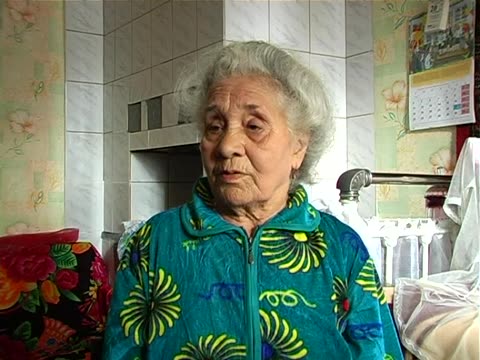
The second part of the tape is a formal interview with Genya Mikhailovna Khotenko, nee Shvartsman, born 1926 in Balta. Khotenko bore the name Skobilov from her first non-Jewish marriage. The team enters her house and sets up the interview with her.
From the machine transcript
The team enters Khotenko's home and sets up the interview. She gives her married name, Khotenko, and her birth year, 1926, and she discusses her health and blood pressure with Kerler and Lemster.
adds her talk about health and blood pressure
Khotenko discusses her life before the war. She then talks about her family. Her father, a baker, was born in Nestoiyta. Khotenko grew up in Nestoyita, before moving to Balta in 1932. Her mother worked in the Balta sewing factory after the war. Her paternal grandparents lived on a kolkhoz. Her son Volodye Shvartsman lives in Tiraspol, Moldova. Her mother’s brother evacuated her and seven relatives with a wagon and horse during the war. Khotenko grew up with six siblings and her sister lives in Sarata.
From the machine transcript
Khotenko says she was born and lived in Balta until the war, when the family was evacuated. She describes her street and the Jews who once lived there. Her father, a baker, came from a village called Nestoyita (?), and her mother sewed. She names her grandparents and a maternal uncle in Odessa, and recounts the killing of the paternal grandparents on a forced march and the evacuation by her uncle. She also mentions her son in Tiraspol, her seven siblings and her surviving sister.
adds her siblings' names and deaths, the killing of grandparents on the road, and her uncle's role in evacuation
Khotenko discusses Jewish life before the war and her education. She attended a Yiddish school for five years. Khotenko discusses Yiddish songs.
From the machine transcript
Khotenko describes prewar life as poor. She says she attended the Yiddish school for five classes and that a Russian and a Ukrainian school also existed. She answers Lemster and Kerler's questions about the Yiddish school and classes, her reading, and the Yiddish literature she studied. She recalls her mother singing old songs, though she remembers none of them.
adds the questions about school curriculum and her mother's singing
Khotenko talks about prewar holiday celebrations and Jewish life before the war. Khotenko moved to Balta in 1932. She also recalls food customs at home.
From the machine transcript
Khotenko answers questions about prewar Jewish holidays at home, saying that there was no synagogue in use. She mentions the shoykhet before and after the war, and describes Passover, Hanukkah and Purim foods and customs such as gifts and children's games. She also recalls that the family moved to Balta in 1932.
adds food customs for Passover, Purim and Hanukkah, and the shoykhet
Khotenko discusses cultural life after the war, in particular theater. She then talks about prewar life at home, in particular Sabbath and Yom Kippur celebrations. Khotenko remembers her non-Jewish friend Pavlik, who spoke Yiddish. She then talks about her family and prewar cultural life. Her grandfather was a tailor.
From the machine transcript
Khotenko recalls Yiddish theater coming from Odessa and her mother's candle-lighting. She says Yiddish was spoken at home, and recalls a non-Jewish friend, Pavlik, who spoke Yiddish with an accent. She talks about grandparents who prayed, one of whom died in 1932 (?); the other was shot on the road. She says there was little Jewish observance before the war and describes fasting on Yom Kippur.
adds language at home, Pavlik, her grandparents' observance and Yom Kippur
Khotenko talks about the Great Hunger in 1932/33. Her sister died during the famine. She then talks about postwar Yiddish culture, in particular theater. Khotenko recalls a Yiddish song about a girl, she heard from Anna Guzik. Khotenko recalls prewar Jewish weddings and discusses holidays before the war.
From the machine transcript
Khotenko describes the famine in which her sister died and the years of hunger, then says she heard Anna Guzik in postwar concerts. She recites part of a song about a girl with geese in the woods and discusses prewar Jewish weddings, with a canopy and big halls, and the custom of carrying a 'makeh' cake. She also answers questions on Sukkot and Purim before the war.
adds the hunger years, the makeh cake custom, and Sukkot and Purim questions
Khotenko answers questions about cultural terminology and discusses folk customs, as well as anecdotes about receiving luck. She explains how her sister went to an old Jewish woman, who averted the evil eye. Khotenko then talks about her family. Her grandson lives in Israel.
From the machine transcript
Khotenko answers questions on Yiddish terms (dybbuk, sick, pious, convert, blessings for the dead) and on the evil eye and cures such as incantations, wax-pouring and cupping. She says her sister was treated by an old Jewish woman who spoke the charm. She mentions Yiddish tales and then her grandson, an athlete in Israel, her son in Tiraspol and the family name Shvartsman.
adds a mix of other terminology questions and mentions of her grandson abroad
Khotenko talks about her family, in particular her son. He was circumcised at a physician’s home in 1952 in exchange for money.
From the machine transcript
Khotenko answers Lemster's questions about who circumcised her son in Balta in 1952. It was not the ritual slaughterer but a Jewish surgeon, at his home, and it was done quietly and for payment. Kerler remarks that this was not permitted then. The passage ends with Kerler asking her to tell about the evacuation and her return to Balta.
Kerler's closing question about evacuation and return.
Khotenko talks about life after the war, when she returned to Balta from evacuation. Khotenko worked as a dishwasher in a kitchen at a military hospital. She then provides information about the lives of her relatives after the war. In particular, Khotenko mentions the hunger of 1947. She then recalls how a neighbor, medical doctor Iosip Viner, was unjustly imprisoned before the war in the late 1930s. Khotenko explains that Viner healed her from scarlet fever.
From the machine transcript
Khotenko describes her return from evacuation: she worked in a kitchen, her sister lived elsewhere with her husband, and her mother worked at a pig farm and later with the harvest. She mentions a relative hanged in Odessa and the hunger of 1947. She then recalls a neighbouring Jewish doctor named Viner (Iosif), arrested before the war in the late 1930s (the year is uncertain); he had cured her of scarlet fever. She also describes shortages and fear of arrests, and Lemster asks whether there was antisemitism.
Her sister and mother's wartime and postwar work and a relative killed or hanged in Odessa.
Khotenko talks about prewar Jewish life. She then talks about contemporary Jewish life and her different last names; before she talks about her family. She remembers her mother writing in Yiddish.
From the machine transcript
Khotenko says whether there were more Jews or sons-in-law in prewar Balta, and discusses the houses on the street and a Jewish invalid living in a nearby village. She answers questions about her house, privatised in her name, her two husbands, and the surnames Litnavetskii (maternal side) and Shvartsman (paternal side), plus Russian surnames of her husbands and sister's husband. She names a list of towns, and speaks of an acquaintance in America selling his house. She says her mother sang Yiddish songs and wrote Yiddish letters. Her son writes Yiddish using Russian words and speaks it well, and his travel route is discussed.
Surname explanations, her mother's Yiddish letters and her son's Yiddish.
Khotenko talks about life today and her best moments in life.
From the machine transcript
Asked by Kerler about the best years, Khotenko says there were none, and the worst were the prewar and war years; now is somewhat better. Lemster asks about the years after her son's birth in 1952. She then talks about her son, who speaks Hebrew and Polish, works two jobs, and has an Israeli passport, and about his family and travel plans.
Her son's languages, jobs and travel.