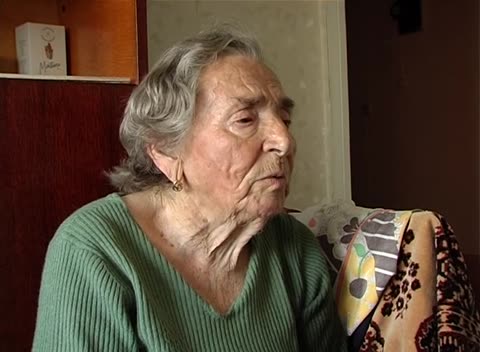
The camera collects some street footage of Balta, where a memorial to the victims of the Balta ghetto is located. Then the team proceeds to to Angelova's apartment. She then speaks about her life today.
From the machine transcript
The scene moves to Angelova's flat, where the interviewers introduce themselves and Angelova speaks about her life today. She talks about her health, operations and a visit to Israel.
Angelova's health and operations; the street footage of Balta is not visible in the transcript.
The formal interview begins. Angelova provides personal information.
From the machine transcript
The formal interview begins. Angelova says she was born in Topole in a region whose name is unclear in the transcript. She grew up there until the war, in about 1920, and her parents worked in a shop. She also mentions that Jews in Krasne Okny were killed.
Mention of the killing of Jews in a nearby town.
Angelova speaks about her family's life at the beginning of World War II. Her parents owned a shop and sold their produce. She then continues to provide personal information and speaks about her family. Angelova's father was born in the Raşcov province and her mother also in Topole. Her parents owned land, as well as kept cows and pigs. She then describes her family home. Angelova then describes how her mother joined a kolkhoz in the 1920s.
From the machine transcript
Angelova gives her name and her father's name, Kolman. She says her father came from the Rashkov area (Bessarabia) and her mother from Topole. The family had a house, land, cows and pigs, and her mother also kept a small shop and later joined a kolkhoz.
Father's origin and a brother hiding in an attic.
Angelova talks about prewar Jewish life in Topole. According to her, approximately fifteen families lived there. She then addresses the period of collectivization in the 1930s when the state expropriated her parents. Angelova then speaks about her family. Her father worked at a manufactory and Angelova on a kolkhoz during this period. Angelova grew up with four siblings. They moved to Kotovsk in 1939, where her parents worked in shops.
From the machine transcript
Angelova says that about fifteen Jewish families lived in Topole and describes collectivization. The family's cows and horses were taken, her father resisted and the family worked on the kolkhoz. She grew up with four siblings. They moved to Kotovsk, where her parents worked in shops.
Mention of a brother's departure.
Angelova speaks about her family's life at the beginning of World War II. She mentions assemblies to gather Jews for forced labor.
From the machine transcript
Angelova recounts the start of the war. Her older brother left, while her parents and grandmother stayed. The Germans registered families and assembled Jews at a stadium.
Angelova talks about her family, particularly her grandparents. She also addresses her family's life before the war.
From the machine transcript
Angelova gives the names of her grandfathers and grandmothers, and says one grandfather was a kulak who kept pigs. Lemster and Kerler also ask about the date of collectivization and about her grandfather's origin in the Rashkov area.
Names of the grandparents and the kulak story.
Angelova addresses her family's fate during World War II. She describes how her immediate family was killed in a mass shooting Kotovsk (Yiddish: Birzule).
From the machine transcript
Angelova speaks about her father, mother and grandmother, who stayed behind and were killed during the war in the Kotovsk district. She mentions her father's earlier time in Bessarabia under the Romanians. Lemster asks where and when the killings took place, and she mentions the stadium and other nearby towns such as Balta. Lemster ends by asking about her siblings.
Includes her father's time in Bessarabia and mentions of Balta.
Angelova speaks about her family. She grew up three brothers and one sister. Angelova then talks about her life and evacuation during World War II. She also served in the Red Army during the war and worked as bookkeeper [in 00:04:45].
From the machine transcript
Angelova names her siblings, including a sister Sonya and a blind brother, and says there were five children. She describes the family's wartime movements, her going to the front, and work there as a bookkeeper. Kerler asks about the Russian term for her military unit.
Adds the siblings' names and the exchange about the military unit's Russian term.
Angelova talks about her life before the war. She then addresses prewar religious life in Topole and recalls private religious gatherings, as well as the local kosher butcher. Angelova states that a rabbi would hold services and also taught children.
From the machine transcript
Angelova says there were many Jews in Birzule before the war. Asked about Topole, she describes prayer gatherings held in a private house, and a rabbi who taught children in Yiddish. She also mentions a ritual slaughterer who killed chickens.
Adds the private prayer house, the teaching rabbi, and the shoykhet in Topole.
Angelova discusses prewar holiday celebration, particularly Passover, in Topole. She also mentions food customs and guests.
From the machine transcript
Angelova answers questions about Jewish holidays in Topole, especially Passover. She describes the communal baking of matzo, how her father led the seder, and an old Jewish guest who came. Lemster and Kerler ask who asked the four questions and whether they sang. She says the family had no Yiddish songs or Jewish school.
Adds matzo baking, the seder led by her father, and the old Jewish guest.
Angelova speaks about her life and education before the war. She attended a Ukrainian school. Angelova also returns to holiday celebration and her family.
From the machine transcript
Angelova says she attended a Ukrainian school and that there were no Jewish schools. She mentions that her family farmed. Lemster asks about a sukkah. She explains that she and her parents read and wrote Yiddish, and says she visited Israel. Lemster compliments her Yiddish.
Adds the sukkah question, her Yiddish literacy, and her trip to Israel.
Angelova talks about her life today and visit to Israel, before recalling traditional weddings in prewar Topole. Angelova then answers questions about cultural terminology.
From the machine transcript
Angelova says she stopped speaking Yiddish after the war. Lemster asks about Jewish weddings, and she describes an open-air huppah and a custom of gifts called makes. Kerler and Lemster then ask for dialect words, such as the word for a holy place, a cemetery, and a Jewish field. She asks about the ages of the others present and mentions her operations.
Adds weddings, dialect-word questions and talk about health and age.
Angelova speaks about her life after the war. She also addresses postwar Jewish life in Kotovsk. She worked as bookkeeper in the Krasnoyarsky district, Russia [00:22:00]. Angelova was married in 1965, which took place in Kotovsk. She also talks about her family. Angelova raised a son and a daughter.
From the machine transcript
Angelova speaks about her postwar life: she moved to Kotovsk after the war and worked as a bookkeeper. She says she worked in Topole and Chorne before and after. She recalls her housing and moves. Kerler and Lemster ask about her marriages, and she says she had two husbands and two children born in the early 1950s. Lemster asks about a dialect word, dybbuk.
Adds two marriages, postwar housing, and a dialect word elicited at the end.
Angelova remembers her childhood memories and describes interactions between Jews and non-Jews, before addressing her military awards.
From the machine transcript
Angelova recalls childhood pranks and joking with her mother, and taking stolen sweets or goods. Lemster then asks about her medals and orders, and she says she received Ukrainian awards.
Interaction between Jews and non-Jews is not clearly shown; the passage covers childhood jokes and medals.
The team concludes the formal part of the interview with Angelova. She also speaks about her family's life before the war.
From the machine transcript
Angelova closes the interview. She says that she spoke Yiddish with her grandmother until age twenty, and that her mother did not sing. Kerler and Lemster ask for the Yiddish term for vineyard or wine garden. Kerler thanks her.
Adds a dialect-word question about vineyard and the language she spoke with her grandmother.