0:00
Waiting in front of Breuer’s office
From the machine transcript
Informal talk among the interviewers while they wait outside Breuer's office, about praying there and about what to take or leave. The transcript is largely garbled.
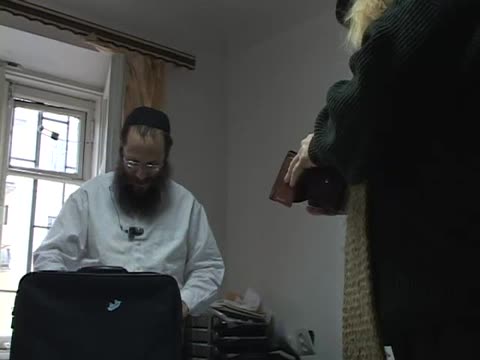
Waiting in front of Breuer’s office
Informal talk among the interviewers while they wait outside Breuer's office, about praying there and about what to take or leave. The transcript is largely garbled.
Informal chat about previous visits to Berdychiv
Informal chat in the synagogue office about earlier visits to the town. The speakers mention a film made there with a cameraman from Kyiv, sending source material and the newspaper, and photographing the rabbi. Someone says he has been there twelve years. Much of the exchange is unclear.
The transcript shows talk of sending sources and photographs and of a New York rebbe, beyond previous visits.
Communal life in Zhytomir
Breuer speaks about the synagogue building and the Jewish situation in Zhytomyr. It is the only synagogue left of dozens, built long ago. He recounts a story about a rabbi's wife and a non-Jewish judge in a dispute over whether there should be other rabbis in the city. He also mentions the relations with the other rabbi (Krinsky?).
The transcript adds the one surviving synagogue and a courtroom dispute about rabbis.
Breuer’s lineage and Hasidic anecdotes
Breuer says Zhytomyr has several thousand Jews, that he is responsible for the surrounding towns, and that there were eight weddings last year and a yeshiva. He then speaks about his Hasidic descent, with rebbes of Chernobyl and other courts. He explains the differences between Chabad and Polish Hasidim, with a story of two Hasidim and their rebbes. The talk turns to the Messiah, Vilnius, and a Chabad Yiddish newspaper.
The transcript adds the community numbers, the Chabad–Polish Hasidic comparison with anecdote, and the newspaper.
Russian Hasidim and Breuer’s family
Breuer discusses Russian Hasidim (Karlin, Slonim) and Chabad's closeness to the Lithuanian world. He tells about his ancestors among Chabad Hasidim, with stories of the Alter Rebbe and of a Hasid called Yomi Kletsker (?), and about his eight children. He and the interviewers discuss Yiddish among Chabad and other Hasidim in Israel, where Hebrew is replacing it.
The transcript adds family stories, his children's Yiddish, and Yiddish in Chabad and Satmar circles in Israel.
Yiddish-speaking Jews in the region and current affairs
Talk about Yiddish-speaking Jews in a nearby town (Mezhybizh (?)), about Jewish students at the university and a shaliach, and a donor from New York. Katz offers to telephone Breuer from Vilnius. A man from the synagogue says he was born in Moscow and has lived in Berdychiv since the war, and says Kaddish for a deceased man. Furman introduces himself and gives his age (87) and birthplace, Berdychiv.
The transcript adds the arrival and introduction of Furman, and a man who says Kaddish.
The research team is in the synagogue to greet Furman and introduces itself to the potential interviewees. The Red Army
Furman says he was born in Berdychiv and was drafted in 1939 to the Far East fleet, where he served until 1941. In the war he was sent to the front and fought at Stalingrad, where he lost a leg. He returned to Berdychiv in 1945 and found his parents, brothers and sisters killed. He says he is a war invalid, group II, and the interviewers record his name, David Zelikovich, from his father's name Zelik.
Family
Furman gives his family details. His father Zelik, from Berdychiv, was a carpenter. His mother Leike was also from Berdychiv. He had a sister and two younger brothers, Moshe and Birl, and he was the eldest, born in October. He worked as a furniture maker for forty years.
His work
Furman says his work continued after the war on his artificial limb. He was a carpenter before the army, and his mother was a dressmaker. Kerler then begins to ask about holidays before the war.
Jewish holidays
Furman answers questions about holidays in the home before the war: Passover with matzo baking, the four questions asked by the father, Rosh Hashanah and Yom Kippur. Asked about the morning prayer, he does not remember it.
Childhood memories and Jewish education
Furman talks about his childhood and school in Berdychiv. There were many Jewish schools alongside Russian, Ukrainian and Polish ones. About 60,000 Jews lived there, and many were killed at the airfield. He gives his siblings' birth years and says his friends were killed in the army. He studied in a Yiddish school, remembers Tolstoy and Sholem Aleichem, and says non-Jews also spoke Yiddish. He lived near the edge of town.
Red Army
Furman explains how he came into the army: called up at twenty, then on the front when the war began, after naval service. He says he and his friends spoke Yiddish before the war and not Russian.
Jewish cultural life before the war
Furman answers questions about cultural life. Yiddish theater came to Berdychiv with actors from Odessa and Leningrad, and he went to the theater often. He recalls the building opposite the synagogue, now a factory, and other synagogues. Asked about Purim plays, he does not remember any.
Jewish holidays customs
Furman is asked about customs. He mentions Hanukkah gelt and Purim noisemakers. He does not know the Tisha b'Av custom, and says his father was not rich. He had one aunt and one uncle, whom he visited for coins.
Chasidim
Others present say there were no Hasidim in Berdychiv. Kerler asks about Levi Yitzhak of Berdychiv and visitors to the grave. Furman does not remember either.
Food customs
Furman answers Kerler's questions about his mother's cooking. She made gefilte fish, a little sweet, fish and soup, and baked cookies, strudel and challah, and lit candles on Friday. Kerler and Lemster ask what it was filled with and what else she made.
Berdychiv before the war
Furman says Berdychiv was a Jewish city where everything was done in Yiddish. Asked how it differed from Zhytomyr, he says he did not go there. The interviewers then turn to Stalingrad.
Stalingrad
Furman explains the importance of the Battle of Stalingrad: Hitler wanted the city for the oil of Baku, Moscow and the Urals, and taking it would have lost the war. He ends with a Russian wartime slogan that there is no land beyond the Volga.