People › Beyle Mindel Vaisman › conversation

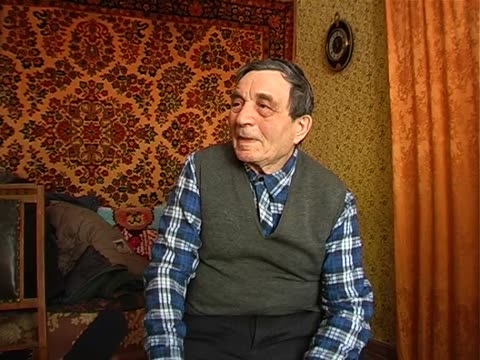
Beyle Mindel Vaisman; Isaak Iosipovich Vaisman

Berdychiv 9 January 2009 Interviewed by Dov-Ber Kerler, Jeffrey Veidlinger 74 min · 2 parts on 2 tapes
Loading the player…
  1. MDV 354 2:30–1:02:30 · 60 min · not online — MCO
  2. MDV 355 0:00–13:57 · 14 min · not online — MCO
Passages
MDV 354 2:30–1:02:30

2:30

Informal chat

Informal MDV 354 · MCO
From the machine transcript

Opening chat among those present, with remarks about the synagogue and what is nearby. There is some Russian talk, partly about whether visitors should go to the synagogue. The speech is fragmentary and the transcript is unclear.

4:21

Prewar Jewish education

before the war Schooling MDV 354 · MCO
From the machine transcript

Kerler asks about Yiddish schooling. Those present recall the Yiddish schools that were closed in the 1930s, and one woman says she attended one briefly but now speaks no Yiddish. The interviewee then says her father, Moyshe Reinsdorf, from a Warsaw family, finished two institutes and came to Berdychiv as a refugee during the First World War.

adds the father's Warsaw origin and the refugee arrival, beyond the label on education

7:26

Jewish life before and after the war

before the warafter the war Daily life (general) MDV 354 · MCO
From the machine transcript

They describe Berdychiv before the war as a Jewish town of over thirty thousand Jews, with many synagogues and prayer in private houses. Under Soviet pressure Komsomol members could not enter the synagogue. After the war some returned from evacuation. They also say how the couple met, that they lived in the same courtyard, and that her father died in 1928.

12:51

Beyle’s family

From the machine transcript

The interviewee recounts leaving Berdychiv on 20 June to Kharkiv, where her grandfather lived, and how the war began two days later. A relative, a lawyer, came to take his family to Kharkiv, while her own family stayed in Berdychiv and was murdered. She evacuated with her grandfather to Uzbekistan and later found her husband through an address bureau.

adds the evacuation route via Kharkiv to Uzbekistan and the fate of those left behind

14:15

Prewar and postwar life

before the warafter the war Daily life (general) MDV 354 · MCO
From the machine transcript

She names the relatives lost in the war: her mother Sara, her sisters Ester and Zisl (the youngest was four), and her grandmother. She says she will show photographs. Kerler then asks about non-Jews in prewar Berdychiv and Yiddish. Both speakers say Yiddish was widely heard in the streets and that many non-Jews spoke it. They describe a Ukrainian locksmith who spoke good Yiddish, and say that few Jews now remain and Yiddish is spoken between themselves.

adds the Yiddish-speaking non-Jewish locksmith and the present small Jewish population

22:30

Jewish weddings before the war

before the war Marriage and weddings MDV 354 · MCO
From the machine transcript

Kerler asks about mixed marriages before the war. They answer that educated Jews often married Russians, while more traditional ones had a wedding canopy. The interviewee then reflects on the losses she suffered in the war.

23:36

Informal chat

Informal MDV 354 · MCO
From the machine transcript

Brief chat between Kerler and the interviewee about other visitors from America who had come earlier. The transcript is garbled.

24:05

Jewish cultural life before the war

before the war Cultural life (general) MDV 354 · MCO
From the machine transcript

Asked about Jewish culture before the war, they recall visits of Jewish troupes and artists from Moscow, Kyiv and Odessa, concerts, and full synagogues at holidays. They remember Jewish weddings with a fiddle, and her father's work as an accountant and his many languages.

adds the touring troupes, the fiddler at weddings and circumcisions, and her father's occupation

27:37

During the war

during the war World War II (general) MDV 354 · MCO
From the machine transcript

They discuss the war years. Wealthy Jews stayed in Berdychiv because the Germans had not harmed Jews in 1914 and they believed money would save them. One family lost its relatives, and they recall the interviewee searching for her family at the station. She also reflects on war today in Israel.

adds the story of the aunt's family and the search at the station, and the reflection on Israel

30:48

Life today

life today Life today MDV 354 · MCO
From the machine transcript

They talk about life today: the possibility of travelling to their children in America, staying at home, pensions and war benefits, rising prices of medicine, and the fall of the dollar. They also speak about the Skver rebbe's family and his grandson, and the death of the rebbetsin, who left eight children.

adds the rebbe's family and the prices and pensions

36:40

Life and celebration of Jewish holidays at home before the war

From the machine transcript

She recalls prewar Passover at home, with the large table, the whole family gathering and the grandfather leading the seder. Asked about Purim, they say they remember nothing particular. They add that the family lived comfortably though not wealthily, and her father knew Jewish history.

39:39

Religious life after the war

From the machine transcript

Kerler asks about Passover after the war. They say matzo was baked in the synagogue, with the dough carried in large baskets to a big oven. They describe the German destruction of the synagogue and its repair by the Jews, and that Pioneers and Komsomol members could not enter. They also say there were many prayer houses of trades before the war.

42:12

Religious customs at home and life before the war

From the machine transcript

The interviewee recalls a home prayer room with a Torah scroll that was stolen in wartime, and says Yiddish is spoken in Berdychiv. She explains which languages were used at home and with her grandchildren. They discuss the Yiddish school, which she knows only a few letters of, and letters in Yiddish from her grandmother and mother that she will show.

adds the stolen Torah scroll, the languages used at home and the letters

46:05

School education and religious life after the war

From the machine transcript

Kerler asks about teachers at school and about synagogue attendance in the 1960s and 1970s. The answers are fragmentary and mixed with Russian chat, and the transcript is unclear.

adds the questions about teachers and postwar synagogue attendance

47:44

Showing letters and photographs

From the machine transcript

The couple shows and reads Yiddish letters and family photographs to Kerler, including a letter written in 1941. They identify her parents Sara and Moyshe Reinsdorf, her sisters Ester and Zisl, and a relative who died in Donetsk. They also remark on a photograph of a soldier.

1:02:12

Service in the army

From the machine transcript

The interviewee says the family was evacuated in 1941, first going to the Caucasus.

the passage is about evacuation in 1941, not army service

MDV 355 0:00–13:57

0:00

World War II and Red Army

From the machine transcript

Vaisman recounts the war: evacuation toward the Caucasus and then to Central Asia, where he worked, and being drafted into the army and sent to the front after a short course. He served for about a year in Romania, catching deserters, and afterwards fought Bandera partisans in the Baltic region. He mentions Jewish comrades, a commander, being questioned about informing, and release from the army. The second informant tells of an old Jewish tailor who stayed under German occupation with his wife and two sons and was hidden by non-Jews. He hid under a bridge with a crying infant and was spared by a German soldier. Kerler also asks whether one could pray in the army.

Adds the tailor's story told by the second informant, the Bandera/Baltic fighting, and the question about praying in the army.
10:31

Food customs on Jewish holidays and religious customs

From the machine transcript

Kerler asks what was eaten at Hanukkah and what customs were kept. The second informant mentions latkes made of buckwheat flour, singing the Hanukkah song, dreidel and Hanukkah money. She describes Jewish home life, her father-in-law putting on tefillin and praying, and says no one taught her to pray. Vaisman adds a remark about a relative in the army before the war. Kerler thanks them and closes the interview.

Adds the Hanukkah food and Hanukkah money, the father-in-law's tefillin, and the closing thanks.