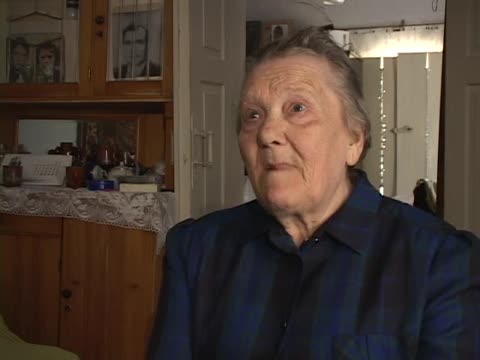
Sabbath celebrations
From the machine transcript
Kerler returns to Sabbath at home and asks about a Sabbath dish. The interviewee does not know the term, and they try to establish what was cooked, with beans mentioned. She also speaks briefly about her late husband.
Also a brief mention of her late husband.
Childhood friends
From the machine transcript
The interviewee mentions a childhood friend who later went to America and visited her. Kerler asks what games they played and what the word for a doll is in Yiddish; she says the Russian word is not Yiddish and discusses other terms.
Life during the war
From the machine transcript
She recalls the arrival of the Germans, who collected money, gold and clothing from Jewish homes, and then the Romanians, who fenced off a square by the school as a ghetto, six years long. She describes a woman accused of being a partisan because of a grenade and shot, and the memorial later built on the square from the bones.
Adds the woman accused of being a partisan and the postwar memorial.
Her life after the war
From the machine transcript
After the war she finished seven grades, then studied three years at a technical school in Moldova and worked there. She married in Sharhorod with a Jewish wedding, in 1958.
Post-war life in Dzurin
From the machine transcript
She says Yiddish was still spoken in Dzhurin after the war and life was hard; her mother was left alone with three children. Her father died at the front, and the family learned of it later; she describes the circumstances of the grave and annual visits.
The catalogue says the father was injured and visited in hospital; the transcript points to his death at the front and a grave visited yearly.
Religious life after war
From the machine transcript
She answers whether Jewish religious life continued after the war: the synagogue became a factory and people met in private houses in Sharhorod for the High Holy Days, which Dzhurin did not have. Kerler asks about Nemyriv too, where there were many Jews but no synagogue.
Story telling
From the machine transcript
The interviewee describes the Dzhurin synagogue (large windows, white stones, women seated) as Kerler asks about its appearance, then Katz invites her to recall early childhood. She sings a little of a lullaby, says her mother could read Yiddish and wrote to relatives in America, and recalls a parable of a rich and a poor brother.
Covers the lullaby, her mother's letters from America and the parable, beyond story telling in general.
Passover celebration in Sharhorod
From the machine transcript
She explains the family went to Sharhorod for Passover to celebrate with her husband's parents and brothers, and the discussion turns to the names of the grandparents, including the grandmother's Yiddish name. Kerler asks about the husband's father's name and birthplace.
Also family names and birthplace.
Family and survival
From the machine transcript
Kerler asks what she wants future generations to remember; she wants people to help each other and live in peace without war. She recalls what helped during the war (giving away belongings for bread, a woman who gave bread) and her mother's work, and her brothers' later careers.
Life today and family
From the machine transcript
She speaks about life today: her son and daughter, a grandson working abroad, and grandchildren. Katz asks about the future of Jews in Dzhurin and Nemyriv; she says only a few remain and expects nothing, and describes being the only Jewish pupil in school and technical school.
Adds her descendants and the small number of Jews.
Postwar religious customs
From the machine transcript
Asked for a Yiddish word for a gravestone, she gives it and says her grandfather's stone in Dzhurin has Yiddish writing. After the war the family brought a rabbi to read it, but no one in Dzhurin now can.
Adds the Yiddish term for a gravestone.
Concluding interview
From the machine transcript
Concluding exchange: Katz encourages her to think of good things, and she speaks of her health and children. She laments that there are few Jews left and that a Jewish match for a widowed relative would be hard to find.
Outside and town footage
From the machine transcript
Camera footage as the team looks for the Gellers' house, with a passerby giving directions in Russian and Yiddish (streets named after Marx and Engels) and the team commenting in the car. The speech is mostly Russian, garbled and unclear.
Interview with Sofia and David Geller (part 1 of 3)
From the machine transcript
The team meets the Gellers at their home and introduces themselves and the project, asking for an interview in Yiddish. Katz and Kerler ask where they were born, David in Zhmerynka and Sofia in Bratslav, and what the Hasidim of Bratslav were called.
The team meets the Gellers outside their house, before they set up the formal interview.
From the machine transcript
The team greets the Gellers outside their house before the formal interview, with introductions of those present, birthplaces (Zhmerynka, Bratslav) and the Bratslav Hasidim question.
The formal interview with the Gellers begins. They provide personal information, before David discusses his childhood memories of Jewish Zhmerynka.
From the machine transcript
Kerler records the date and Geller provides personal information: Sofia gives her family name Dikerman and birth in April 1929, and David's birth in May 1929. David then begins to speak about Zhmerynka as a railway junction and a Jewish town, while Sofia and Kerler chat about the archive.
Geller talks about prewar Jewish life in Zhmerynka. He recalls leisure activities in town. David then addresses his family's life at the beginning of the war, when they evacuated. His father was a barber and a communist, according to David. David describes his evacuation in a heated goods train toward Tashkent, Uzbekistan, traveling for one month. David continues that they evacuated further to Samarqand Shahri, where he worked on a kolkhoz in the Panjakent region.
From the machine transcript
Geller recalls Zhmerynka's many Jews and evening strolls on the main street, then the start of the war: his father, a barber and communist, was evacuated with others by train. They traveled a month in freight cars to Tashkent, then on to Samarkand and a kolkhoz in the Panjakent district (?).
Geller describes the living conditions at the kolkhoz. He also speaks about his family. Geller's father was drafted in 1942. According to Geller, his mother was pregnant and she gave birth in Zhambyl Qalasy, Kazakhstan. Geller's mother passed away in Samarqand Shahri and he and his two brothers had to take care of themselves; Geller explains.
From the machine transcript
Geller describes the kolkhoz housing, a cotton storehouse where families slept on the ground, and his father's army call-up in 1942. His mother, pregnant, gave birth in Dzhambul; she died in Samarkand and was buried in a mass pit, leaving three orphan sons.
Geller talks about his life in evacuation, after his mother passed away. Geller's maternal aunt took care of his infant brother in Shymkent, Kazakhstan. Geller continues that he began a turner apprenticeship at a factory teaching facility (Fe'Ze'O - фабричное заводское обучение), before he worked a factory in Shymkent. Geller then explains that he moved to his father, who lived in Türkmenbaşy (formerly known as Krasnovodsk). Geller worked at a cafeteria there.
From the machine transcript
Geller tells how an aunt took the infant brother, and he trained as a turner at a factory school in Chimkent and worked at a plant, receiving bread rations. His father, a worker in a labor army and later at a port, took him to Krasnovodsk, where he worked in a cafeteria.
Geller speaks about his siblings' life during the war, as well as his life in Türkmenbaşy. Geller's father was drafted for the second time. He then describes his return home to Zhmerynka, via Baku (Azerbaijan), after the war ended.
From the machine transcript
Geller speaks about his brothers (Velvl in the army, the youngest, Moshe, with aunts) and his father's second army call-up, which left him alone. He returns to Zhmerynka from Turkmenistan via Baku on 9 May 1945 and finds aunts there, then leaves for Kyiv in 1947.
Geller speaks about his life after the war. He left Zhmerynka for Kyiv in 1947 and attended again the Fe'Ze'O. He was drafted for military service in 1950 and served until 1953. Geller then speaks about his service in the Primorsky territory.
From the machine transcript
Geller says he studied again at the factory school in Kyiv to be a turner, and was drafted in 1950 and sent by freight train for a month to the Primorsky region near Vladivostok.
David talks about his family. They raised two daughters, who live in Moscow. David then addresses his life during World War II, particularly how his family evacuated.
From the machine transcript
Geller answers that their daughters are content. Kerler then asks how the evacuation from Zhmerynka was organised. The speaker, who was twelve, recalls loading belongings, leaving most things behind, and travelling in heated freight wagons. Katz begins asking how it was decided that Geller should go into the army, and Kyiv is mentioned.
The transcript shows no mention here of Moscow; the passage is chiefly Kerler's questions on how the evacuation was organised.
David speaks about the moment when he volunteered for military draft. He then describes the work tasks in the army, as well as in his profession as turner.
From the machine transcript
Geller explains that he had a four-year deferment from mobilisation. He pressed the authorities to take him, and then worked for a month in Kyiv on bricks. Back in Bratslav, already married, he found work as a turner at night because electricity was supplied only at night. Kerler closes by turning to postwar antisemitism.
David and Sofia discuss postwar antisemitism, before addressing the contemporary Jewish press. They then address the period of the Doctor's Plot in 1952-53.
From the machine transcript
The Gellers discuss antisemitism after the war. One says he never heard a slur in Central Asia, where Uzbeks were friendly. They reject the claim that Jews did not fight at the front, and compare the antisemitism of today with the past. They also discuss the Jewish press and the Doctors' Plot of 1952–53, when small towns were not affected. The speaker labels are uncertain in places.
Also covers the Jewish press and the Doctors' Plot period, with Kerler's questions.
Sofia speaks about her life today and the relationship with her non-Jewish neighbors. She discusses her childhood memories of Jewish Bratslav and her family. Sofia's father was a coachman. She also mentions her mother's observance.
From the machine transcript
Sofia describes how few Jews live in Bratslav today and that there is no militia or police presence. Asked by Kerler what she remembers of old Bratslav, she says she was born into a drayman's family. Her mother kept the home and lit Sabbath candles, and her grandfather, a melamed, was killed in the pogroms of 1918. The war began when she was twelve, and her father had a wagon with two horses.
Adds the grandfather's death in the 1918 pogroms and the family's wagon and horses.
Sofia talks about her life during World War II and describes her family's evacuation toward Lugansk, as well as settling down at a kolkhoz. Sofial then addresses her life and work on the kolkhoz until December 1941. They then evacuated further to Tashkent, Uzbekistan, from where they moved to a kolkhoz at the Kamashi station in Kaskadarya Province, Uzbekistan. Sofia explains how her mother arranged transportation for her children to a nearby town to escape the hunger on the kolkhoz.
From the machine transcript
Sofia tells how her family left Bratslav on the father's horse wagon. The journey took six weeks, with the parents, siblings and a brother's wife, to the Luhansk area of the Donbas, where they worked on a kolkhoz. In December 1941 they travelled by freight train to Tashkent, then to a kolkhoz near the Iranian border in Kashkadarya oblast. There her mother took the hungry children to a nearby town. Her parents' names are given as Avrom Elye and Kheyke, and a brother is Leyb.
Sofia speaks about her family, before she addresses prewar Jewish life and religion in Bratslav. She also speaks about the fate of the local Jews during the war. Sofia then recalls her mother's praying customs.
From the machine transcript
Sofia gives her mother's and father's birth decades. She says that before the war over five thousand Jews lived in Bratslav and that most perished in the camps, while local policemen plundered Jewish houses. She recalls five synagogues, one with a mikveh. Asked by Katz about Bratslav Hasidim, she says she remembers none, though Nakhman and Nosn are mentioned. She also recalls her mother praying in Hebrew and telling stories at home in Yiddish.
Sofia addresses her family's return to Bratslav in 1944 and their life after the war. She grew up with five siblings. Sofia then returns to prewar Jewish life and culture. She recalls traditional weddings.
From the machine transcript
Sofia says the family returned to Bratslav in August 1944. She finds life just after the war better than today, because people then got on with each other. She describes prewar Bratslav as a Jewish town in which Jews married only Jews, and says that over two thousand Jews lived there after the war. She recalls Jewish weddings with Yiddish songs, dancing and music, and laments that today's young people marry out, including her granddaughters.
Sofia talks about her family. She also recalls snippets of the well-known Yiddish song "Itsik hot shoyn khasene gehat" (Itsik was already married).
From the machine transcript
Sofia cannot recall Yiddish songs, saying decades of pressure made them forget. Katz and Kerler prompt her, and she and others sing fragments of 'Itsik hot shoyn khasene gehat' and 'Lomir zikh tsekushn'. She talks about her family: her daughters live in Moscow, a granddaughter studies there, and an aunt sang Yiddish songs. They now speak Russian at home. She says that Yiddish was her parents' language and that her older brother finished six years of Jewish school before the war, while she attended a non-Jewish school. Kerler also asks about Nemirov and a saying about it.
Beyond the song fragments, adds her family in Moscow, language at home, Jewish versus state schooling and the Nemirov saying.
Sofia speaks about postwar Jewish life in the region. She returns to her wedding in 1953, as well as addresses her life today. Sofia then speaks about her family.
From the machine transcript
Sofia describes Bratslav weddings after the war, such as her own, where all 150 guests were Jews. She says Jews are few now and that singing in Yiddish is possible only at home. Kerler asks what song was sung at her wedding. She lists the long lives of her parents and an uncle and mentions a 'Jewish field'. Katz comments, and Uman is mentioned.
Sofia and David speak about contemporary Hasidic visitors to Bratslav.
From the machine transcript
The Gellers speak about the Bratslav Hasidim who now visit the town from America and Israel and who are not descended from local people. Katz asks who they are. Kerler mentions an Israeli youth of Moroccan parentage who speaks fine Yiddish. A story follows about visitors the husband guided towards Nemirov, one of them on a motorcycle. Katz then moves on to prewar food.
Sofia addresses prewar holiday food customs, particularly on Passover. They also discuss Passover, as well as the contemporary community. Sofia and David also speak about Yiddish dialects and Hasidism.
From the machine transcript
Sofia describes Passover before the war. Her mother baked three pud of matzo for a family with six children, and the chametz was removed from the house and sold. A discussion follows of the contemporary Jewish community, a clever man, and the few remaining Jews and non-Jews. Katz asks whether Bratslav Jews were called 'Bratslaver' or 'Breslover' and about the tsadik Nakhman and Nosn, and whether she heard Hasidic stories. The group then chat about the ages of the interviewers. The passage ends with a wedding klezmer, a caller and table dancing, and Kerler asks how the 'sher' dance went.
Adds the pronunciation of 'Bratslaver', Nakhman and Nosn, interviewers' ages, and wedding music.
Sofia speaks about traditional dancing customs. They then sing "Lomir zikh iberbetn" (Let's make up).
From the machine transcript
Sofia and a second voice explain how the 'sher' was danced, in a set of four couples. A woman sings and others join in, giving the words of 'Lomir zikh iberbetn', a song of making up after a quarrel. The conversation then turns to the interviewers' meal of varenikes at the restaurant, and to Nemirov vodka.
Adds the explanation of the sher dance and the talk about lunch and Nemirov vodka.
Sofia speaks about her life today and family. Her sister lives in Israel. They then answer dialectological questions from the AHEYM Yiddish linguistic questionnaire.
From the machine transcript
Geller and others discuss whether to emigrate to Israel, where Sofia's sister lives, or move to Moscow, as the children ask. They also mention Moscow and Vilnius as cities. Kerler then asks dialectological questions about how a few short words are said in Yiddish. The items include a word for 'door', and the transcript is too poor to say more.
Adds the talk about moving to Israel or Moscow and the dialect-question items.
Sofia and David speak about Sabbath food customs at home before the war. Sofia also describes other holiday dishes and shares baking recipes (e.g. strudel).
From the machine transcript
Kerler asks about Sabbath food. Sofia and David speak of the Sabbath cholent, which was cooked in the baker's oven. They compare chopped fish with gefilte fish, and the Yom Kippur kreplekh. Sofia explains how her own strudel and honey-baked sweets differ from the version of Kerler's mother, who was from Kremenets. They also discuss the Yiddish word for oil.
Adds fish dishes, Yom Kippur kreplekh and the dialect word for oil.
Sofia talks about her family, specifically her grandmother. David then explains how he learned Yiddish after the war. Sofia then speaks about the beginning of the war, the day her family evacuated. Sofia describes how her parents had to let go of their animals.
From the machine transcript
Sofia says her father's mother was a Lithuanian Jewish woman who died in 1939, and Katz asks what her Yiddish was like. They discuss differences between towns' Yiddish and how David, who knew no Yiddish after the war, learned it from his in-laws. Sofia says her mother kept turkeys, geese and ducks but no goats, and describes the family leaving the animals loose on the day of the evacuation. The conversation ends with Katz and Sofia naming Bratslav families now in America, including Feldman and Levine.
Adds the evacuation-day scene with the animals and names of relatives in America.
The camera collects outside footage of Geller's home.
The camera cuts to the Geller's interview. David speaks about his life before the war and describes his circumcision ceremony. He states that his father was excluded from the Party.
From the machine transcript
David Geller tells about his own circumcision, held when he was eight days old, with his mother and grandmother carrying him to the synagogue. His father, a Communist, was excluded from the Party over it. Kerler comments on his fine Yiddish and asks about his brother.
The catalogue gives no detail on the Party expulsion beyond a short mention; the transcript also shows Kerler asking about the brother's burial or death.
Sofia talks about her brother's circumcision, including food customs for the "Kriyat-Sh'ma" reading (a prayer that must be recited every evening before bed the night before).
From the machine transcript
Sofia Geller describes the special small cakes baked before the war for the night before a bris, when the children came to a Krishme-leyenen (Kriyat Shema) gathering. Kerler asks how they looked and when they were baked. The passage ends with toasts and a joke about drinking, in which Kerler says he drinks only symbolically.
The transcript also shows toasts and a short exchange about who drinks.
Sofia points out her photograph and the camera records more family photographs. They then chat.
From the machine transcript
The hosts and Kerler chat over the family photographs, with wishes for good health. They thank the visitors for coming and talk about Jews and about speaking Yiddish.
Sofia and David sing well-known Yiddish songs. Sofia also sings a song in Russian, as well as nigunim (Hasidic tunes).
From the machine transcript
The Gellers drink toasts and sing together, including a wedding-related song. Kerler explains that he can speak Russian but does not understand it. The passage includes a Russian song and a Yiddish folk song about a peasant and a balalaika, with Kerler's thanks. Singing is mixed with chat.
The transcript shows toasts and chat about languages around the songs; the nigunim named in the catalogue are not clear.