People › Avram (Avrohom ben Khayim Nisen) Khaimovich Khavin › conversation

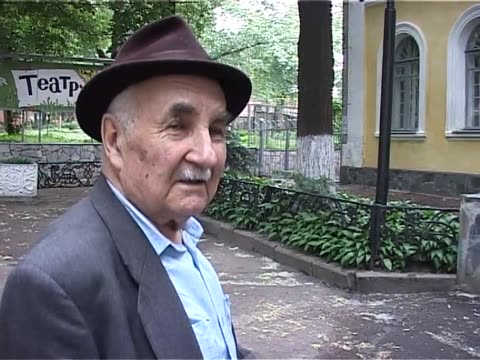
Avram (Avrohom ben Khayim Nisen) Khaimovich Khavin

Chernihiv 27 May 2003 Interviewed by Dov-Ber Kerler, Dovid Katz 61 min · 1 part on 1 tape
Loading the player…
  1. MDV 404 0:00–1:00:39 · 61 min · archive.org
Passages

0:00

On the way to the Yiddish school.

Tour MDV 404 · MCO
From the machine transcript

In the car, Khavin and Kerler stop at the building that housed the Yiddish school. Khavin explains that the children studied all the ordinary subjects (mathematics, physics, chemistry, biology, Ukrainian, Russian) in Yiddish, with no religious instruction. The school was closed down and liquidated in the 1930s, which Kerler remarks was very early.

2:12

The former Great Synagogue and prewar religious life.

From the machine transcript

Khavin describes the former Great Synagogue, now a theater, with its three halls for several hundred men and its prayer customs. He says his family went only to the New Market synagogue and recalls famous visiting cantors there. Much of the passage is a conversation with a guard who will not admit the group, with talk about the building's remodeling and its women's gallery.

The catalogue omits the guard's refusal and the discussion of the building's present use and remodeling.

11:28

Encounter with soldier.

Informal life today MDV 404 · MCO
From the machine transcript

Khavin tells a story about his father in the army, apparently while the speaker was a soldier, and about cigarettes at the front. The details are unclear in the transcript. The catalogue's 'encounter with soldier' is not clearly confirmed.

13:02

Holidays.

From the machine transcript

Khavin describes the Passover seder in his parents' home before the war: the search for hametz, the foods, the seder plate, and his father's song. He also mentions Purim gifts carried to relatives, Shavuot as a favorite holiday, and the Sabbath songs at home. Kerler asks whether songs were sung for Purim and Hanukkah.

20:01

Pre-war religious life.

From the machine transcript

Khavin names three rabbis in the town (the Trisk, Rybka and Chernobyl rabbis, the transcript is unclear) but does not know which was in which synagogue. He recalls an old, learned rabbi to whom his father took questions, and a shokhet from whose slaughter his father would not eat. Katz then asks for the Yiddish names of towns around Chernihiv.

21:53

Surrounding towns.

From the machine transcript

Khavin gives names of towns and villages around Chernihiv, and Katz asks how each was said in Yiddish. These include Rybka (?), Horodnia, Berezna, Sosnytsia, Novhorod-Siverskyi, Brahin, Pryluky and Krasylivka. Khavin says Jews in the twelfth century could not live in towns and lived in villages, and that Chernihiv, Nizhyn and Berdychiv were exceptions. A tsar later barred them from villages (this part is garbled).

25:18

Jewish life in towns and villages.

From the machine transcript

Khavin says that from the twelfth century (?) Jews gradually began to live in cities, and that none of the Jews in the villages survived the war, because Hitler killed them all.

26:01

Pre-war friends and sins.

before the war MDV 404 · MCO
From the machine transcript

Khavin reflects on why six million Jews died, saying he can accept his own guilt but not that of children and pious women, and mentions a relative who came to Moscow to his sister. He begins a longer story about relatives in Moscow and a trip toward Oster (?), with a question about the Yiddish form of that name. The recording is interrupted by a Russian request not to disturb the filming.

28:48

Family.

From the machine transcript

Khavin tells about his older sister and her husband Pinye Rozenblum, a Polish Jew and revolutionary who worked in Moscow at an institute for nationalities. Rozenblum was arrested in 1937 and exiled to Magadan for ten years, and was rehabilitated under Khrushchev. He lived in Moscow until his death, and his son emigrated to Israel. At the end Katz and Khavin discuss the Yiddish form of the town name Kozelets.

The catalogue gives Rozenblum's arrest and rehabilitation, but the passage also covers his exile, his son's emigration and a name-form question about Kozelets.

35:52

Friend and family.

From the machine transcript

Khavin and Kerler discuss his brother-in-law's later life: he stayed in the party and did not want his son to leave, but the son emigrated to Israel as an engineer and later lived in Haifa. A woman relative and a niece in Haifa are mentioned. Talk turns to Khavin's granddaughter, who lives in Simferopol and is of marriageable age.

The catalogue speaks of a friend; the transcript concerns relatives in Israel and a granddaughter.

42:23

Postwar religious service and today.

From the machine transcript

Khavin recounts how after the war Jews prayed in a club in a basement and then received a building through the Hesed, with Sasha as chairman until he and his wife emigrated to Israel a couple of years earlier. They collected money to buy tables and a kiddush table, and the talk covers support from Zhytomyr and payments. Kerler and Khavin discuss a young Hebrew-speaking rabbi (?) and a bearded man named Nokhum. The passage ends with Russian proverbs, which Kerler renders in Yiddish.

The catalogue mentions only the basement club; the transcript also covers the Hesed building, funding for furnishing it, and the visiting rabbi.

47:49

Family photographs.

From the machine transcript

Khavin shows a photograph of his father, who is named in Yiddish as Khaim Nisn ben Yankev Khavin. He then shows a picture of his granddaughter Milana, who is 25, married, and lives in Simferopol. The interviewers say she should find a match and perhaps go abroad. Khavin is then asked about his army rank, which was that of a technical lieutenant.

49:16

Red Army during war.

during the war Army service MDV 404 · MCO
From the machine transcript

Khavin explains his rank of technical lieutenant in the Red Army, which meant he could repair, drive and shoot with a tank. He recalls being in Chernivtsi when the war began. His unit moved to Hlyboka, about fifteen kilometers away, where on the first day there were already dead and wounded.

50:34

Pre-war Jewish Chernivtsi and Mohyliv-Podilskyy.

before the war Local Jewish history MDV 404 · MCO
From the machine transcript

Khavin answers Kerler's questions about prewar Chernivtsi, saying he saw its large synagogue but does not remember what Yiddish was spoken. He says the Romanians did not kill the Jews of Chernivtsi and that the Jews of Mohyliv-Podilskyi also survived. He and Kerler discuss Mohyliv, where his wife's family came from and where the cemetery lies on a hill.

52:51

Informal chat about religious life today.

Informal life today Religious life (general) MDV 404 · MCO
From the machine transcript

Khavin and Kerler talk about religious life in Chernihiv today and about the minyan after the synagogue closed, which gradually became hard to gather. Khavin tells the story of Maksim, who lived in a village in Byelorussia, kept Jewish observance at home, and was killed after an incident with a militiaman. He ends with remarks on his own limited observance and on payments and parcels from Israel.