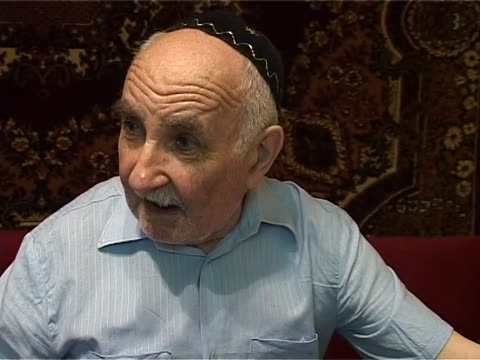
After Katz's opening statement of the date and place, Khavin gives the name of the town and discusses how Jews called it. He describes the three rabbis in prewar Chernihiv and the four synagogues (the great synagogue, now a theater, the Naye Mark shul, the misnagdishe shul and the Liskovitse shul). Katz asks about the meaning of the names and of misnaged.
includes the town's name in Yiddish and the meaning of the synagogue names
Khavin discusses whether his family were Hasidim and gives personal information at Katz's request: his name, surname, street address, apartment and telephone number, and his full Hebrew name. He gives his date of birth, in 1918, and says he lived on Chekhov Street until 1936.
includes a question on Hasidim and the speaker's address and telephone
Katz and Kerler ask a few words from the dialectological questionnaire, among them a word for belly, and Khavin answers; they say they need the Chernihiv Yiddish and not that of Mohyliv. Khavin then reflects on his Yiddish, his grandfather the melamed and his commitment to Jewishness, and says he has survived the war years and goes to the synagogue.
includes questionnaire words and his remarks on his Yiddish and Jewishness
Asked about prewar religious life, Khavin says the Jews were very observant and each of the three synagogue halls held a minyan of about a hundred men. He explains the terms tsadik and guter yid, and recalls his father bringing poor guests home from the synagogue for the Sabbath. A visiting guter yid stayed with the family for about a week and Khavin spoke with him about Pushkin and Tolstoy.
includes the guests at the family table and the visiting guter yid
Khavin explains that he studied ten years in a Russian school, which is why he lacks fuller religious knowledge. Kerler asks whether sick people came to the guter yid; he does not know, and says the visitor stayed in the family's big room for a week or two.
Katz asks about terms such as Litvak and misnaged, and Khavin explains that Chernihiv Jews were Litvaks, speaking with a Lithuanian accent unlike Polish Jews. They discuss where a different Yiddish begins, with places named including Nizhyn and Pryluky, and a few words such as come and buy. Khavin says he had not heard of the Vilna rabbi or the Baal Shem Tov, and that two synagogues were taken before the war.
includes questions on Litvaks, the dialect boundary and the Baal Shem Tov
Khavin says that before the war his father went daily to the synagogue, while the children attended a Russian school. He starts to explain that there were two Yiddish schools in Chernihiv when he was seven, where all subjects, including mathematics and physics, were taught in Yiddish.
Khavin recalls the cheder, where a melamed taught him and two other boys, and being put in a Yiddish school for half a year before his siblings moved him to a Russian school. Answering Kerler, he explains the move partly through growing antisemitism and the situation under Stalin, and says he attended the melamed until about 1932. He describes the teacher as a cultured man who taught Chumash and prayers, but says he himself did not pray until after returning from the army.
includes the transfer to the Russian school and the end of cheder in 1932
Khavin recounts the postwar prayer house in Chernihiv, bought by returnees from the army and evacuation with money collected around the town. After a story about the closing of the synagogue under Khrushchev in 1956, when the police threw out the prayer books and the matzah machine, he says the churches were closed soon afterwards. Private minyanim followed, until the last Torah reader died in 1989.
includes the matzah machine and the minyanim after the closure
Khavin recounts the recent setting up of a Jewish religious community and prayers at first in apartments, then in rooms obtained after a fire. Talk with Kerler about a former theater building, the Hesed and the Kyiv rabbi Bleich, which was not given to them. He says they pray five times a week in the new room, and Kerler and Katz arrange to attend morning prayers.
includes the Hesed, the theater building and the plan to attend prayer
Khavin describes Soviet-period private minyanim and then speaks about his family at Kerler's request: his grandfather the melamed, grandmother Kune and his learned father. He names his mother Malka Rakhel and eight children, of whom five survived, with names given, and his parents married in 1902. He mentions a sister who died in Haifa.
Khavin discusses with Katz the phrase for being born. He says he and his two brothers all served at the front, were wounded and survived, and mentions a brother-in-law who also fought. Kerler redirects the conversation to the holidays.
At Katz's request, Khavin remembers the holidays at his parents' home, beginning with Rosh Hashanah: the big challah, the festive table with fish and a fish head, apples with honey, and why his father did not eat gefilte fish. He recalls the candles his mother made for the Ten Days, and Yom Kippur eve with the chicken meal and the shoykhet. He says his father made his own wine and never bought it, and begins a story about his grandmother's wine.
Khavin tells the family anecdote about grandmother Kune, who made wine from cherries; the geese ate the discarded cherry pits, got drunk, and she began plucking them, thinking they were dead. They then woke up. He adds that his father made wine from apples and grapes.
Khavin describes his father inviting many friends at holidays, then the building of the sukkah after Yom Kippur with boards from the woods, tables and the holiday meal there, including fried meat and noodle dishes. He says Shavuot was considered the best holiday and discusses Sukkot and sleeping in the sukkah. He ends with Simchat Torah, when children played games with nuts and received gifts.
Khavin recalls Hanukkah before the war: his grandmother gave each grandchild five kopeks of Hanukkah money, and his father fattened geese that were slaughtered by the shoykhet for the holiday. Kerler asks about force-feeding geese, which his father avoided, and about the goose cracklings and fat. His mother made buckwheat pancakes fried in goose fat, and Khavin and Kerler discuss the terms for pancakes and latkes. Katz asks about Hanukkah and Purim games and noisemakers.
Includes the terminology of pancakes and latkes, Purim noisemakers and a rabbi receiving the best goose, not just the holidays.
Katz asks Khavin what he remembers of prayer. Khavin says he needs a prayer book, recites a Kaddish and says he can read Hebrew only in the synagogue; he says he knows other prayers only in Russian. He then recites a blessing, perhaps one over wine. Kerler and Katz ask whether there was a beys-medresh in Chernihiv; Khavin says he only heard of one.
Kerler and Katz put dialectological questions to Khavin. The items include words for ceiling, beam, back, suddenly, and 'very ill', along with sentences to translate. The sentences include 'Jews live on this street', 'you were at our place', 'they are Jews', and 'I don't know whether he knows me or not'. Khavin often says he does not remember a word; there are also expressions of pleasure and of a bad face.
Kerler asks whether Khavin's father told stories about rebbes and tsadikim; Khavin says there was no such talk in Soviet times, though his father took him to the synagogue. They discuss which cities counted as Jewish: Vilna, Kyiv, Vinnytsia (?) and Chernihiv. Khavin gives figures for Chernihiv's prewar population, and Katz clarifies them as 56,000 inhabitants of whom 26,000 were Jews.
Includes Khavin's comparison of Vilna, Kyiv and Vinnytsia as Jewish cities, and the population figures.
Katz and Kerler continue the dialectological questionnaire, asking how Khavin says words such as well, potato, shop, merchant, attic, rich man, and cross. They also ask for flowers, tomorrow, evening, and various sentences to translate. Khavin often answers with Russian glosses or says he does not know the word.
Kerler and Katz wind up the questioning and thank Khavin. A phone call about a man (Mark Lipkovich) is discussed, and arrangements are made regarding a possible further Yiddish speaker. Khavin then mentions family members' knowledge of languages, including German, English and French.
Khavin shows photographs of relatives and names them for the camera: his grandparents, his father and mother, his brothers Kolman and Yankev, and his sister Libe. Katz and Kerler ask him to name each in Yiddish. Some of the names are unclear in the transcript.
The speakers talk about timing at the synagogue, including when Aleinu comes in the service, with Khavin saying about twenty minutes after half past. The transcript shows nothing clear of Khavin's war medals.
The transcript shows talk of prayer times rather than medals.