0:00
The research team enters Rakhil Shlemovna Shames’ apartment
From the machine transcript
Kerler opens by asking permission to talk with Shames and recalls that the team visited her in summer; she says she does not remember.
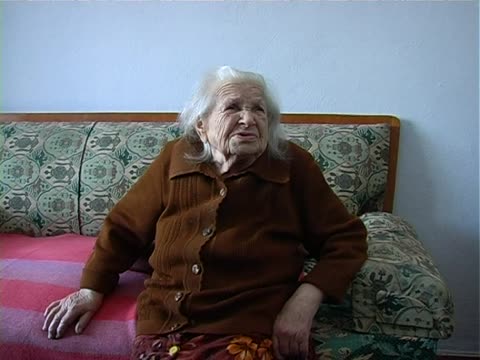
The research team enters Rakhil Shlemovna Shames’ apartment
Kerler opens by asking permission to talk with Shames and recalls that the team visited her in summer; she says she does not remember.
Family and life today
Shames confirms she is from Yanushpol, not far from Donets (?), and says she remembers little now. She was born before the war and had one sister. Her father Shleyme was killed by the Germans, and her mother was Sarah. Until the war she lived in Yanushpol. Kerler also asks whether Hesed helps her.
Hesed help and her sibling and parents' names, beyond the family and life today label.
Childhood memories of Yanoshpil and family
Shames says she did not attend a Yiddish school; Yanushpol was a Jewish shtetl, and a synagogue existed. Her father worked in a mill and her mother was a housewife. She cannot recall aunts and uncles, and mentions possible relatives in America. She worked 23 years as an accountant in a factory after the war.
Relatives abroad and her postwar work as an accountant, beyond childhood memories.
Life during and after the war in Khmil'nyk
Shames says she spent the war in the Urals, alone. She did not return to Yanushpol because no one lived there and her mother had been killed there (?). She says many Jews were killed near Khmil'nyk. She trained as an accountant in Yanushpol before the war and says life was always hard.
Earliest childhood memories
Kerler asks about her earliest memories. She says she studied at a Ukrainian school and that Jews spoke Yiddish among themselves. She recalls Passover being kept as Jews did at home and that she was the eldest sister.
Passover at home and her position as eldest sister.
Life today and information about Yiddish-speakers in the region
Shames says many Jews left Donets (?) and few remain. Kerler asks about a Jewish mother and daughter who live nearby, and they discuss trying to reach them by phone. She describes a Christian woman who helps her, cooks for her and looks after her, as she has not been outside this year.
Jewish neighbours and her Christian helper.
Anti-Semitism
Kerler asks about antisemitism after the war. Shames says it has always existed, that there are very few Jews now and that everyone struggles. Kerler then asks about relatives in America, and she knows nothing of them.
Family and prewar celebration of Shabbat
Shames says she could read Hebrew, taught by a teacher (a melamed), and that she is now alone. She says her father worked in a mill and her mother kept Sabbath and holidays as was customary, and went to synagogue. Her mother survived the war, though how is unclear. Kerler asks about Sabbath dishes and gefilte fish, and she remembers little.
Hebrew teacher, mother's survival and Sabbath dishes.
Evacuation and arrival in Khmil'nyk - 19:59
Shames describes her evacuation, living with a Christian woman who treated her well and working in a factory. She wrote letters to find her mother, who had survived, and then returned to Khmil'nyk, took up work and rented lodging. Kerler also asks about her health, and she says she has not gone out for a long time and is wary of a neighbour.
Letters to find her mother, her return to Khmil'nyk and her situation today.
Childhood in Yanoshpil and life today
Asked about nearby towns, Shames recalls little. She has not met Yiddish-speaking Christians. She says a teacher taught her Yiddish as a child and she went with her mother to synagogue, but she now remembers nothing of Yiddish and has no one to speak with. She mentions four neighbours.
Yiddish literacy and her lack of Yiddish speakers today.
Life during evacuation
Kerler asks about the Christian woman from whom she rented a room in evacuation. Shames says she was good to her, and the woman rejoiced when she learned her mother had survived. She then returned, took up work and buried her husband.
Jewish holidays
Kerler asks about Hanukkah food and Hanukkah money, and Shames says she remembers little as it was so long ago. He then asks whether she remembers the great famine of the 1930s.
Great Hunger
Shames says she will never forget the famine, but has little to tell. Asked whether Jews also died, she replies unclearly. Kerler asks how people survived and then asks about Yiddish theatre in Khmil'nyk after the war.
Jewish life after the war in Khmil'nyk and life today (Israel)
Shames speaks about Jewish life in Khmil'nyk after the war: she and her mother worked and prayed there, a synagogue existed for a time and was later closed, and she cannot say when. Today there is no synagogue and she says few Jews remain. Kerler asks about a shoykhet, Yom Kippur fasting, whether she receives matzo or help from outside, her TV viewing and Israel, which she has never thought of visiting. She speaks of a Christian helper and her family.
Closing of the synagogue, shoykhet, Hesed aid, Israel and her Christian helper.
Jewish religion and wedding
Kerler asks Shames what being a Jew means and whether God exists. She answers briefly that there is nothing to think about and that it is a Jewish God. She married after the war and had no children. Kerler thanks her and praises her Yiddish.
Questions on Jewish identity and God, marriage and absence of children.