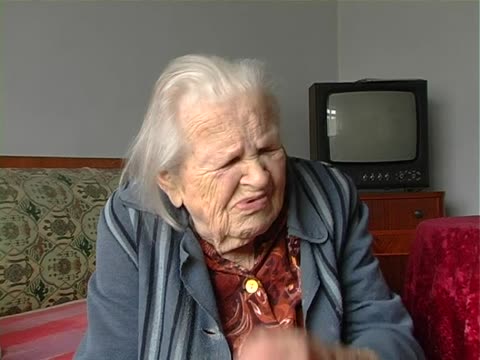
The research team enters the apartment
From the machine transcript
The interviewers enter the apartment and establish with Shames that she speaks Yiddish. Kerler gives the date as 25 May 2008 and the place as Khmil'nyk, and asks how the town name is said in Yiddish.
Personal introductions and family
From the machine transcript
Shames gives personal details: her name, her father Shlomo, who worked in a mill in Yanoshpol, and her homemaker mother Sarah (Sharkeh). She had one sister, Niusye. Kerler asks about the town and its Jews before the war. She cannot recall the name of a nearby town where her father also worked.
Adds the names of her parents and sister and her inability to name the nearby town.
Yanoshpil before the war
From the machine transcript
Shames answers brief questions about Yanoshpol: there was one synagogue in the small town, and her father was a miller. She says she had another sister who was killed.
Life today and family
From the machine transcript
Shames says only Yiddish was spoken at home. Her mother was Jewish, her sister was killed by the Germans, her father was also killed, and her mother later died. She did not know her grandparents and does not know where her father was born. His family had lived earlier in Lube (?) and moved to Yanoshpol when she was small.
Adds that her father too was killed, her lack of memory of her grandparents and the family's move from Lube (?).
Life before, during, and after the war
From the machine transcript
Shames speaks about the war years and after. She worked in a factory in evacuation and then came to Khmil'nyk, where her mother had survived the war. She worked as an accountant, did not attend a Yiddish school (she was taught at home at eight), then switched to Ukrainian. She tells how her father was killed and how her mother hid and survived, and cannot recall details.
Adds her mother's survival in hiding, and the Yiddish-to-Ukrainian language change.
Jewish life after the war in Khmil'nyk
From the machine transcript
Shames says that after the war there was still a synagogue and a shochet in Khmil'nyk and people prayed, but later that stopped and Jewish life faded. Few Jews remain today because many emigrated to Israel. Lemster asks about her memory of the Jewish holidays.
Celebrating Jewish holidays and Yanoshpil
From the machine transcript
Lemster asks about prewar holidays such as Passover and Purim in Yanoshpol. Shames says all Jewish holidays were observed and the synagogue was in use, but she gives few details, and says she cannot sing. Kerler asks whether the town's name has changed and whether there was a cheder, and she is unsure.
Adds the question of a possible renaming of the town and talk of the Jews leaving for Israel.
Family
From the machine transcript
Kerler notes that her sister Niusye was killed not far from the town. Shames explains that the sister was handed to someone who took money to hide her but gave her up, and she was killed.
Early childhood memories
From the machine transcript
Kerler asks about childhood friends and school. Shames says she attended a Ukrainian school and there was no Yiddish school. After finishing she stayed at home helping her mother. She recalls a teacher who taught her Hebrew as a child, and Kerler asks about Purim food.
Adds the teacher who taught her Hebrew and the question about Purim food.
Celebrating Jewish holidays and family
From the machine transcript
Shames remembers only buying matzo at Passover; she recalls no other holidays. She says her mother died long ago and she is alone. She mentions an aunt in America and a cousin who went to Israel.
Life today
From the machine transcript
Kerler praises her Yiddish. Shames says she is the only Jew left in her village or street and a Christian neighbour helps her. She describes her pension and her 20-odd years of service in a textile factory, where she worked in the laboratory and as accountant until it closed. She tells how she and her mother bought a house that was later taken and replaced by an apartment.
Adds her isolation as the sole Jew, her pension and loss of the house.
Food customs and religious customs
From the machine transcript
Kerler asks whether her mother made gefilte fish and whether she could read Yiddish books. She repeats that as a child she learned Hebrew from a teacher but forgot it. Questions about whether her mother taught her candle blessing and about the arrival of Soviet rule (1919 (?)) follow. She cannot recall details of her studies in a technical school elsewhere.
Adds the Sabbath candle question, the Hebrew teacher and her technical school.
Pogroms and religious customs
From the machine transcript
Kerler asks whether she heard about pogroms before Soviet rule. Shames says she remembers that Jews were killed. He then asks about the Tisha b'Av custom of throwing burrs at people's beards in the synagogue.
Adds the pogroms and Tisha b'Av burr custom.
Childhood memories and family
From the machine transcript
Shames says her father remained a miller until he was killed. Her parents went to the synagogue on holidays and took her; as a child she could read Hebrew but now knows nothing. Kerler asks whether non-Jews in Yanoshpol spoke Yiddish, and she says no. She remarks on the synagogue's fate under Soviet rule.
Adds the question about non-Jewish Yiddish speakers and her father's work until death.
Life after the war in Khmil’nyk
From the machine transcript
Kerler notes that Khmil'nyk was a spa town after the war and asks whether Jews came in summer. Shames says they did, but Jewish practice faded. She worked as an accountant in an office where Jews spoke Ukrainian or Russian. At home with her mother she spoke Yiddish.
Jewish weddings and Yiddish
From the machine transcript
Shames cannot name a town near Yanoshpol. Kerler asks about Jewish weddings, which she does not recall, since Soviet times had come. She says that at the synagogue she went with her mother. Yiddish was spoken before the war, but at work after the war Ukrainian. She says nobody is left to speak Yiddish, as few Jews remain.
Adds the language question and her view that few Jews remain to speak Yiddish.
Life in Yanoshpil and after the war in Khmil’nyk
From the machine transcript
Kerler asks about vodka and the word 'dybbuk', which she does not know. She recalls a holy site visited on yortsayt, with a rebbe before Soviet rule. Back in Khmil'nyk after the war she worked at a factory making boilers, in the laboratory and as accountant, before Kerler proposes a short Russian-to-Yiddish word test.
Adds the dybbuk question, the holy site and the rebbe.
Dialectology
From the machine transcript
Kerler and Lemster run a Russian-to-Yiddish vocabulary questionnaire with Shames. Items include greetings, animals (mouse), body parts, kinship, adjectives, the words for pious and honest, enemy, and the rich man. She often does not recall the word, and sometimes answers in Ukrainian or Russian-influenced forms. Sample sentences are translated and the interviewers thank her.
Concluding the interview and life after the war
From the machine transcript
Kerler invites Shames to tell something freely in Yiddish; she says she has nothing to tell and did not expect the visit. The interviewers explain they study the Yiddish language. She says she learned Yiddish as a child and speaks it now with nobody. She describes working for 23 years in a textile factory, where co-workers spoke Russian or Ukrainian because the boss was Christian. She recounts evacuation to the Urals, her parents being taken, her return to Khmil'nyk, where her mother had survived.
Adds her statement that she speaks Yiddish with no one now and the account of evacuation and return.
Concluding the interview with Rakhil Shlemovna Shames, nee Goldes (see MDV 420)
From the machine transcript
A woman (probably Shames, the interviewee of the previous tape) speaks to Kerler as the interview closes. She mentions a non-Jewish woman, a Russian or Ukrainian, and says something about hospitals. Kerler wishes her good health.
Research team enters Brukha Fayveshevna Gammer’s apartment
From the machine transcript
The team arrives at Gammer's apartment and sorts out the arrangements. Someone in Russian mentions another interview in the neighbouring room, and Lemster explains that the team speaks only Yiddish. There is brief talk about what language the household uses.
Shows a Russian-speaking woman discussing the room arrangement, and Lemster stating that the team speaks only Yiddish.
Personal introductions
From the machine transcript
Kerler states the date and purpose of the interview, and Gammer gives her name, born Goldis, with her father Fayvesh, and says she was born in Khmil'nyk in 1924 to Khmil'nyk-born parents. Her mother was Eni. Her father was born in 1893 and was a tailor; her mother worked as an employee (a shop cashier, it seems) and died shortly before the war. During the war the family lived in evacuation in Central Asia. A second woman gives her name as Genia, and the town is said to have had about twelve thousand Jews before the war.
Adds the interview's formal opening, the name Genia, the mother's work and death, and the evacuation.
Life in Khmil'nyk before the war
From the machine transcript
Gammer says Khmil'nyk had about twelve thousand Jews and was a Jewish town. Even the Ukrainians understood Yiddish, though they could not speak it well. She names three prayer houses (the tailors', the shoemakers' and the rich men's synagogue near the sanatorium) and recalls the wealthy Jews. She recalls her father as a poor tailor who sewed for villagers. Lemster then turns to her schooling.
Education and Yiddish literature
From the machine transcript
Gammer describes her schooling in the Khmil'nyk Jewish labor school. It taught in Yiddish up to the seventh grade and was then made a Russian school. She lists the subjects, a good Yiddish literature teacher, and the writers read, including Bergelson, Fefer, Markish and Peretz. She sent her Yiddish school books to a museum in Kyiv. She still reads Yiddish and subscribes to a Yiddish newspaper, and the interviewers discuss Yiddish periodicals with her and her daughter.
Adds the writers studied, the books sent to a Kyiv museum, and Yiddish periodicals read today.
Childhood memories
From the machine transcript
Gammer recalls a childhood among poor children, who did not play with the rich. She explains the geography of Khmil'nyk: the old town and the new town beyond the bridge, where the wealthy lived.
Yiddish poems
From the machine transcript
Kerler asks whether she remembers poems by Yiddish poets learned at school. She remembers a singing teacher but no Yiddish poetry, and no Ukrainian or Russian poems either. Talk returns to the Yiddish books she sent away and bought after the war. Lemster then raises Jewish holidays before the war.
Jewish life before the war and Yiddish songs
From the machine transcript
Gammer says the Jews kept the holidays before the war and that there were two or three ritual slaughterers in town. She notes the Soviet bans on religion and recalls a Yiddish theatre in Khmil'nyk, where traveling troupes also came. She mentions the actress Klara Young, and the theatre director's family being killed by the Germans. After the war there were only concerts with Yiddish songs and dances. Gammer says she herself does not know Yiddish songs.
Adds Yiddish theatre and concerts, the shoykhets, and Soviet restrictions.
Jewish weddings after the war
From the machine transcript
Gammer talks about a Jewish wedding in Khmil'nyk after the war. The bride was local and the groom from Chernivtsi, and the huppah was held in the park by the sanatorium. Klezmers came from Vinnytsia, and she attended five or six weddings. Lemster and Kerler ask about the wedding-cake custom and its name and about who led the wedding. Her answers are partly unclear.
Education and family
From the machine transcript
Gammer says she studied Yiddish for seven grades, reads it today, but cannot write by hand. She discusses her family. Her mother came from a rich family in Lithuania and knew prayers and Hebrew, and her grandfather Zalmen was a doctor. Her grandmother was Ite Beyle. Her paternal grandfather Shloyme was a poor tailor with six children. The matchmaking of her parents is explained by a Lithuanian typhus loss during the Petliura period. Her father, a young Komsomol member, worked for the Cheka and became a partisan.
Adds the Lithuanian grandfather Zalmen, the matchmaking, and the father's Komsomol and Cheka background.
Her father
From the machine transcript
Gammer recounts that her father was caught by Petliurists together with his brother and a cousin. He was thrown into the old bathhouse by the bridge and held in the mikveh to be drowned, but was dragged out. He survived and later lived as an invalid on a pension. Lemster asks whether he lived, and says he will look at a photograph later.
Adds that the father survived and later received an invalid's pension.
Showing photographs of Jewish partisans
From the machine transcript
Gammer and her daughter show family photographs. They identify her father's partisan relatives, including Tule (Naftule) Goldis, a brother of her grandfather, and a cousin. Kerler relates one man to the Petliurists.
Religious service before the war
From the machine transcript
Gammer recalls being taken to the synagogue by her mother. Wealthy women could not pray, so they gathered around her mother in the rich synagogue and repeated what she said. Kerler asks whether she learned Modeh ani. Her father did not attend services because he was a partisan and a Soviet man.
Food customs
From the machine transcript
Gammer answers Kerler's questions on food. Only kosher food was eaten, with animals taken to the shoykhet. She has not heard of Jews raising pigs to sell to non-Jews. The family kept no poultry in the yard. She says she is old and tired.
Her husband and life after the war
From the machine transcript
Gammer talks about her husband Bore Gammer, a first-group invalid who lost a leg in the war as a tank driver. His parents lived in Vinnytsia, and he studied there before going to a tank school in Kyiv. After the war he came to Khmil'nyk. She returned from evacuation in 1948 without parents and was taken in by her mother's friend.
Life after the war and today
From the machine transcript
Gammer says she worked 37 years in a bread shop and now lives on a pension. Her daughter is also an invalid. She spoke Yiddish with her husband at home, and her daughter Genia learned to read Yiddish from her father. She comments on Jews who left for Israel, Germany and America, and on the town's Jewish population: about twelve or thirteen thousand before the war and five or six thousand after.
Jewish life in Khmil'nyk before the war
From the machine transcript
Gammer talks about a rebbe in town before the war to whom boys went. Lemster and Kerler ask about visiting a good Jew (tsadik), whisperers or incantations (oyfshprekhn) and a dybbuk. She says she knows what such healing means but did not witness it.
Dialectology and life today
From the machine transcript
Gammer answers dialectological questions: the meanings of dybbuk, a clay golem and meshumed. She says she remembers little and cannot recall Yiddish proverbs. She notes that nowadays everyone speaks Ukrainian or Russian and that her old neighbor remembers Yiddish. Lemster praises her memory.
Adds the dybbuk, golem and meshumed vocabulary questions, absent from the label.
Food customs and holiday celebration
From the machine transcript
Gammer answers questions about prewar Sabbath and holiday food. She mentions challah, fish, noodle kugel, cholent and vinegar meat, and discusses terms for chopped fish and a jellied dish. She recalls Hanukkah latkes and children singing a Simchat Torah rhyme, which she repeats for Lemster to record. There are brief answers on Purim and a Passover memory of her grandfather, the dishes and the four questions, with goose fat for Passover. She says her mother died two weeks before the war, so she has no memories of her blessing the candles.
Adds the Hanukkah and Simchat Torah children's customs, Purim and Passover recollections, and the long list of food terms.