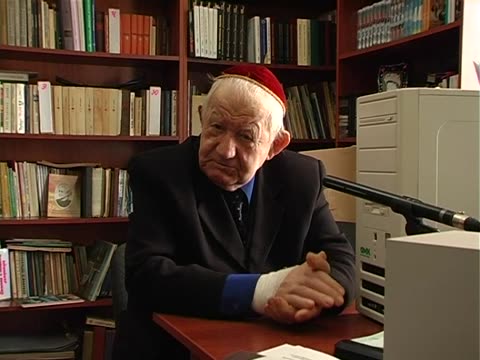
This tape begins with scenes of an unidentified town.
From the machine transcript
Opening stretch with Kerler speaking, partly in Russian and partly in Yiddish; the talk is fragmentary and the subject unclear in the transcript. The informant answers with a single word.
The camera then cuts to a formal interview with Semyon (Yisrul) Aronovich Vaisblai (b. 1930 in Chemerivtsi). He describes prewar Chemerivtsi and also talks about how there was a synagogue in his childhood home. Vaisblai also describes the Jewish kolkhoz that was found in the town.
From the machine transcript
Vaisblai talks about prewar Chemerivtsi. He says Chemerivtsi was in Bessarabia, then Ukraine, and gives its distance from Kam"yanets'-Podil's'kyy. His family was very poor, so a prayer room was kept in his father's house instead of sending him to cheder; poor rabbis came to pray there. He describes the Jewish kolkhoz, including women's field work led by a woman he calls a 'lankovoy' (?), and mentions an uncle who worked with the horses.
Adds the question of when Chemerivtsi was Bessarabian versus Ukrainian and the explanation of the term for the woman field-leader.
He talks about his family, including his grandparents, Biumen and Pesye-Rokhl, his parents, Avrum and Nunye, and his siblings, Gitl and Berish. He also comments on who worked on the kolkhoz and what particular duties he and some of his family members had there.
From the machine transcript
Vaisblai names his family at Kerler's request: his grandmother Pesye-Rokhl (a grandfather named Biumen (?)), his mother Nunye (?), his father Avrum, his sister Gitl and his brother Berish. He explains that his sister registered him with the patronymic Aronovich under Soviet rule. He then describes the Jewish kolkhoz in Chemerivtsi, where non-Jews were also taken on, and how he and his uncle took the horses out to pasture at night.
Adds the explanation of how he got the patronymic Aronovich and the kolkhoz's hiring of non-Jews.
Vaisblai’s father could not walk because of an injury, so he worked as a cap maker rather than on the kolkhoz. Vaisblai also speaks about the changes that occurred in his family after his mother died in 1937 and further describes life before the war in his hometown.
From the machine transcript
Vaisblai explains that his father did not work on the kolkhoz because of a leg injury and instead made and remade caps. His mother died in 1937 and was buried in Kam"yanets'-Podil's'kyy; the father cooked for the children and later remarried a woman who bore no children. He tells how his father was beaten by a Soviet militiaman and the man was later sentenced. The passage ends as the war begins and his father says they must evacuate.
Adds the story of the father's beating by a militiaman and the sister's death in Israel.
Vaisblai begins to relate his experiences during the war, explaining that when his family was sent to the ghetto in Kam”yanets’-Podil’s’kyy, he went there separately, fleeing around the region to bring food to his father. He eventually left the ghetto entirely and continued moving from town to town, assisted by many of the non-Jews he met, and encountering several other hidden or fleeing Jews along the way.
From the machine transcript
Vaisblai describes his wartime experiences as a boy of eleven. His family was taken to Kam"yanets'-Podil's'kyy, where his father, mother and grandparents are buried; he escaped on his father's urging and was held for a time by a German. He describes the old and new ghettos, bringing food to his father, the killing of children, and an uncle Zelik, a wealthy man. He then wandered among Dunaivtsi, Kupyn and other villages, hiding that he was a Jew and being helped by various non-Jews. Much of the passage is Russian or garbled.
Adds the attempted conversation about the old and new ghettos and the killings of Jews at Dunaivtsi, which the catalogue does not detail.
Vaisblai then entered the village of Demkovtsy, where the residents knew his grandmother. There he was taken in for two weeks by a non-Jewish woman, despite the fact that he was filthy and covered in lice.
From the machine transcript
Vaisblai arrives in the village of Demkovtsy, where a non-Jewish woman who knew his grandmother, a dealer in cloth before the war, takes him in. He was dirty and lice-ridden, and stayed in her house for two weeks. He then goes to religious villagers of a sect and answers Kerler's questions about which villages he passed through, in what order.
Adds Kerler's clarification of the route through the villages.
After that experience, Vaisblai stayed in the home of a couple, “pious people,” who “believed in Jesus, but not in Christ.” Professor Kerler suggests that these people may have been Old Believers. In the next set of towns, Vaisblai encountered other Jews in hiding, but eventually decided it was safer not to stay with them.
From the machine transcript
Vaisblai describes the pious villagers who took him in, and Kerler asks about the sect. Kerler asks for clarification of what the term for them means. A village official sends him on to Chertkiv, and he arrives at a settlement near Demkovtsy where there are Jews in hiding. He mentions a non-Jew punished for hiding Jews, and says that when other Jews were caught he decided it was safer to leave them and go on alone, speaking Yiddish only with difficulty.
Adds the story of a non-Jew beaten and sent to Chemerivtsi for hiding Jews.
Vaisblai continued fleeing from village to village, staying with different sorts of people, all of whom were non-Jews. He eventually reached a kolkhoz, where, having adopted the name Vasil’ Ivanovich, he was able to stay with the help of a non-Jewish woman who pretended he was her nephew. Vaisblai left the kolkhoz in 1945 only after victory was declared as he was afraid of exposing his true Jewish identity.
From the machine transcript
Vaisblai continues from village to village. He is taken in under the name Vasil' Ivanovich by a childless couple, and later by a woman named Maniya, who presents him as her nephew from Poltava. He herds cattle and horses at a kolkhoz, hiding that he is a Jew, and stays until the Germans are driven out in 1945 because the villagers frighten him. Kerler asks about places such as Zavadyntsy and Futori and about local words.
Adds the details of the false Poltava origin and the herding work.
In the immediate postwar period, Vaisblai returned to Chemerivtsi, where his neighbors returned to him his father’s pillows and allowed him to live in his grandmother’s old house. He then describes his life in subsequent years, focusing on his family and their various occupations.
From the machine transcript
After the war Vaisblai returns to Chemerivtsi and gets back two pillows left with a neighbour; he lives in his grandmother's old house. He says the family had no gold and was poor. He discusses his later life, including his sister (or aunt, as Kerler's questions clarify), who studied and a brother who taught at a university, and another brother who studied engineering. Kerler asks about the word for a woman who leads a field party.
Adds the later careers of the relatives and the discussion of the term for the field-party leader.
This tape is a continuation of a formal interview with Semyon (Yisrul) Aronovich Vaisblai (b. 1930 in Chemerivtsi). He discusses his family life, work and education in the postwar period and shares his views on Jewish emigration to Germany.
From the machine transcript
Vaisblai talks about helping an aunt, his father's sister, and her daughter. The daughter now lives in Germany with her husband and family and is content there. He explains why he himself did not want to emigrate to Germany: he does not know German, and he has a German pension and a good life where he is. His first wife died some years ago and his present wife comes from Uman'; she understands Yiddish.
Also covers the relatives who emigrated to Germany, his reasons for staying, and his present wife from Uman'.
He sings “Tsen kopeks” (“Ten Kopeks”) and then recites the words again for clarity. He states that he learned this song and others from demobilized Jewish soldiers after the war.
From the machine transcript
Vaisblai sings a Yiddish song about ten kopeks, and Kerler has him repeat it line by line so the words can be understood. He then explains in Russian and Yiddish that he learned such songs from Jewish officers who came back from the front. He says he did not understand them at the time but learned them anyway. He adds that no one in Khmel'nyts'kyy is left who could tell these things.
Vaisblai briefly talks about the four grades he completed in a Soviet Yiddish school. He also comments on the state of the contemporary Jewish community and the Yiddish language in Khmel'nyts'kyy. He considers himself a unique interviewee because he remembers so much so clearly and was old enough to understand what was going on during the war.
From the machine transcript
Vaisblai says he is a unique informant because he was old enough to see and remember everything during the war. He mentions Hungarians and Romanians in the Vinnytsia region. Kerler asks whether anyone else has interviewed him; he says yes, in Russian, and that this is the first video recording.
Also covers earlier interviews done in Russian and this being his first video interview.
He sings “Rebe Reb Shneyer” (“Rebbe Reb Shneyer”), recalling that he learned many Yiddish songs from Jewish soldiers and from his older sister. He then talks about his sister’s life, the hardships she faced, and about her children in Israel and the US.
From the machine transcript
Vaisblai sings a song about a rabbi and a ritual-purity episode, and says he learned such songs from Jewish soldiers. He also learned them from his older sister, who was a secretary. He then describes her two marriages, the second to a blind man, and her children, two sons in Israel and daughters in America. One of the daughters is ill and another works as a hairdresser. Kerler then asks when he came to Proskurov (Khmel'nyts'kyy).
The sister's life is described in detail, including her two marriages and children abroad.
Vaisblai came to Khmel'nyts'kyy in 1977. Before that, he lived in the town of Horodok where, he explains, there were many Jews after the war. Vaisblai then describes postwar Jewish life in this town and the postwar period in the Soviet Union in general, focusing specifically on the housing troubles with which he dealt.
From the machine transcript
Vaisblai says he came to Khmel'nyts'kyy in 1977 after living in Horodok from 1945. He says there were more Jews in Horodok than in Chemerivtsi after the war, and recalls praying at his father's house in Chemerivtsi. He tells long stories about a miserly man named Khaim Bronshtein and a thief named Yozye Stoharski. Kerler then asks about his sister Gitl's songs, and Vaisblai sings a short rhyme.
Includes the stories of Khaim the miser and the thief, and his sister Gitl's songs, which the catalogue does not mention.
Vaisblai recites fragments from a few songs, including “Sapozhkelekh” (“Little Boots”) and sings several songs, including: “Nokhemke mayn zin” (“Nokhemke My Son”), “Oy iz dus a Rebenyu” (“Oh is that a Rabbi”) and “Vi azoy s’iz nisht git tsi geyn zibn vokhn in eyn hemd” (“How Bad It Is to Go On Wearing the Same Shirt for Seven Weeks in a Row”). He mentions that the last song was often sung by his friend Avrom, a man who did not drink liquor, but rather eau de cologne.
From the machine transcript
Vaisblai recites and sings several Yiddish songs: a song about Nokhemke and his son, a hasidic rebbe song, and the comic song about seven weeks in one shirt. He says the last was often sung by his friend Avrom, a tailor who drank eau de cologne rather than liquor. Kerler asks him to continue between songs.
Vaisblai sings “Fraytik af der nakht” (“Friday Evening”) and shares his attitudes towards the decline of Yiddish and about the State of Israel.
From the machine transcript
At Kerler's request, Vaisblai sings a Sabbath-eve song slowly so the words can be heard, and Kerler asks him to repeat another song. He says he copied songs into a notebook and that rabbis used to enjoy his singing. He says Yiddish is dying because no one knows it, and talks about Israel, its president and Shimon Peres as an artist, and what he sees of Israel on television.
Adds his remarks on Israel, its president and television coverage.
Vaisblai sings “Vi azoy s’iz nisht git tsi geyn zibn vokhn in eyn hemd” once more and then sings “Makhteyneste Mayne” (“My In-Law”).
From the machine transcript
Vaisblai sings the song about leaving home at six o'clock with a headache again, this time more slowly. He then sings a song in which a man takes leave of his in-laws and entrusts his daughter to them. Afterwards he speaks about his health and a recent illness of two weeks earlier, when he was taken to hospital.
After briefly discussing his contemporary health problems, Vaisblai shares his work history in the postwar period, consisting of many different jobs in several towns. He also explains how he met and married his first wife Fania, and how they had a wedding with klezmer musicians.
From the machine transcript
Kerler asks what work he did in Horodok after the war, and Vaisblai tells a long story of poverty and many jobs: porter, trading in spirits from Chernivtsi, shop and warehouse work, work in a village (Zakupne), and in a store. He describes the risk of shortages and prosecution, and a clerk whose boss helped him. He also tells how he met Fania, an orphan from Zin'kov, and how Jews collected money for a wedding with klezmer musicians from Donetsk (?).
Gives the work history in much detail, with stories of shortages and fraud charges, and tells how he met his first wife.
Vaisblai describes his home life in the postwar period and talks about his children now living in Israel and Germany.
From the machine transcript
Vaisblai describes his postwar working life as a storekeeper and restaurant worker, and a job buying plums. He also tells of running into trouble with the militia and of building a house in Horodok. He then explains that he moved to Khmel'nyts'kyy and worked as a restaurant director. He says he spoke Yiddish with his wife throughout. The wife came from Zin'kov (the transcript is unclear). His children live in Israel and Germany. Much of this part is in Russian.
Adds the story of building a house in Horodok and the move to Khmel'nyts'kyy; the transcript does not clearly show how the children's countries are divided.
Vaisblai underscores his faith in G-d, who has saved him from “many deaths and dangers.”
From the machine transcript
Vaisblai says he believes God has saved him from many deaths. He refers to being taken to hospital when close to death and to recovering.
Vaisblai states that the best years of his life are in the present.
From the machine transcript
Asked about the best years of his life, Vaisblai says they are the present. He recalls always having been afraid, and reflects on wealth and inheritance. Kerler thanks him for the interview and praises his Yiddish.