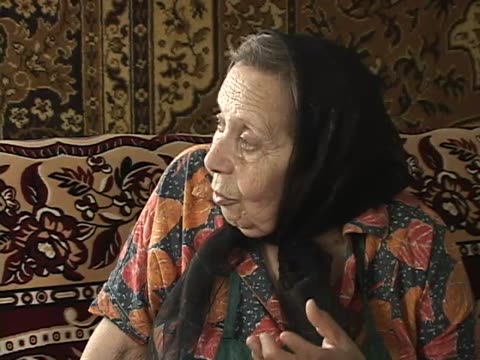
A brief exchange about school and teachers. The interviewer asks who taught the subjects in Yiddish, and she recalls Yiddish teachers, including a director and his wife who were not local. She cannot now remember the director's name.
The transcript shows talk about Yiddish-language teachers, not food customs.
She speaks about school discipline and the Sabbath, and recalls a non-Jewish woman who did work for the family on the Sabbath. She says her mother wrote letters in Yiddish to a brother and sister in America. The interviewers then ask about the words dybbuk, golem, kisl and others, and about words for a dove or pigeon.
The transcript shows questionnaire word items, including 'dybbuk' and 'golem', in addition to the literature catalogued; no journals are mentioned.
Elicitation of Yiddish words: build, hill (?), cross, kasha, 'higher', nudnik, room. She mentions her brother's children in Brooklyn. She complains that she has no one left to speak Yiddish with.
The transcript shows vocabulary questions and relatives in Brooklyn, not an account of a grandfather's Passover.
Questionnaire items continue: the word for a shed or barn, window glass, mouse, thanks, the greetings for morning and evening, breathing, and being ill. She says she grew up in a Yiddish-speaking home, and Lemster praises her Yiddish and memory.
The transcript shows only questionnaire work; there is no sign of the interview ending or of outside footage.
Questions about the words for 'ill' and 'sleepy' and the difference between them. She says that prompting is not allowed in school. The passage is partly in Russian.
The transcript shows no conversation with an unidentified man and no entering of a van.
Elicitation of vocabulary and short sentences: 'he likes it', 'where he goes', 'he ran away from the Germans', and words for honest, pious and religious. Also words for ladder and for a Jew who converts, where she says she is unsure. Much of it is interleaved with Russian.
The transcript shows questionnaire work, not travel to the cemetery.
Continued questionnaire work on words for a bad person or apostate, a non-Jew and a Christian, headache, church or monastery and peasant. Talk of a kolkhoz with Jewish members and pronunciation variants such as boymele, followed by sentences on dates, 'you are right', paying for a night's lodging, crying, and the word for grandmother. It ends with a question about charms or spells against illness in her town.
The transcript shows Yiddish questionnaire work; no arrival at a cemetery is evident.
A short answer to a question about charms. She says she knows one that she was taught, and Kerler and Lemster ask how people used to say such incantations.
The transcript shows a question about incantations, not town footage.
She recites or tells a short humorous story about three women sitting on one stone. Questions follow on words and usage about heating irons with coals, the word for 'tasty', and the idiom 'it doesn't go into my head'.
The transcript shows a short anecdote and household-word questions, not an arrival at a ghetto site.
Sentences to translate: 'I walk on the street', 'I live on the street', and the word for a street. She mentions that only Jews lived on the street. Lemster and Kerler joke about someone from Brooklyn and America.
The transcript shows sentence elicitation, not an introduction of Vainshelboim.
Elicitation on sentences about poor eyesight and sleep, then the words for a well, a potato (kartoshke, bulbe, kartofl) and a shop. Pronoun forms ('you', 'your') are also asked.
The transcript shows vocabulary elicitation; no formal introduction is evident.
Further sentences: the phrase 'a year on my enemies', the word for 'enemy', and the difference between 'everyone' and 'each one'. The informant gives a number-of-people example.
The transcript shows questionnaire items, not family talk.
Questions on 'one and a half', 'another story' and sentences about sitting at the table with her father. Much of the passage is in Russian, including a remark about being photographed.
The transcript shows questionnaire items, not school education.
Elicitation of words about Hanukkah and the dreydl, 'rich men' (gvirim), the plural 'tables', and pronunciation of 'then', 'on the road' and 'wagons'. Questions about 'whose child' follow, with some Russian asides. No narrative about Ostroh is evident.
The transcript shows questionnaire items on Hanukkah and plurals; no childhood memories of Ostroh are evident.
Questions on plurals and forms ('we will go together'), the word 'mistama', and words for ceiling, floor, bridge, boards, fence and face. Also verb forms such as 'to overlook'.
The transcript shows household and grammatical elicitation, not family talk.
Elicitation of 'a lot of', 'to come back' (tsurik versus kerik), 'came back from the war', 'perhaps' and 'suddenly', with questions about how her mother would have said them.
The transcript shows questions about word forms; religious school is not discussed.
Last questionnaire items on pronunciation variants such as 'various'. The interviewers then say they are looking for a wooden synagogue, and the informant speaks about wooden buildings and a wooden shul. Her Yiddish is praised, and she says that English-speaking Jews would be different.
The transcript shows elicitation and talk of a wooden shul, not acquaintances or party organization.