0:00
Greeting and setting up interview.
The team greets the household on arrival. Lemster and Kerler make small talk with Vainshelboim about an earlier visit some years ago and about a bottle of drink they did not bring this time.

Greeting and setting up interview.
The team greets the household on arrival. Lemster and Kerler make small talk with Vainshelboim about an earlier visit some years ago and about a bottle of drink they did not bring this time.
Personal introduction.
Vainshelboim gives personal details: his Yiddish name Yitskhok Tsvi, son of Menakhem-Mendl, and his passport name Isaak Grigorievich. He was born in 1918, and the interviewers wish him long life. He lived in Ostroh until the war.
Life before the war.
Vainshelboim recalls that the Soviets arrived in 1939 and he was taken into the army. He describes Ostroh before the war as an entirely Jewish town with many synagogues. The great synagogue still stands, and he tries to recall the Hebrew inscription in gold letters over its entrance, without success.
adds the army service and the inscription over the synagogue entrance
Education.
Vainshelboim speaks about his schooling: eight classes in a Polish school and about two and a half years at the Ostroh yeshiva. He mentions five teachers and Polish and mathematics, and that he studied Gemara tractates such as Bava Kama and Bava Metzia. He no longer prays regularly. His father's name is Mendl, and he was born in Ostroh.
adds the Polish school and the yeshiva subjects
Family.
Vainshelboim talks about his family. His father was a tinsmith and his mother, Zlate, a housewife; both were born in Ostroh. They had four children, two boys and two girls, and he was the youngest. He mentions sisters including Zisl, and a brother David; the birth years are unclear. He says he did not work.
Religious life in Ostroh.
Kerler asks about pride in the great synagogue of Ostroh; Vainshelboim speaks of an old cannonball that still hangs in the wall. They discuss how a circumcision was held, with prayers, the rabbi and the mohel. He says Ostroh had one yeshiva and at least fifteen small synagogues, including a butchers' prayer room inside the great synagogue.
Holiday celebration and poverty.
Vainshelboim talks about Purim and Hanukkah in prewar Ostroh. He describes a Purim play, masks made from watermelons, singing, and a masked ball at the house of a rich man; he compares the poverty of those days with the prosperity of today. A woman in the room, possibly his wife, briefly interrupts in Russian or Ukrainian. At the end he says that Yiddish was spoken at home and his father prayed.
adds poverty then and now, the masks and singing, and the remarks about a woman in the room
Sabbath celebration.
Vainshelboim recalls Sabbath observance at home: his mother gave no food unless he had prayed, and she blessed the candles on Friday night. He contrasts observant Sabbaths and festivals then with today. Kerler then starts a dialectological question about what was thrown into people's beards on Tisha b'Av and a phrase for a headache.
adds the start of the questionnaire at the end
Dialectology and family.
Kerler puts a few dialect questions, including expressions for a headache and a short sentence with the word for 'as soon as'. Vainshelboim then says he has family in Israel, and that he married in 1946 (?) a woman from Slavuta whose parents were killed there. He ends by saying a pit with sixty people was found in Ostroh.
adds the questionnaire items, relatives in Israel and the 1946 marriage
Mass burial site.
Vainshelboim describes the recently discovered mass grave of about sixty Jewish victims near Ostroh. A man buying a plot on the road out of town to build a house began digging and found a pit 26 metres long and 6 metres wide. The dead had Polish documents and are to be reburied in the Jewish cemetery. Kerler and Vainshelboim discuss informing the rabbi and a memorial along the road.
adds the details of the discovery, the measurements, reburial and the question of informing the rabbi
Dialectology.
A long dialectological questionnaire in which Kerler asks for Yiddish words and Vainshelboim replies. The items cover greetings and times of day, animals, body parts and illnesses, colours, house and farm words, a window pane, a stove (?), a wall, stative verbs, belief, religion, apostasy and a peasant, the bed, vodka, potatoes, kinship terms, the midwife (kushertke) and the village healer Menye, and a few sentences to translate. It is interrupted by Russian asides and by his story of an American rabbi with ten sons.
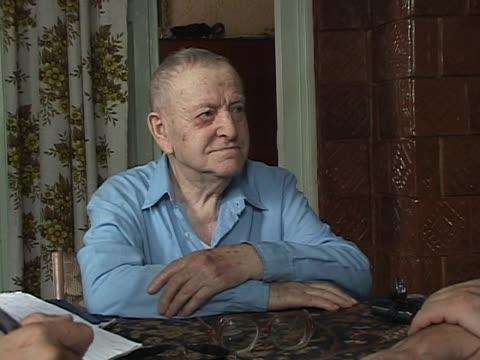
Prewar Jewish Ostroh and concluding interview.
Vainshelboim talks about Ostroh before the war: a beautiful town where the shops were all Jewish and where non-Jews who grew up playing with Jewish children also spoke Yiddish. In a Russian stretch he recalls his two-storey wooden house, dismantled and carried off after the war, and then his work for 44 years at a warehouse in Slavuta. He recalls a clever, helpful rabbi whose name is unclear in the transcript. Kerler thanks him and says the team must move on to Zaslav and Zhytomyr.
adds the Yiddish-speaking non-Jews, his workplace in Slavuta and the rabbi he remembers
Items of the dialect questionnaire asked here; each link plays the moment.