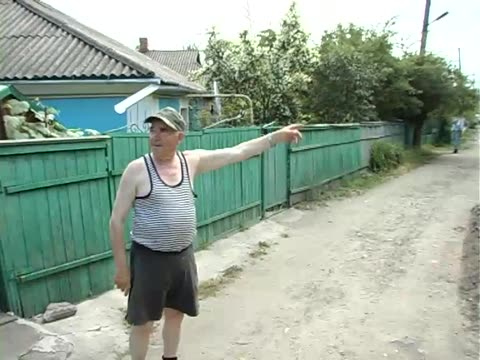
Aleksandr briefly speaks about the community, before the team greets Pesia Kolodenker, born 1927 in Tulchyn, as well as Yenta's son. They then walk to Yenta's, nee Tolkovitz, home, born 1927 in Tulchyn.
From the machine transcript
Greetings continue as more of the group arrive. Someone mentions Hebrew and living in Israel for some years, and Kerler explains that the team members come from various places, including America. Much of the passage is garbled and includes a recogniser loop.
Shows talk of Hebrew and a stay in Israel; little of the community talk or the walk to Yenta's home is recoverable.
The team greets Yenta who speaks about her husband Lev Kolodenker, including his work (see MDV 728,729). She raised two sons one of whom lives in Canada.
From the machine transcript
An elderly woman talks about her late husband. He was a hard worker at the factory, so that three people were hired to replace him when he retired, and he was spoken of on the radio. She describes his last illness, and her son from Canada coming to visit. Kerler asks about the son in Canada and about Israel, and says he himself lived in Canada while another woman lives in America. The passage ends with a check of the date and the husband's age.
Gives the husband's work and illness and Kerler's remark about having lived in Canada.
The formal part of the interview begins. Yenta speaks about her family, particularly her husband's military awards. He served in the Red Army for seven years. Yenta then speaks about Nisen's fate during World War II, when he was imprisoned in the Tomashpil ghetto.
From the machine transcript
A woman speaks of a man's seven years of service with many medals. After his death he was buried next to his mother, in a place that was kept for him. She then tells of Tomashpil, where his mother was killed and he found her among the dead by her bag. Kerler asks whether this is her husband. Who is meant at each point is not fully clear in the transcript.
Adds the burial beside his mother and his mother's killing in Tomashpil.