0:00
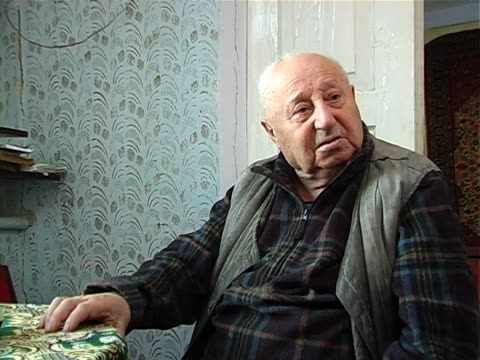
Interview with Nisen Ovshiyevich Yurkovetskij
Yurkovetskij answers questions about his life, mostly in a loosely ordered conversation. He says he trained as a driver in Bratslav in 1937 and drove for decades. During the war he drove in Poland and Finland and served in Odessa; he was wounded in the leg, sent home, and later spent a year in the Pechera camp. He drove a general through Budapest, Prague, Vienna and Berlin, and describes the hunger in Budapest and a general's profiteering. He describes the 1919 pogrom in Tul'chyn, in which his father (a hatmaker), mother and grandfather were killed by a bandit band, and how his grandmother raised him and his brothers in poverty, with a Polish priest involved in his rescue. A brother died in the war, and his sons now live in America. He also names the Jewish streets of Tul'chyn and gives the Jewish population as over ten thousand. He talks about Stalin, Trotsky and Lenin, his school, an old synagogue, Poland and Finland in 1939–40, being wounded in Odessa when the war began, the ghetto in Bershad', and the visitors' own homes.
Beyond the catalogue's summary, the transcript has long stretches on Budapest and the general he drove, the Jewish streets of Tul'chyn, Stalin and Trotsky, and the final talk about the visitors' homes.