0:00
[undescribed content]
Kerler and others discuss the team's upcoming route and travel plans, mentioning Mukachevo (?), Bukovina and Transcarpathia. This is talk among the interviewers rather than an interview.

[undescribed content]
Kerler and others discuss the team's upcoming route and travel plans, mentioning Mukachevo (?), Bukovina and Transcarpathia. This is talk among the interviewers rather than an interview.
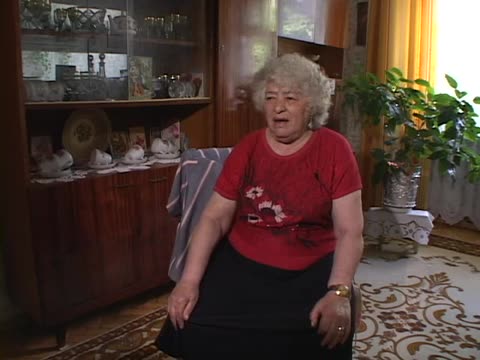
Entering Barshteyn’s apartment. Jewish life today and family
Barshteyn talks about her family today: one son in Vinnytsya and two grandchildren. She says Sabbath services are not currently held in the synagogue because of repairs, so Jews gather on Friday, and older people are afraid to go out at night. She remarks on the amount of antisemitism today, and Kerler then states the date and place of the recording.
adds her son and grandchildren, and the present-day antisemitism she mentions
Introduction and life today
Barshteyn gives personal information: her Yiddish name, her birth in Sharhorod in April 1928, and her residence there before and during the German occupation. Her parents are buried in Sharhorod; she mentions two sisters, one of whom lived in Israel, and says she herself has been to Israel twice.
House
Family
Barshteyn gives her father's name as Kalmen, and says her mother was also from Sharhorod. She talks about her father's livelihood, about her mother, who was raised as an orphan by grandparents, and about the naming after a grandfather, Yasl (?), whose Yiddish name she cannot recall.
adds the maternal grandparents' upbringing of her mother and the naming after a grandfather
Early childhood memories
Barshteyn recalls her childhood in Sharhorod: a small one-room home, three daughters, and a father who worked alone. The family was not rich but never went hungry. She briefly mentions her late husband and offers to show a photograph later, and Kerler asks about her mother's housekeeping.
adds the poverty of the household and her husband's death
Jewish holidays and food customs
Barshteyn describes how her mother baked challah and bread in an oven at home and kept the Sabbath as required. A stretch of apparent laughter and joking follows.
Jewish life before war in Sharhorod
Barshteyn describes Jewish life in prewar Sharhorod: the many synagogues, the great synagogue that still stands, and the Romanian Jews who prayed there during the occupation. She recalls Passover at home, her six years at a Yiddish school, kosher meat and the shoykhet, and the two tsadikim's graves that the Jews refused to have moved.
Life today and Jewish sites
Barshteyn continues about the tsadikim's graves and visits to them, including Jews who went to Israel and came back. She says she travels once a year to her parents' graves, and gives the dates of her father's and mother's deaths.
adds her annual visits to her parents' graves
Barshteyn goes to the door
Barshteyn goes to the door and speaks in Russian with a young man, Serezha (?), apparently about money he owes or has been given. Interviewers and the other person speak briefly; the transcript is poor.
Life today
Barshteyn recounts that a young non-Jewish man came to her the previous day, a stranger asking for help, and that she gave him money. Kerler comments.
Synagogue and prayer house in Sharhorod before and during the war
Barshteyn describes the great synagogue of Sharhorod and her mother's story that a wall was found in the earth when it was built. She recounts how the Soviets took it over for a factory, and how, during the Romanian occupation, deported Jews were forced into the synagogue and beit midrash and many froze to death in the winter; the bodies were thrown into a pit. She also mentions a German unit's short stay and a German who worked in the mill.
adds her mother's account of the wall found in the ground and the oil-press story
The German Julius
Barshteyn talks about a German named Julius who worked in the mill as an engineer before the war and was friendly to Jews. During a roundup he intervened and no one was killed; he wore a German uniform but harmed no one. She does not know his surname.
Non-Jews in Sharhorod
Barshteyn answers Kerler's question about non-Jews who spoke Yiddish. Old gentiles in Sharhorod spoke it better than she does, from friendships with Jews and from attending the same school.
Yiddish literature and Jewish school
Barshteyn says that she read Yiddish books and that her school, with Jewish teachers and a Jewish director, taught everything in Yiddish. Kerler asks about a typical school day and poems, and she says she knows many Yiddish songs and offers to sing one.
Religious customs in her family
Kerler asks about religious practice in her family. Barshteyn was not taught a morning prayer, and she recalls some blessing fragments. There were no cheders in her time, though her father told of attending one; he prayed in the synagogue with tallit and tefillin and went to a synagogue of the Levites.
Synagogue for the Levites
Barshteyn describes the synagogue for Levites in Sharhorod: the shames lived on the ground floor, a cantor and a kohen were present, and the women prayed in a separate room, hearing through a window, with women's prayer readers. She says the synagogues were closed by the state after the war, in the 1950s, and that praying and Yiddish were forbidden.
adds the description of the women's section, and the Soviet closing of synagogues
Life after the war in Sharhorod
Kerler remarks that Yiddish was spoken in Sharhorod almost until the 1990s. Barshteyn says she spoke Yiddish with her parents, but now speaks Russian with her children and everyone else.
Moving to Vinnytsya in 1983 and life today
Barshteyn recounts working twenty years as a telephone operator at the post office, then retiring and moving to Vinnytsya with her widowed father, after her mother's death, to be near her son. She speaks of visiting her parents' graves at Sharhorod, where there is no one to say Kaddish, since her son knows Yiddish but does not speak it. She describes the gravestones she had put up for her mother and father.
adds her work as a telephone operator and the gravestones she had made for her parents
Yiddish songs
Asked about songs her mother sang, Barshteyn sings several Yiddish songs, including Tumbalalayka and a Zionist-style song, and a humorous song about a rabbi who rules on a kosher question. She also sings a song about a teacher teaching the alphabet to small children. Kerler asks about the origin of the songs and about other songs, and she says she has no memory of some he names.
Life today and footage of Barshteyn’s apartment
Kerler and Barshteyn discuss a possible return trip to Sharhorod the following year, with the team and with her son driving, to say Kaddish at the graves. Barshteyn thanks the team, and Kerler mentions that they are going next to Moldova and Romania.
adds the planned visit to Sharhorod with the team
Van footage