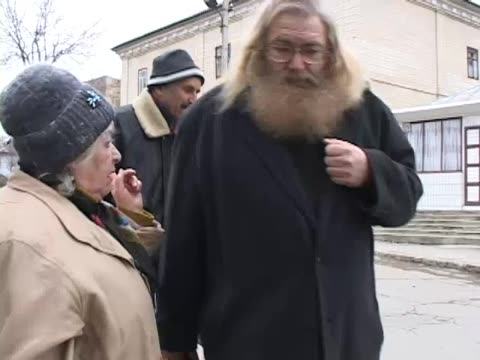
Shabbat celebration
From the machine transcript
Barshteyn answers Lemster's questions about Sabbath in her parents' home. She describes her mother lighting candles on Friday evening and praying for the health of her children and grandchildren. She lists Sabbath foods such as soup with noodles, meat and kugel, and discusses whether cholent was made, recalling that her grandmother in Sharhorod made it in the oven. Lemster ends by asking about Yom Kippur kapores.
Holiday celebrations and town footage
From the machine transcript
Barshteyn speaks about the Yom Kippur kapores custom, in which women used a rooster or money, and about the old shoykhet. Her mother performed it. Katz and Kerler pursue the details, and the talk is interrupted by traffic and logistics in Russian. She also mentions a roundup in which people were seized on the street and taken to a monastery. Katz closes by asking when the synagogue was built.
Beyond holiday celebrations, a mention of a roundup of people taken to a monastery, and talk about local places in Yiddish and Russian.
Religious buildings
From the machine transcript
Barshteyn tells how the synagogue was built from an ancient wall found in the ground, many years or even thousands of years ago, according to her telling. She describes the large building, visiting cantors, and its size (some hundreds of worshippers). She says that during the occupation only Bukovinian Jews prayed there. She recalls the beautiful beis medresh, which was crowded with Romanian Jewish refugees, and says many died of disease. Kerler and Katz press her on dates; the passage ends with Russian talk about going to a café.
Adds the wartime refugee use of the beis medresh (Bukovinian and Romanian Jews) and the founding legend of the wall.
Encounter with Yiddish-speaking non-Jew Matteu
From the machine transcript
The team meets a Ukrainian man, Matsey (also called Volodya, surname Pidpaliuk (?)), who is about seventy and speaks Yiddish. He says he lived all his life on a Jewish street and worked with Jews. Asked by Kerler and Lemster, he points out the old shoykhet's house, recalls Jews hiding in a cellar during the war, and mentions playing with Jewish children. He talks about his five children, Soviet life and politicians, the Jews he worked with, and whether life was better with Jews.
Names the man and his background, and adds the wartime hiding in a cellar, his children, and Soviet-era talk.
Yiddish song and lore
From the machine transcript
At the interviewers' request, the man recites Yiddish rhymes and a song about a mother arranging a marriage, set in the attic, with the refrain that there is no money and no good looks. Kerler and Lemster explain that they are recording for a university and studying Yiddish, and they ask him to repeat it several times. They also ask in Russian about payment and about other songs.
The passage is mainly a song, and the interviewers explain the purpose of the recording.
Personal information
From the machine transcript
Lemster asks the man about his father's name and what he worked at. He answers in Russian that he was formerly called a speculator and is now called a businessman. He recalls a Jewish militiaman named Berman (?) who helped someone wrongly accused. Kerler then asks whether he attended Jewish weddings.
Jewish weddings and friends
From the machine transcript
The man describes Jewish weddings as lively and cheerful and says that Moldovan musicians played. He danced with Jews and had a Jewish friend (a name close to Yasha Moldovan (?)). Answering Lemster and Katz, he also recalls in Russian a Jewish schoolmate, Klara Minakur (?), and a friend who left.
Adds the musicians' origin, his Jewish friends, and a schoolmate.
Life today and Yiddish song
From the machine transcript
The man says in Russian that friends call him though he has no phone. He tells how he slaughtered chickens, lambs and calves for Jews and says he kept five hens and a rooster. He describes Jews bringing him matzo and recalls Yiddish names of meats, and he repeats a Yiddish saying about a Jew with a Jewish soul. Lemster and Kerler keep asking for a song and for Yiddish words; a recogniser loop mars part of the passage.
Adds his own slaughtering for Jews, his poultry, matzo brought by Jews, and the request for a farewell song.
Conversation in Russian about his life during Soviet period and today
From the machine transcript
Mostly in Russian, the man tells how in Kazakhstan around 1955 he worked on a construction site, and a Jewish foreman asked in Yiddish whether he was a Jew. He answered that he was a Ukrainian who had grown up among Jews, and the Yiddish helped him. He tells a joke about Khaim at customs. Lemster and Kerler praise his Yiddish and ask for a proverb, a curse or an anecdote; he offers curses such as going into the ground and a black year.
Concluding the interview and Jewish food customs
From the machine transcript
Lemster asks the man whether he cooks Jewish dishes. He says he can make roast and fish, describing how gefilte fish is stuffed and what goes into the filling. He also names potato pancakes, with Lemster and Kerler supplying the Yiddish terms. The interviewers thank him and say farewell with good wishes.
Adds the food discussion and the closing farewell.
Town footage and synagogue
From the machine transcript
Brief exchange in which Lemster and Kerler ask about a place with music and a temple, apparently the synagogue and its past, with some years mentioned. The passage is largely unclear, and a Russian remark about an old cemetery follows.
Barshteyn shows Jewish cemetery
From the machine transcript
At the old cemetery, Barshteyn explains that part of it was cleared for a road in Soviet times. Her mother helped gather the bones, and the gravestones of two tsadikim were left standing. She tells of the tsadikim's legendary powers and of Jews who emigrated to Israel having the graves repaired. Katz and Kerler try to read the Hebrew inscription (Naftali Hertz) and work out dates. She then takes them to her mother Brayne's grave and says a few words there.
Adds the Soviet-era road clearing, the legends of the two tsadikim, the reading of inscriptions, and the visit to her mother's grave.
Barshteyn explains how the community takes care of the Sharhorod cemetery. She then points out her graves of her relatives. The camera then records footage of the old Jewish cemetery.
From the machine transcript
At the Sharhorod Jewish cemetery, Barshteyn explains that a man is paid to look after the graves. She points out her father's grave and says he was a kolkhoz bookkeeper. She wants the team to photograph a notable sculpted monument and talks about other tombstones.
Gives her father's occupation and the name on the family grave.
Barshteyn explains graves of various locals, as well as distant relatives. She then points out the place to wash the dead prior to burial ("toytshtibl").
From the machine transcript
Barshteyn reads inscriptions on graves of local people and of a cousin of hers, and comments on the rich families buried there. She and Kerler then identify the building where the dead were prepared for burial and discuss how it was used.
Names the graves she reads out, and discusses the purification house and the custom for the dead.
Barshteyn addresses Jewish life during World War II. She remembers Romanian Jewish refugees, especially Dr. Taykh.
From the machine transcript
Barshteyn recalls a Romanian Jewish refugee doctor named Taykh (?) who came during the war. After he died, his body was placed in a metal box and taken to Romania. She also complains that her family paid money and got nothing for it.
Barshteyn and the team return to the van and she sings well-known Yiddish songs during the journey (Lomir zikh iberbetn; Makhteyniste mayne).
From the machine transcript
In the van, Barshteyn sings 'Lomir zikh iberbetn' and then a song about a mother-in-law and daughter-in-law, and ends with a short Hebrew-flavored song about Jerusalem and Eretz Yisrael. Kerler and Lemster applaud and comment, and Kerler asks her to sing 'Rebbe reb Shneyer'.
Includes a third song about Jerusalem and Eretz Yisrael.
Barshteyn sings the Yiddish song "Rebbe reb Shneyer."
From the machine transcript
Barshteyn sings the Yiddish comic song 'Rebbe reb Shneyer', about a woman who asks the rabbi whether a dairy knife made meat can be made kosher. The rabbi answers with the remedy of burying it in the earth.
Barshteyn discusses Yiddish songs, particularly Yiddish songs from Bessarabia. She then remembers poor Romanian refugees, who died in the cold winter of 1941. Barshteyn witnessed the transport of the corpses to a mass grave.
From the machine transcript
Barshteyn says she forgot many songs and that Bessarabian songs were very sad. She then tells how Jewish refugees from Bessarabia and Moldova came to Sharhorod, carrying little. Many froze in the severe frost, and she saw with her own eyes how the frozen bodies were carted away to a common pit. She begins to speak of the Germans' arrival.
Mentions that the refugees came from Bessarabia and Moldova, and her remarks on Bessarabian songs.
Barshteyn speaks about her life during World War II when she was imprisoned in the Sharhorod ghetto. She describes the first two weeks under German occpation. According to Barshteyn, Germans kidnapped Jews off the street and she then describes how her German friend Julius successfully negotiated with the occupiers to free them.
From the machine transcript
Barshteyn tells of the German troops' first two weeks in Sharhorod, when they seized Jews off the streets, including children and old people, and held them in a large building. An ethnic German named Julius, who had worked at the mill and lived on good terms with the Jews, talked to the Germans, and the Jews were released without being shot.
Barshteyn addresses her life during the war when the Sharhorod ghetto was under Romanian command, as well as Julius's fate after the war. She then shares episodes of killing in the ghetto, as well as how Romanian Jews shared housing with local Jews.
From the machine transcript
Barshteyn continues about Julius, who stayed after the Germans left and later disappeared. She tells of a girl threatened by the Germans and her mother killed, and of the looting of shops and the mill when the war began. She describes how the Romanian Jews in the ghetto lived with local families and told them about life in the Romanian cities.
Mentions the killings in the town and the Romanian Jews living with local families.
Barshteyn speaks about life after the war, when Romanian Jews returned to Bessarabia. She returns to describing when Romanian Jews froze to death.
From the machine transcript
Barshteyn says the Romanian Jews went home after the war and names several towns they came from. She returns to describing how many of them froze to death and were taken to a mass grave. Kerler asks whether 'Romanian Jews' meant Bessarabian Jews.
Kerler asks whether 'Romanian Jews' meant Bessarabian Jews, and she gives the refugees' places of origin.
Barshteyn characterizes Romanian Jewish communities from Bessarabia, Moldova and Romania. She then briefly returns to the German invasion of Sharhorod. Barshsteyn also talks about contemporary life.
From the machine transcript
Lemster and Kerler ask whether there were sayings about Jews from different places, such as Odesa or Bessarabian Jews. Barshteyn says only Jews from Moldova and Romania came to Sharhorod, and S3 adds a remark about survival. She also briefly returns to the German entry into the town and the locals' fear. The last part is a Russian and Yiddish exchange about the route of the van.
Includes questions about sayings on Jews from different places and the discussion of the route.
In the remaining part of the recording, the team listens to music.
From the machine transcript
The team plays recorded music in the van. Kerler comments that one piece is Hasidic-style and unlike the older Yiddish songs, and that such songs are now made in New York and Jerusalem. The rest is garbled, with Russian remarks about the recording.