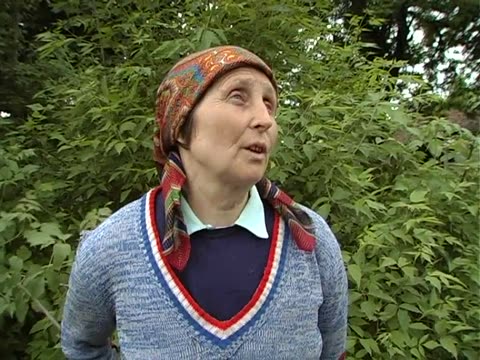
People › Dora (Dvoyre) Iosifovna Yatskova › conversation

Dora (Dvoyre) Iosifovna Yatskova

Kopayhorod 24 May 2008 Interviewed by Dov-Ber Kerler 60 min · 1 part on 1 tape uncertain
Loading the player…
  1. MDV 770 0:00–1:00:00 · 60 min · not online — MCO
Passages

0:00

Town footage of Kopayhorod

Footage MDV 770 · MCO
From the machine transcript

Brief remarks among the interviewers and others while filming in the town, in Russian with a little Yiddish. They talk about a House of Culture, a street name and what a word means; little more is clear.

1:15

Interview with unknown woman in Russian

From the machine transcript

Interviewers talk on the street with a local woman, mostly in Ukrainian and Russian. She tells what she heard from her mother and grandmother, Pelageya Vasilyevna Demianchuk: Jews hid in the reeds and in a cellar during the war, a baby was born in hiding, and a later letter from the son seeking the family went astray. Kerler and Lemster then ask about addresses, houses and former Jewish residents: a Farber family that left for Germany, a shop, a former synagogue, the Grinman brothers, one now in Israel, and a hairdresser family. The passage ends with the group leaving for Yatskova's house.

13:44

Beginning of the interview with Dora Iosifovna Yatskova

From the machine transcript

Setting up in Yatskova's flat: she and the visitors look for a socket and talk about the TV. She mentions her poor health and heart. Kerler then announces the date and place of the interview in Kopayhorod and addresses Yatskova as from Murafa, near Sharhorod.

The transcript shows the setup of the room and her health complaints before the interview starts.

15:39

Personal information and family

From the machine transcript

Yatskova confirms Murafa, in the Sharhorod district, as her birthplace, and gives her maiden name as Kremer. She says her father directed the Yiddish school in Kopayhorod, that he was a very educated man who knew Hebrew fluently, and that he had completed a yeshiva in Moldavia (?). Lemster asks when the family came to Kopayhorod.

The transcript adds the maiden name Kremer, the father's Hebrew learning and yeshiva, and Lemster asking when the family moved to Kopayhorod.

21:11

Childhood memories and family

before the war ChildhoodFamily history MDV 770 · MCO
From the machine transcript

Yatskova says she does not remember Murafa, as she was small, but that Kopayhorod was a good shtetl with many Jews who lived on friendly terms. She says she is the only one left and did not want to leave. Her son is a military colonel in Baranovichi, Belarus, but she cannot visit his fifth-floor flat because of her health. The passage ends as Kerler turns to the 1930s before the war.

The transcript adds her son the colonel in Baranovichi, why she cannot visit him, and her decision to stay.

22:51

Life in ghetto

during the war Ghetto MDV 770 · MCO
From the machine transcript

Yatskova speaks about the hungry years, when she was seven, and then the occupation. She was in the ghetto, with the family driven there and kept for three years until 1944, and she is officially a ghetto prisoner. Lemster and a second voice ask where the ghetto was.

The transcript adds the hungry years at the age of seven before the occupation.

23:48

Childhood memories and family

before the war ChildhoodFamily history MDV 770 · MCO
From the machine transcript

Yatskova says her parents spoke Yiddish and Russian at home and that her father read Sholem Aleichem in Yiddish to the children, including Wandering Stars and Yosele Solovey. She says her grandfather was an educated pharmacist, that he and his relatives were in Odessa and that the Germans killed them all. She has one brother, Hershele Kremer, two years younger, who lives in Israel and does not write to her. The talk turns to phone numbers.

The transcript adds the home languages, the Sholem Aleichem readings, the grandfather in Odessa killed by the Germans, and the brother in Israel.

27:09

Work

From the machine transcript

Asked about her work, Yatskova says she was an accountant for some years and then worked in culture at the House of Culture. She says she was artistic director of the club and worked there some forty years. Kerler and Lemster help with the Russian word for her post.

28:15

Family and Jewish cultural life

From the machine transcript

Yatskova says that in her cultural work she organized dancing and singing, but only Russian and Ukrainian songs, and that she knows no Yiddish songs. She says her father played the violin, mandolin and guitar and led the school orchestra. She recalls visiting the Jewish theater in Odessa, where she saw Mikhoels, understanding the plays but finding it hard to speak.

The transcript adds the father's instruments and school orchestra, and her visits to the Odessa Jewish theater.

29:52

About speaking Yiddish

From the machine transcript

Yatskova explains that she understood Yiddish but spoke Russian and Ukrainian, because she had no one to talk to, although Kopayhorod Jews spoke Yiddish. Lemster asks why she did not speak it, and she insists she loves Yiddish and cannot renounce her Jewishness. She says she survived the hungry years and the occupation and that the school had seven classes. A stretch of the Yiddish line is a recogniser loop.

The transcript shows her attitude to Yiddish and the seven classes of the school.

31:17

Jewish life before the war

before the war Local Jewish history MDV 770 · MCO
From the machine transcript

Yatskova describes the Yiddish school, with seven classes and many Jewish children. Next to it stood a two-storey synagogue, men below and women above, where she liked to listen to the prayers. After the war the building was gone and the site held a village council. Her father, as a teacher, did not go to the synagogue but prayed at home, and the family kept the holidays, buying matzo brought from Mohyliv (?). She says a shoykhet lived in the town.

33:51

(Not Described)

From the machine transcript

Yatskova says the prewar years in the shtetl were good, with people living in harmony, unlike now. She says no one needs her, that she is ill with heart and blood-pressure trouble and cannot travel anywhere, and that three years of occupation were a nightmare. Lemster then asks about the Jewish cemetery.

35:12

Jewish cemetery

From the machine transcript

Yatskova describes the old Jewish cemetery, where a monument stands to a woman tsadeket called Malkele (?). Kerler asks who she was, but Yatskova does not know. She says Jews from Israel used to come, in buses, to pray there. They restored the monument the previous year, and she visits it herself although she cannot pray.

37:06

Family and life after the war

From the machine transcript

Yatskova says her father, mother and brother were with her in the ghetto. After the war her father was director of a Ukrainian school, since there was no Yiddish school, and her mother worked as a librarian. Yiddish was spoken at home. Her parents studied at the Russian gymnasium in Zhmerynka. Her father also had a Hebrew and yeshiva education, and few in the Vinnytsia region knew Hebrew. Lemster asks about food at home.

The transcript adds that the parents were in the ghetto, the mother was a librarian, and the parents' gymnasium in Zhmerynka.

38:34

Jewish food customs

From the machine transcript

Asked about food at home, Yatskova names chicken broth, potatoes and other ordinary Jewish dishes, and for the Sabbath stuffed fish. She says she cannot translate the terms into Yiddish. Kerler suggests she come back with a translator, and she asks the visitors where they are from.

39:40

Life today

life today Life today MDV 770 · MCO
From the machine transcript

Yatskova tries to recall the Israeli city where her brother Hershl (Tsvi) Kremer lives, perhaps Netanya (?), and when he left, and says he has not written for a long time. Lemster tells her about a 103-year-old woman he met in Vinnytsia. Yatskova mentions Arkadii Isaakovich, a local man who speaks good Yiddish. She describes the Jewish cemetery, where people from Bar and Vinnytsia were also brought for burial.

The transcript adds the brother's name and uncertain city, Arkadii Isaakovich, and burials of people from Bar and Vinnytsia.

42:46

Family

From the machine transcript

Yatskova says her grandparents were all shot during the occupation. One grandfather was in Odessa and the other in Murafa, where he died long before, and he was a pharmacist. She remembers him as very religious and praying. Kerler checks whether she knows the Yiddish word for 'pious', and she recognizes it after a moment. Which grandfather is called Yankl is unclear in the transcript.

44:00

Childhood memories and life today

before the warlife today ChildhoodLife today MDV 770 · MCO
From the machine transcript

Yatskova talks about her grandfather the pharmacist in Murafa, later a dock porter in Odessa, whom local non-Jews remembered, and about a non-Jewish woman who spoke Yiddish better than she did. She explains that she read Sholem Aleichem in Russian and that her family spoke Russian with the children. Asked about Kopayhorod, she says she knows nothing of its history or of Malkele at the cemetery, and she complains that visitors from Israel throw away her flowers. She says neighbours treat her well, that her father was respected and taught many locals, and that she regrets not leaving after the war. She recalls friends the Grinmans, Misha playing the accordion while she directed stage shows, and her visits to the Odessa Jewish theater and its actors. She finishes by thanking the visitors, and Lemster offers her Yiddish books. The transcript ends before the catalogued passage ends.