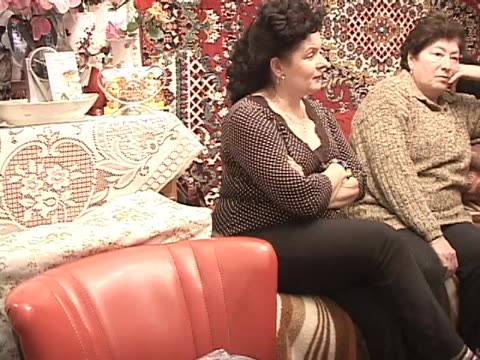
Gotlieb chats.
From the machine transcript
Opening chat and preparing the recording: a remark in Hungarian about a professor's earlier visit, then arranging the recording and noting the date and place (Budapest). Kerler remarks that Hungarian is a hard language and asks how she learned it so well.
Gotlieb discusses her childhood memories and languages spoken at home. She then recalls childhood games.
From the machine transcript
Gotlieb says Yiddish and Hungarian were spoken in her childhood, with Hungarian at school and Yiddish at home and in the courtyard. Her courtyard had many children, and she mentions a family of twelve of whom three remain. She recalls playing with nuts on Sukkot, then talks about lighting the Hanukkah candles on the eighth day and singing Ma'oz Tsur.
Adds the Hanukkah candle lighting and the Ma'oz Tsur singing today.
Gotlieb speaks about Hanukkah celebrations and sings parts of Ma’Oz Tzur (Rock of Ages). She then shows family photographs.
From the machine transcript
Gotlieb names the dreidel as the Hanukkah game of her childhood (in the form 'trendele'). Kerler looks at a booklet about the Yismach Moshe, and Gotlieb mentions her son, who died at forty-eight. The name of her hometown is garbled, and Kerler asks what she remembers of it and its childhood years.
Adds the son who died and the dreidel word; the Ma'oz Tsur singing and photographs are not clearly shown in this passage.
Gotlieb speaks about prewar Jewish life in Sátoraljaújhely. She also speaks about her religious life today.
From the machine transcript
Gotlieb recalls childhood years and a song about her little town (rendered as Belz?). She says she visits the grave of the Yismach Moshe every few months to pray for health. She describes keeping Sabbath with kiddush and havdalah as she learned it from her mother, and says her sisters stayed behind.
Gotlieb talks about her life during World War II. Gotlieb has relatives in Israel.
From the machine transcript
Gotlieb talks about living in Budapest and says she lost her husband and her son. She has relatives in Israel, speaks with them by phone a few times a year, and wishes to visit once more, but she and Kerler note the current war there. Kerler then asks when she left her hometown.
The transcript shows nothing clearly about her life during World War II here; it shows her loss of husband and son and today's contact with Israel.
Gotlieb speaks about her life before the war. She left her hometown in 1934 to find work in Budapest. She then speaks about her family. Gotlieb grew up with three brothers and a sister.
From the machine transcript
Gotlieb says she came to Budapest to work at eighteen, when young people were taken away for labor; the year is unclear (Kerler says 1934, but 1943 is also heard). She recalls her mother's advice about Sabbath, then says she was one of seven children, a brother and a sister died, and a brother named David studied at a yeshiva in Uzhhorod while the others worked with her father. Kerler asks about her learning to read Hebrew letters.
Adds the siblings' numbers and the brother's yeshiva study in Uzhhorod; the catalogue's three brothers and a sister is not clearly shown.
Gotlieb addresses her religious education, taught by her mother and at school. Gotlieb studied at a Hungarian Jewish school. She then talks about her family. Gotlieb's father was a leather merchant.
From the machine transcript
Gotlieb says her pious mother taught her to pray and to read and write the holy tongue, though she herself was unwilling to learn. She attended a Hungarian school, where some Yiddish was also taught. Her father worked in leather, her mother was named Chaya Sara, and a long stretch about a professor and other people is garbled; Kerler and Gotlieb end by discussing songs she learned.
Adds a garbled stretch about a professor and a discussion of songs.
Gotlieb addresses food customs at home before the war.
From the machine transcript
Gotlieb answers questions about everyday food at home: cholent on Sabbath, potatoes and baked goods in the week, and meat and fish only on Sabbath. She says she made fish herself but not stuffed fish with sugar, as the Polish Jews did. Kerler also asks whether she remembers Hanukkah songs, and she names Ma'oz Tsur.
Gotlieb discusses contemporary Hanukkah celebrations, before recalling contemporary Hasidic visitors.
From the machine transcript
Kerler asks how the dreidel game was played, and Gotlieb says she now plays it at the club with others. A woman present is mentioned as a teacher of the holy tongue. Gotlieb names her mother Chaya Sara and father Shlomo, then recalls Hasidim visiting town from Brooklyn, London and elsewhere, around the time of a rebbe's death (a year like 1928 is heard). They discuss the Yismach Moshe's grave and a document in Kerler's archive.
Adds the parents' names, a rebbe's death and the Hasidic visitors from abroad.
Gotlieb shows family photographs of her cousins in Israel. She also speaks about her family.
From the machine transcript
Gotlieb and others show photographs and a Hanukkah menorah in Israel, including a cousin (sister's child) in Netanya or Tel Aviv. She says she has also been to Israel. Kerler discusses sound quality and a visit two years earlier, then raises Purim and other holidays.
Adds the Netanya cousin and a visit two years earlier; the catalogue mentions only the photos.
Gotlieb addresses prewar holiday celebration, including Purim. She recalls Purim shpiels in Hungarian, performed by boys; as well as Purim shpiels in Yiddish at the Polish rebbe's house.
From the machine transcript
Gotlieb recalls Purim in her childhood: children carried food gifts and received money. The Purim play was in Hungarian, performed by boys in costume and makeup, and a Yiddish play was performed at the Polish rebbe's house. She describes the Polish rebbe's dress and says she did not like the Polish Jews' Yiddish, which she found different. She begins to recite a Purim song.
Adds the description of the Polish rebbe and her opinion of Polish Yiddish.
Gotlieb recites Purim shpiels, she learned from her grandmother. She then describes how she went from house to house on Purim.
From the machine transcript
Gotlieb recites and sings a Purim rhyme and says her grandmother taught it to her. She went from house to house at home, received money and baked goods, and recites another Purim rhyme about falling. She says she has no one to speak with now and so does not speak Yiddish well.
Gotlieb talks about holiday food and drinking customs, particularly on Passover and Hanukkah.
From the machine transcript
Gotlieb answers questions about holiday food: Passover dishes such as potato dishes, matzo-meal dumplings and eggs, and wine, with an expensive wine for some. For Hanukkah they ate soup and meat and latkes made from potatoes, not sweet. For celebrations they ate simple pastries with nuts, poppy seed and apple, and Kerler asks for a song her mother or grandmother sang.
Adds Passover food and drinks and the latke recipe.
Gotlieb speaks about contemporary religious life and cantors' performances.
From the machine transcript
Gotlieb recalls a song from childhood and then talks about cantors. She says her father sang in the synagogue and she went with him as a child, and mentions a cantor with a fine voice today in a Budapest street. She mentions her little town and a visit there, then Kerler asks whether the family was Hasidic.
Adds a childhood song and the father's synagogue singing.
Gotlieb talks about her family and prewar religious life in her hometown, including the difference between Sephardic and Ashkenazi Jews and local yeshivot. She then describes prewar Jewish life in Sátoraljaújhely. During his childhood, Gotlieb visited the grave of Yismach Moshe with her father, she explains.
From the machine transcript
Gotlieb says her family was Ashkenazi (not Hasidic) with twelve children, and explains the Yismach Moshe as a Hasidic rabbi who she says waited for the Messiah in a tree. She says her town had three yeshivas and a community, a Jewish population of 3,800 (as heard) among around 14,000, and a beautiful river. She says she went with her father to the Yismach Moshe's grave, and her mother consulted a pious man about kosher questions, but sick people went to the doctor.
Adds a local rabbi consulted on kosher questions and on whom the sick relied.
Gotlieb addresses praying customs and recalls her mother reading tsene-rene (Yiddish-language bible) on Sabbath. She then speaks about her family, before remembering her visits to Uzhhorod.
From the machine transcript
Gotlieb speaks of praying to the Yismach Moshe and recalls her mother reading the Tsene-rene in Yiddish to the children on Sabbath. Her brother went to Uzhhorod for further yeshiva study, and she has some memories of going there and having a bicycle taken, in parts mixed with Hungarian. She mentions a nephew from Uzhhorod called Weinberger, whom she describes as a Jewish priest (?), and a relative who studied in Prague.
Adds the yeshiva in Uzhhorod and the story of the relative Weinberger and the bicycle.
Gotlieb addresses her childhood memories, including games and going to the kosher butcher.
From the machine transcript
Gotlieb recalls childhood games in the courtyard, such as jumping over squares, while there were no animals as the courtyard held over forty children. She says she carried a chicken to the ritual slaughterer for the Sabbath, and meat was eaten only on Sabbath. Kerler then asks about the school she mentioned.
Gotlieb talks about her school education at a Hungarian Jewish school. She then speaks about her family and recalls singing on Sabbath. Gotlieb also mentions her mother's observance.
From the machine transcript
Gotlieb says Jewish history was taught at school by a woman teacher, but in Hungarian, not in Yiddish. Her mother taught her to read, and Gotlieb says she was unwilling. She says her father's mother sang with the family on Sabbath and mentions Sabbath songs, and Kerler asks about a song about the Messiah. She says her mother spoke with the Polish rebbe, whose Yiddish she could not follow, and she was angry at him for a remark about her mother.
Adds the Polish rebbe and her anger at him over her mother.
Gotlieb speaks about prewar Sukkot celebrations, including food customs.
From the machine transcript
Asked what was done on Sukkot, Gotlieb lists baked goods: kolach, strudel with chocolate, cabbage or poppy seed, and a pastry with jam, some named in Hungarian. Kerler and S2 help with the terms. Gotlieb then says she cannot think what more to say.
Gotlieb speaks about contemporary Jewish life.
From the machine transcript
Gotlieb and Kerler discuss the idea of founding a school for learning Yiddish in Budapest, and Kerler's wish to come and teach. They talk about Yiddish study at the university and among Lubavitch Hasidim. Gotlieb recalls a young man in Israel who would not or could not answer her in Yiddish.
Adds the idea of a Yiddish school, and the Israel anecdote about a young man who did not answer in Yiddish.
Gotlieb answers questions about food and cultural terminology.
From the machine transcript
Gotlieb answers questions about food and kinship-related terms: flodn, kugel, the Sabbath morning cake (koilitsh versus khale), the dough offering taken from challah and the word for midwife. S3 and Kerler help in Hungarian and Yiddish when she cannot find the Yiddish word. Kerler and Gotlieb also compare Slavic words and names such as her husband's and Kerler's.
Adds the midwife term and Slavic-word and name discussion.
Gotlieb recalls Sukkot celebrations at home. She describes how she built her family's sukkah, in which her father spent the night. Gotlieb then addresses Hoshana Rabbah (seventh day of Sukkot) and Passover.
From the machine transcript
Gotlieb recalls Sukkot at home: she says she built the family sukkah with decorations while her father slept in it. She then answers questions about the sukkah roof, Hoshana Rabbah and Passover, including the seder, the four questions and the song about the kid goat, which she remembers only in part.
Gotlieb speaks about praying customs and recites the morning prayer "Modeh ani."
From the machine transcript
Gotlieb talks about her morning prayers and recites the Modeh ani, blended with other prayer fragments and Yiddish phrases. She explains that she prays each morning, asks God for help and good health, and sees prayer as something not only for men.
Gotlieb speaks about prewar customs on Tisha B'Av. She then addresses folk customs to avert the evil eye. Gotlieb mentions that the community prayed for her when she was sick as child.
From the machine transcript
Gotlieb speaks about Tisha B'Av, fasting and the children's custom of throwing burrs. She says she no longer remembers many details at 83. She then describes the evil eye and the remedy of pouring water over coals. She recalls being very ill at age nine, when an amulet or ribbon from Jerusalem was brought and prayers were said for her in the synagogue, and Kerler notes she left for Budapest nine years later.
Adds the Tisha B'Av customs and the age of nine for the illness and move to Budapest.
Gotlieb speaks about her life after the war. She lived in Sátoraljaújhely until 1987 and then moved to Budapest, where she worked in the community kitchen. At the age of eigteen, Gotlieb worked at a factory in Budapest.
From the machine transcript
Gotlieb talks about her work in Budapest and her return home. She worked in a kosher community kitchen and went back and forth to her home town. She says she returned to live in Budapest in 1987 after her son died. At eighteen she worked in a factory, not in the kitchen.
Adds the son's death as one reason for the move, and the return in 1987.
Gotlieb addresses prewar life in Sátoraljaújhely. In particular, she remembers a visiting priest, who spoke Yiddish. She also addresses the Jewish occupational structure and institutions in town. Gotlieb then describes the local bath house.
From the machine transcript
Gotlieb remembers a priest who visited her father and read and spoke Yiddish with him. She answers questions about local occupations such as leather work, tailors, shoemakers and watchmakers, and about the two mikvehs, Hasidic and Neolog, with their bath-houses.
Adds the leather-trade father and trades, plus the two mikvehs.
Gotlieb addresses prewar cultural and religious life. She then answers questions about cultural terminology.
From the machine transcript
Gotlieb answers questions on prewar cultural and religious life: the library with Hungarian and Yiddish books and the beis medresh. She also answers questions on terms such as 'good place' for cemetery, 'good Jew', and Polish Jews. Kerler explains that the second woman speaks Sátmar Yiddish well and could be a rebbetzin.
Gotlieb recalls prewar traditional weddings. She remembers the wedding of the rebbe's daughter. His daughter was married to Rabbi Chaim Elazar Spira's son. She then speaks about life today.
From the machine transcript
Gotlieb recalls a grand wedding in Sátoraljaújhely of the rebbe's daughter, married to the son of the Munkács rebbe; Kerler places it in 1933. She speaks about the rabbi (Meizels), his Yiddish and her neighbours. The conversation moves to Yiddish speakers today, who can speak it but will not, a planned visit to the grave of a tsadik, and relatives' marriages in Hungarian.
Adds Yiddish speakers today, the planned grave visit, and the relatives' marriages.
Gotlieb speaks about healing customs during her childhood. They then discuss local geography, before she talks about contemporary Hasidic life.
From the machine transcript
Gotlieb tells, partly via Hungarian and S2's summary, about her childhood illness and the healing customs used: coals in water and the amulet. She recalls an operation after eating hot cracklings. The group then discusses distances between towns, a cemetery, and a Hasidic businessman, Berkovits, and his factory moving to Romania. Hasidic life today and the High Holiday prayers are also mentioned.
Adds the Berkovits discussion, the factory moving to Romania, and the operation after eating cracklings.
Gotlieb recites again the Purim shpiel. She then explains how children sang it in her hometown and addresses prewar Passover and Purim celebrations.
From the machine transcript
Gotlieb recites the Purim shpiel verses that children sang in her home town, and answers questions about when and how it was performed, with children going from house to house. She and S2 also describe prewar Passover and Purim customs of charitable collections, such as for a poor bride's dowry, and getting new clothes for Passover.
Adds the charity collections and the new clothes at Passover.
Gotlieb speaks about her and her family's life before World War II. She worked at a broom factory in Budapest at the age of eighteen.
From the machine transcript
Gotlieb tells, mainly in Hungarian and then summarised in Yiddish by S2, about her family's hardship in the early 1930s. Her father, a hide dealer, lost his goods in the cartel period and the family was evicted and lived in a broom factory, where her brother was born. Her pious mother urged him to buy a horse and cart, which brought him success. Kerler then asks about her mother's Sabbath observance.
Adds the father's trade, the eviction, and the horse-and-cart story.