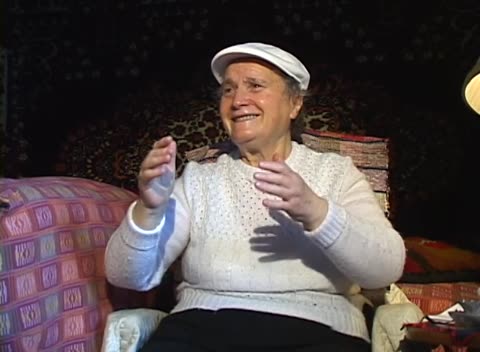
The team arrives at Gotlieb's home.
From the machine transcript
The team walks through the streets looking for Gotlieb's address, with talk among Kerler and others, partly in unclear language. They ask about her whereabouts and finally greet her at the door. Much of the speech is garbled.
The team greets Gotlieb at her apartment and then sets up the interview with her. She then provides personal information and speaks about her family, while showing photographs. Friedman was born in Sátoraljaújhely (Yiddish: Ihel).
From the machine transcript
The team greets Gotlieb in her apartment and introduces themselves by first names. Kerler explains the Yiddish interview, and she says she has no one to speak Yiddish with. They speak of the Yismach Moshe Teitelbaum, buried in her home town, and she refers to her husband and son, now dead, and relatives in Brazil. She says the town was called Ihel in Yiddish, and Kerler states the date and begins the interview.
Adds Teitelbaum's grave in her home town and her references to her husband, son and relatives in Brazil.
The formal interview with Gotlieb begins. She provides personal information and speaks about her family. Gotlieb's mother was born in 59:47 and her father in Sátoraljaújhely. Her father was a leather supplier.
From the machine transcript
The formal interview with Gotlieb begins. She gives her married name Gotlieb and her maiden name Friedman, and says she was born in Ihel (Sátoraljaújhely) in 1925. Her mother, Khaye Sore, came from another place that is unclear in the transcript; her father, Shloyme, was born and lived in Ihel. Kerler and she work out his trade, and it was dealing in raw, unworked leather rather than making shoes or leather goods.
Gives her parents' names, her father's leather trade, and the mother's origin as unclear.
Gotlieb speaks about her family. She grew up with two brothers and two sisters.
From the machine transcript
Gotlieb names her siblings, two brothers and two sisters, including David and Meir. The youngest sister is named Gedole and is eleven or twelve years old. She says David studied to become a rabbi in a town about eighty kilometres away, where he lived with a relative.
Names the siblings and says David studied away from home.
Gotlieb talks about her life and education before the war. She studied with a private tutor. Gotlieb then briefly addresses her life during World War II, before talking about her life after the war. Gotlieb returned to her hometown and was married to a Jewish Red Army soldier in 1946. Gotlieb raised a son, who passed away at the age of 48. Gotlieb then addresses her life today.
From the machine transcript
Gotlieb says her mother advised her to stay in Pest when the Germans came, and recalls hardship and the help of strangers. After the war she returned to her hometown and married in 1946 (the year is unclear in the transcript). She says her husband, a Jewish Red Army soldier, had lost his family, and she gives his name as Bela Gotlieb and his Jewish name. They had one son, who died young, in 1948 by the transcript's wording (this does not fit the catalogue's age of 48, which may be a mishearing). She then speaks about living alone today, her few contacts and her religious observance.
Gives her husband's name and Jewish name, and the decline of observance among others today.
Gotlieb talks about prewar Jewish life, including religious institutions, in Sátoraljaújhely. According to her, 3060 people lived there. She has relatives in Israel and America.
From the machine transcript
Gotlieb describes prewar Jewish life in her hometown: about three thousand Jews, Neolog, Orthodox and Hasidic communities, and her own Orthodox family. She mentions early morning prayer and study, two mikvehs, three ritual slaughterers, three large synagogues and many small stiblekh. She talks about Hasidic dancing and mentions a rabbi whose son now lives in New York.
Adds the three communities, mikvehs and small prayer houses.
Gotlieb discusses her family. She also addresses her work after the war. Gotlieb helped out her father after school. After the war, she managed her own business of leather supplying in Sátoraljaújhely, until the expropriation of her business by the Soviet government. Gotlieb then recalls her childhood memories and her mother's observance.
From the machine transcript
Gotlieb names her paternal grandfather Moshe Friedmann and grandmother Malke (née Blumenfeld), and mentions five uncles and one aunt on her father's side. The family dealt in leather. She helped her father, then after the war ran her own business with her husband until the Russians took everything. She speaks about her town's location, now in Hungary, and about her very religious mother's last words on keeping the Sabbath.
Names grandparents and mentions the mother's Sabbath admonition.
Gotlieb speaks about prewar holiday celebration at home. She then addresses her education at a Hungarian Jewish school.
From the machine transcript
Gotlieb speaks about prewar holidays at home, noting that her family was not rich but gave generously to others. She says her mother taught her Hebrew reading, and that she attended two Jewish schools, a Neolog and an Orthodox one, taught in Hungarian and Yiddish. She tries to recall a poem or song from school.
Adds poverty and charity at home, and a poem recalled from school.
Gotlieb sings a Yiddish song, she recalls from her childhood. She then addresses prewar Passover and Purim celebrations. Gotlieb describes how she went from house to house with a mask. She also recalls two Purim shpiels (19:57).
From the machine transcript
Gotlieb recalls prewar childhood: listening to cantors in the synagogue and preparing for Passover with separate dishes, the four questions asked by the youngest, and new clothes. She describes going from house to house in a mask at Purim to deliver food gifts. At Kerler's request she recites a Purim rhyme and a verse from a Purim shpil, repeating it slowly several times so he can write it down.
Passover preparations and Kerler's request to write down the rhyme.
Gotlieb speaks about her childhood memories and friends. She then addresses her mother's teachings, before remembering Sabbath food customs at home.
From the machine transcript
Gotlieb says she spoke Yiddish as a child and learned Hungarian in school, with some German. She mentions many Jewish children around her and that some non-Jewish children also knew Yiddish. She remembers her mother as clever and helpful, then describes the Sabbath food: soup, meat, compote and the baked Sabbath stew (cholent). She also talks about fish dishes and the difference between Hasidic and other tastes.
Adds the languages spoken and a discussion of fish dishes and terms.
Gotlieb describes how she koshers meat. She then returns to Sabbath food customs.
From the machine transcript
Gotlieb describes how her mother koshered meat by soaking and salting, removing the neck and checking the liver, and roasting it over a fire. Kerler asks whether any words were said while salting. She says her family bought bread on Sabbath, only taking challah when it was baked, and Kerler asks for her word for Sabbath bread.
Gotlieb speaks about prewar Jewish life in Sátoraljaújhely. Gotlieb's brother studied at a yeshiva in Uzhhorod, where their uncle lived. She then talks about visiting the grave of Moshe Teitelbaum aka Yismach Moshe.
From the machine transcript
Gotlieb says her brother David studied at a yeshiva away from home and was clever, but he and all her brothers were unmarried and perished, as did her parents and relatives. She recalls fragments of a song her mother sang. Then she talks about the tsadik Yismach Moshe (Teitelbaum), whom people visit for blessings from around the world, and about her own visits to his grave.
Adds the loss of her family and a song her mother sang.
Gotlieb talks about her family, specifically her father's observance. She then answers questions about cultural terminology.
From the machine transcript
Gotlieb says her father was not a Hasid and visited the tsadik's grave only once a year on the yortsayt, as did her uncles, who were Orthodox. In response to Kerler's questions she explains terms such as baal-shem and the cup-pouring at Passover, and what "good Jews" meant.
Adds the terminology questions.
Gotlieb addresses praying customs and prayers she learned as a child. She then recites the morning prayer "Modeh Ani."
From the machine transcript
Gotlieb speaks about Sabbath-ending prayers and the greeting "a gute vokh" with its replies, then the prayers she learned as a child. She recites the morning prayer "Modeh Ani" and other prayer texts, though the transcript is largely garbled here.
The Havdalah greeting and replies, and other prayers.
Gotlieb describes a Purim shpiel in Hungarian before the war, where men dressed up as women.
From the machine transcript
Gotlieb recalls a big Purim shpil performed by Hasidim in which men dressed as women, and she says it was in Hungarian as well as Yiddish. She recites some Hungarian verse from it. It was about the story of Esther, in which Haman is hanged; she says she was a small child and does not remember more.
Gotlieb explains how her family spent Sabbath together telling stories. She then recalls Hanukkah food customs and shares in Hungarian a recipe for log-shaped pastry stuffed with apricot preserves, chopped dates, walnuts, and raisins (flodn).
From the machine transcript
Gotlieb says stories were told at Sabbath gatherings but she recalls none. Kerler asks about words such as dybbuk and golem and then about Hanukkah food; she names meat and soup and, with some difficulty, fried dough foods. She tries to give a recipe for flódni, partly in Hungarian, and Kerler discusses strudel and poppy-seed flodn.
Kerler's questions about golem and dybbuk and the terms for pastry.
Gotlieb speaks about Sukkot celebrations before the war. In particular, she describes her family's sukkah. Gotlieb then speaks about prewar Jewish life in her hometown and addresses conversions to Christianity. She also recalls non-Jews who spoke Yiddish and the use of Hebrew terms among Jews.
From the machine transcript
Gotlieb describes the family sukkah with paper cut-outs and decorations, where her father slept. She says she knew of no non-Jews converting to Judaism, and of Jews who converted to Christianity she says her mother considered them worse than a cat or dog. She recalls non-Jewish servants who spoke Yiddish, including one who worked for a rabbi, and then answers Kerler's questions about Hebrew-derived words used to prevent non-Jews understanding.
Adds conversions, Yiddish-speaking non-Jews and Hebrew terms.
Gotlieb talks about Jewish life before the war, including occupational structure. She also briefly touches upon school performances.
From the machine transcript
Answering Kerler's questions, Gotlieb lists Jewish trades in town, including baker, shoemaker and carpenter. She discusses the words for the Sabbath bread (barkhes, challah, kalach) and for potatoes. She says there was no regular theatre, only children's plays at school and at Purim.
Adds the bread and potato terminology and the lack of theatre.
Gotlieb speaks about traditional weddings before the war. She then remembers synagogue service and Hasidic life in prewar Sátoraljaújhely. Gotlieb mentions that followers of the rebbe danced a Mitzvah tantz during weddings.
From the machine transcript
Gotlieb recalls prewar Jewish weddings as beautiful, with singing but no instruments among the Orthodox and men and women separate; she says the rebbe danced a mitzvah dance with his followers. She describes sermons in the synagogue given in Yiddish or Hungarian and Hasidic life of study and singing. The passage ends with a discussion of the difference between rov and rebbe and their plurals, with Neolog and Orthodox rabbis.
Adds the sermon language and the rov/rebbe plural questions.
Gotlieb answers questions about cultural terminology. She also speaks about her life in Budapest and meeting fellow Jews from different regions before the war.
From the machine transcript
Gotlieb answers questions about terms for a cemetery, a good place and a good (pious) Jew, and says she does not know the expression 'Hungarian donkeys', the word for an opponent of the Hasidim, or the word for a Lithuanian Jew. In Budapest she lived among Jews who were less observant than her family at home. She met Polish and Ukrainian Jews but not Romanian ones, and discusses names for Polish Jews. She says that Polish Jews were called untrustworthy, and gives an anecdote about her husband's father, a trader.
Adds the Polish and Ukrainian Jews she met, a story about her husband's father, and the explicit negative stereotype of Polish Jews.
Gotlieb addresses her mother's baking customs. She then speaks about healing customs before the war.
From the machine transcript
Gotlieb answers questions about the baked goods her mother made, which she calls very fine, and about wine and brandy (palinka). She then speaks about healing customs. As a very sick child she was given a red ribbon from Jerusalem and prayers were said for her. She and Kerler discuss extinguishing coals in water as a remedy, and the havdalah custom of putting money in the pocket for a blessing.
Adds the drinks, the havdalah money custom and her own childhood illness.
Gotlieb answers questions about cultural terminology.
From the machine transcript
Gotlieb answers questions about terms for a non-Jewish cemetery and for a church. She does not know several of the words and says there were three churches. She recognises the word for ritual impurity (tume), used when Jews were not allowed to enter a church. At the end Kerler thanks her and asks her to repeat the second Purim play.
Gotlieb recites and sings the Purim shpiel again.
From the machine transcript
At Kerler's request Gotlieb repeats a short rhymed Purim play verse for him to write down. He asks for repetitions line by line, then asks her to say it with a melody, and she recites and sings it. The verse greets the company and names her siblings and parents. Kerler thanks her at the end.