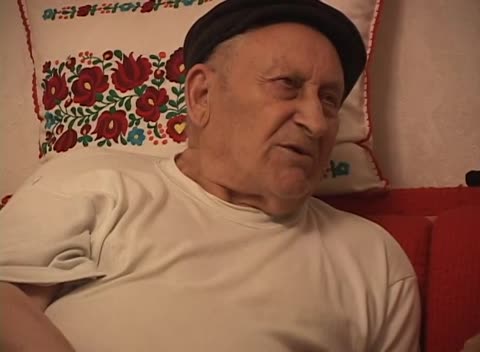
Galambos speaks about his yeshiva education. He also recites the lyrics of a Yiddish song about a "yeshive bokher" (yeshiva student). Galambos describes how he went "esn teyg" (join families for meals) at different homes and his daily study routine. Galambos attended yeshivot in Kisvárda (Yiddish: Kleynvardeyn) in 1936 and Putnok in 1935.
Kerler asks Galambos about his yeshiva years. Galambos recites a Yiddish song about the hardships of being a yeshiva student. He describes eating each day with a different family and the daily round of study, prayer and meals. He studied in Kisvárda and Putnok in the mid-1930s.
The song text and a Putnok year (1935) are in the transcript.
Galambos talks about prewar religious life in Vaja, particularly his religious school (cheder) education. He also addresses his mother's observance. Galambos recalls how his mother read the megillah out loud to other women. Galambos then addresses different religious texts he studied in cheder and yeshiva.
Galambos says all of Vaja was Orthodox and kosher, with Ashkenazi rather than Hasidic Jews, and that boys wore sidelocks. He tells how his mother read the megillah aloud to other women. He describes cheder from age three, including girls' cheder, the teaching of Hebrew and translation, and his own gaps in understanding the prayers. He also compares cheder and yeshiva study of Gemara.
Language of instruction in cheder and the question of Hasidim in Vaja are also discussed.
Galambos continues describing his schedule as a child, with school and cheder every day from age six, and says he had little real childhood. He also describes Sabbath afternoons at cheder. Kerler asks whether certain texts were said with a melody, and Galambos has not heard that.
Galambos answers questions about which prayers and Sabbath rituals were sung with a melody, such as Yom Kippur, Rosh Hashanah, Friday night and kiddush. He sings a song about the town of Belz and childhood there. They then mention a brother who has died, and Kerler asks about his years in yeshiva.
Galambos speaks about his life in Vaja, after he graduated from the yeshiva in 1936. Galambos then touches upon his visit to Auschwitz. He served in the Hungarian army and was a forced laborer during World War II. Galambos's father and four sisters were killed in Auschwitz. He states that nineteen members of his family were killed in the camp.
Galambos gives the years of his yeshiva study and says the yeshiva life ended with the coming of the war. He talks about returning to Vaja and about Auschwitz, which he has visited. He was in the Hungarian army, and his father and four sisters were killed in Auschwitz. He gives figures for his family's losses, with nineteen heard.
The family losses are named in detail and the yeshiva years are repeated.
Galambos speaks about life today. He then speaks about Jewish life after the war. Galambos returned to Vaja in 1944. According to him, 184 Jews (out of 2,700) lived in prewar Vaja and 41 Jews returned after the war.
Galambos describes a recent event in a synagogue where a man wept while speaking about the Holocaust. He says he came back to Vaja in 1944. Before the war Vaja had 184 Jews; 41 returned afterwards, and only a handful now remain. He adds that few survivors are left in the world, with a few in America and Israel, and mentions one man in Budapest.
Catalogue says 2,700 population; the transcript heard here has only the Jewish figures.
Galambos speaks about his family, particularly his brother. He then speaks about prewar life in Vaja and Jewish regional geography. He also touches upon prewar traditional weddings.
Galambos speaks about his late brother and the last time he saw him. Kerler asks about the proportion of Jews to non-Jews in Vaja and in other places, such as Czechoslovakia, Munkács, Huszt and Beregszász, and where Yiddish speakers remain. Kerler then asks about Jewish weddings, and Galambos recalls three weddings of his sisters in the family. He says non-Jews did not speak Yiddish in Vaja, but did in the Carpathians.
Comparison with other towns' Jewish populations and non-Jewish Yiddish speakers.
Galambos addresses prewar Purim celebrations, including food customs. He also recalls Purim shpiels. Galambos then speaks about Passover celebrations before the war.
Galambos describes Purim in Vaja: going to the megillah and then going door to door with a Purim play for small coins. He says part of a Purim rhyme, which Kerler asks him to repeat so as to write it down. He answers that a chimney-sweep play was not done and that the shoykhet organized the Purim performance. He lists the festive meal, then answers Kerler's questions about the four questions at the Passover seder and the Haggadah, and links them to Auschwitz.
Galambos and Kerler discuss belief in God after the Holocaust. Galambos mentions prayers said by women, including the prayer to the God of Abraham at the end of the Sabbath, and Psalms. Kerler asks about the future of the Jewish people and whether he has relatives in Israel. Galambos answers about the Land of Israel and a story about Moses and the sea.
Theological reflection after the Holocaust, and the question of relatives in Israel.
Galambos talks about prewar religious life in Vaja, in particular visiting the grave of the Kaliver tzadik (Rebbe Menachem Mendel Taub). Galambos then shares an episode about the Tosher rebbe, Grand Rabbi Meshulam Feish Segal-Loewy.
Kerler asks whether people from Vaja used to travel to a rebbe or a grave. Galambos says his father went to the grave of the Kaliver tsadik, and he himself did not. He tells an episode about the Tosher rebbe, to whom Jews came in the ghetto asking what would happen, and who answered that he was a simple man; Kerler tells a story of his own. They mention the rebbe's son in Canada. They then turn to Jewish weddings in Vaja.
The Tosher episode is placed in the ghetto in 1944.
Galambos describes Jewish weddings in Vaja. There was a canopy and a meal, with no dancing, a toast, and singing at the meal. A wedding jester from a nearby place rhymed there. He says there were no klezmer musicians in the village.
Galambos says he still makes his mother's dishes, such as gefilte fish and cholent. Kerler asks about Sabbath loaves, dumplings and the terms for them, and Galambos says he still has matzo meal. They discuss whether Jews drank palinka and whether it had to be kosher. They also cover wine, drinking on Passover and Purim, and toasts at kiddush in the synagogue. The recording has English and Russian fragments from others in the room.
Terms for challah and dumplings, plus drinking customs.
Galambos and Kerler talk about the customs between Rosh Hashanah and Yom Kippur, and Galambos mentions casting crumbs into a spring (tashlikh) with a kind of noodle food (?). Kerler asks about old women's charms against the evil eye and whether coals were put out in water against illness. Galambos does not remember such charms; people said Psalms for the sick.