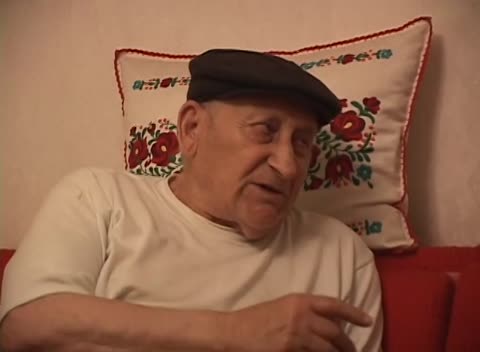
Kerler asks Galambos about the prayer recited at Rosh Hashanah, and Galambos recalls a Rosh Hashanah custom and a rhymed saying. The passage is hard to follow in the transcript.
The transcript is too garbled to show the chanting or the saying clearly.
Kerler asks whether it was cold at Sukkot and whether people used to sleep in the sukkah. Galambos says Sukkot weather was still fairly good in the past, though it is cold now.
Galambos answers questions about terms for the synagogue and church, about changing the name of a very sick child, and about where the dead were buried before the war, though he does not follow that question. He also discusses knocking on the shutters to call people to services and says he could read some Yiddish before the war.
The catalogue's 'healing customs' is the renaming of a sick child; the transcript also covers burial, knocking at the shutters, and reading Yiddish.
Galambos mentions praying and reciting Kiddush in the small community of Vaja today, which has no rabbi. Kerler and Galambos then discuss the Yiddish names of Hungarian towns, such as Klausenburg for Kolozsvár and a town with a large Jewish community whose name is unclear in the transcript.
The transcript shows a discussion of the Yiddish names of Hungarian towns and of the community's leader, not geography as such.
Galambos addresses prewar occupational structure in Jewish Vaja. He also mentions the local wine production, before talking about prewar Shavuot and Sabbath food customs.
Galambos says Vaja's Jews were craftsmen and merchants, with a shochet, a shamash, a gabbai and a rabbi who died in the early 1930s (?). He describes a nearby village with a beautiful synagogue where kosher wine was made. Kerler then asks about Shavuot dairy foods such as cheese pancakes and kreplach, and about goose fat, cholent, kugel, beans and Passover-style dishes, and the two compare Yiddish and Hungarian words for them.
The transcript shows an extended comparison of Yiddish and Hungarian food words and a discussion of kosher goose fat.
Galambos talks about making kosher Kiddush in the synagogue and about keeping separate Passover dishes in the attic before the war. He describes Passover foods such as stuffed goose, matzo balls and potato kugel, and says that in Vaja the Orthodox did not eat soaked matzo (brak) except on the last day. Kerler then asks him to recite Purim plays again.
The transcript shows the discussion of whether soaked matzo (gebrokts) was eaten, and Kerler's request for Purim plays.
Galambos recites Purim-play rhymes for Kerler, who explains that the scholars find them interesting. Galambos then says he visited Israel about eight years earlier and liked it, but has mixed feelings about the Hasidim there. He also recites a prayer he said on Yom Kippur for Jewish children and finds it hard to translate.
The transcript also contains his views on Hasidim and military service and a Yom Kippur prayer he composed.
Galambos discusses his childhood memories, before he sings "Habeit mishamayim" (look from heaven) in Yiddish. Galambos heard the song in 1948 in Pest, performed by a Polish theater troupe.
Kerler asks whether Galambos sang Hungarian songs in childhood. Galambos then recites the words of the song 'Habeit mishamayim' in Yiddish and says he heard it in Pest around 1948 from Polish Jews.
The transcript shows the song is recited as text and that he places it around 1948.
Galambos recites the words of 'Papirene kinder'. Kerler remarks that the film in which it appears came out after the war. Galambos says 41 people came back to Vaja and that he says Kaddish for his brothers, and Kerler asks about his brother's widow.
The transcript shows the return of 41 people to Vaja and his Kaddish for his brothers.
Galambos shows family photographs and speaks about his family. He shows again the photograph when his family was forced to move from Vaja to Kisvárda on April 17, 1944.
Galambos shows family photographs, including a picture of his siblings; one sister died in Auschwitz. He explains that a non-Jewish photographer took the April 1944 picture of the family being driven to Kisvárda (the name is garbled). He also shows a group photograph of Jewish children in Vaja and talks briefly with Kerler about the Hungarian language.
The transcript shows the sisters and brothers, the non-Jewish photographer, and a group photograph from before the war.
Galambos shows a Haggadah and gives it to Kerler. Kerler asks him again for his address and asks him to tell a story or sing a song about what will happen when the Messiah comes.
Kerler asks about a song on the coming of the Messiah, and Galambos answers with remarks about the shofar. They discuss how to send material to him, and Galambos talks about the coming Rosh Hashanah.
The transcript shows talk about sending material and about the coming Rosh Hashanah.
Galambos and Kerler talk about stale noodles, then about America and Canada, democracy and Israel, and how the United States has helped Israel. They go on to talk about the Jews of Debrecen, Romania, and Galambos's learning of Hungarian. Galambos says he spoke only Hungarian at school and Yiddish at cheder.
The transcript shows talk about noodles, democracy, Romania and Galambos's language learning.