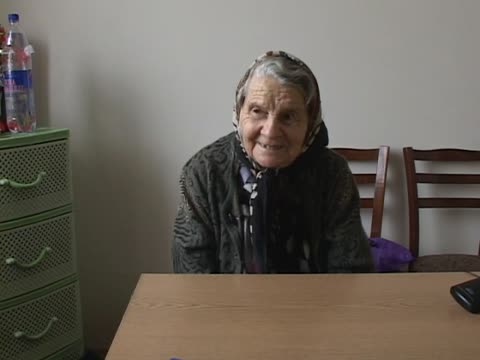
This recording is a continuation of a formal interview with Malka Zelikovna Altman. Altman continues telling the story about her husband Mordkhe and his encounter with the rebbe of Stefanesti. She then talks about prewar Jewish life and different synagogues 2:10, as well as Sabbath celebrations.
Altman finishes the story of her husband Mordkhe (Matye) meeting the rebbe of Stefanesti while on military duty. She then answers Kerler's questions about her father's synagogue, called the tailors' or Shmeshe synagogue, and a nearby synagogue with a nickname. Kerler asks about Havdalah and her mother's Friday-night candle-blessing prayer, which she says she does not remember. She describes what her mother prepared for Sabbath and mentions losing an eye and hearing in one ear during the war.
The catalogue sentence omits her father's synagogue and the Havdalah and candle-blessing questions, and the war injury already surfaces at the end.
Altman briefly addresses her life during the war, before she talks about her family. She raised two children. On the way to evacuation, she was thrown off the train and lost one ear. She then recalls life during the Soviet period. Before the war, Altman learned with a tailor. She and mother worked at the fur factory after the war.
Altman speaks briefly about her two children. She compares life under Romania and under Soviet rule, and finds the Soviet period better. She says she learned from a tailor, then worked at the mechanical plant, as did her husband. She gives prices of bread and sour cream from Soviet times and says she and her husband lived on one wage. She also mentions her neighbours and her dislike of quarrelling.
The catalogue mentions the fur factory and the train incident, which this passage does not clearly show. The transcript adds prices and wages, neighbours and her children.
Altman remembers a Yiddish saying (a patsh farreynt zikh, a vort gedenkt zikh - ), before she talks about life today and her education during the Soviet period before the war.
Altman recalls a Yiddish saying about a slap and a word, and talks about a dispute with a neighbour. Kerler asks about stories her parents told. She explains the expression for 'empty dreams' and says she cannot recall old tales. She speaks of her pious mother and of her children's Soviet schooling.
The transcript also covers the neighbour dispute, the meaning of a folk expression, and her mother's piety.
Altman discusses food customs and her mother’s recipes. She recalls a Viennese soup her mother would cook. Altman then talks about holiday celebrations and recites prayers. In particular, Altman addresses Purim and Passover celebrations and songs.
Altman answers Kerler's questions about her mother's cooking, including a Viennese soup. She recalls Yom Kippur fasting and the morning prayer, which she tries to recite. She talks about Hanukkah, with latkes and honey pastries, and about Purim: gifts of food and the Purim play, which she was ashamed to have her brother take part in. She recites Purim rhymes, describes Passover, including the four questions, and ends with a brief exchange about a fire brigade.
The transcript adds Hanukkah customs, the morning prayer, Yom Kippur fasting, and her brother's wish to join the Purim players.
Altman answers Kerler's questions about travelling theater troupes that played in Russian, and about the Yiddish theater in Beltz. She saw the play Tevye the Milkman there after the war, because before the war she had no money for the theater. She then talks about her earnings and sewing a dress for herself, and about her father's low wages and the hard life.
The transcript adds the travelling troupes, the title of the play, and her father's earnings and hardship.
Altman answers questions about the meaning of 'a good place' and 'a good Jew', and about the Yiddish of Baltic, Polish and Ukrainian Jews. She describes a Jewish wedding before the war: the canopy, music, dancing, and uninvited guests. She tells of a violent local man nicknamed Feyse Laber (?) who disrupted weddings and singing.
The catalogue's 'Pesye' appears in the transcript as a man's nickname, Feyse Laber (?); the passage also covers dialect differences among Jews of other lands.
Altman talks about prewar Jewish life and recites a few lines of the song “Beltz, Mayn Shtetele Beltz.” She then answers questions about cultural terminology.
Altman recalls a few lines of the song about Beltz, her little town, and describes running from synagogue after Sabbath services to a river. She and Kerler then go through the meanings of several words: a story about demons, a dybbuk, a golem, 'a taste of Sabbath', and a type of wooden clapper.
The transcript adds her Sabbath memory of the river and the word meanings asked by Kerler.
Altman answers a long dialectological questionnaire. Kerler gives Russian words and sentences, and she supplies the Yiddish. Items include greetings and replies, the polite 'please' and 'thank you', household words such as house, room, window and wall, body parts, adverbs of time and speed, and sentences with 'also' and 'later'. Kerler notes that her speech is hard to hear. Russian interruptions about water glasses intrude.