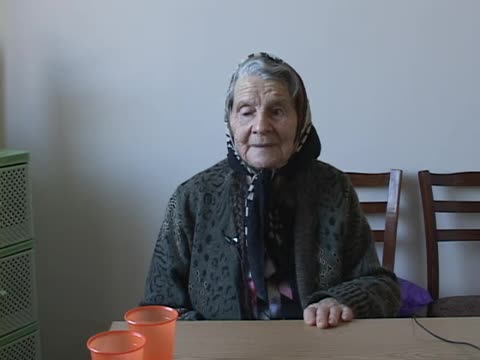
The tape is a continuation of a formal interview with Malka Zelikovna Altman. Altman answers a number of dialectological questions from the AHEYM Yiddish questionnaire.
Opening exchange about the recording. Altman says she knows Yiddish as well as Russian, and Kerler compliments her Yiddish and asks what she remembers. She starts to say that her wartime evacuation experiences cannot be written down, and that she lost the sight of an eye. The transcript here does not clearly show dialectological questions.
The transcript shows talk about her Yiddish and the start of her evacuation story rather than clearly dialectological questions.
Altman recounts her evacuation. She was thrown off a train and became gravely ill, was taken to a hospital, and was separated from her parents when she went for bread. She describes how she refused a man's proposal because of her promise to wait for her husband. A friend cared for her in hospital, and a man who worked for the railway helped save her. Kerler asks who threw her off and who rescued her.
Shows her refusal of a marriage proposal and her hospital recovery, and that she was separated from her parents.
Altman speaks about finding her sister and about her husband's reaction after the war. She had lost an eye, and he stayed devoted to her. She describes their good, modest married life. She also says she lacked only a year to reach one hundred and answers Kerler's questions about the evil eye and the folk remedy of quenching coals.
Includes talk about her husband's letters and marriage, and a Yiddish phrasing about aging.
Altman talks about postwar Jewish life and the difficulties practicing religion. She then answers a series of dialectological questions from the AHEYM Yiddish questionnaire. Altman also talks about life today.
Altman talks about postwar religious life, saying that Jews who tried to pray in a house were driven out, with prayer books burned. She then answers a long series of questions about Yiddish vocabulary and usage, including words for honest, pious, Hasid, convert, sick, 'please', street, river, well, bucket, vodka and flowers. In between she comments on non-Jews and prayer and expresses distress at news of violence in Moscow. She says people may speak Yiddish differently from her.
Shows a stretch where Altman reflects on violence in Moscow and on Jews and non-Jews, and a second voice joins briefly.