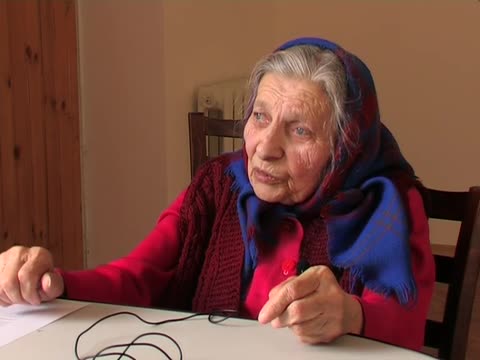
The tape is a continuation of formal interview with Beila Naftulevna Reizman. Reizman talks about her life after the war, after she returned to Tighina. Three of her brothers died at the front. She explains that her home was destroyed and non-Jews stole her family’s possessions. Reizman rented out a place from her neighbor for two years. When Reizman began working at the 2:09, her and her sister were given an apartment.
Reizman recalls the time after the war. Three of her brothers fell at the front, and nothing remained of the family home, since non-Jewish Moldovan neighbours had carried off the belongings. A neighbour rented the family a small room for a year or two, after which Reizman worked at a workplace (name unclear) and she and her sister were given an apartment. She comments that Jewish life continued but was not what it had been before.
Adds the neighbours' rented room and Lemster's questions about how long she lived there.
Reizman answers questions about Jewish life after the war. The synagogues were wrecked and everything taken out of them, though people might gather privately to pray. A ritual slaughterer came later, but she does not remember who he was or where he came from. Lemster also asks whether she lives alone now.
Asked about Yiddish sayings and curses, Reizman says she remembers none, and recalls her father kissing the mezuzah, praying in a tallis and being buried in his tallis. She says her mother did not sing and that she herself remembers no Yiddish songs, jokes or wise sayings. Lemster repeatedly prompts for anything she heard from her parents.
Adds the burial in the tallis and the failed prompts for songs and sayings.
Reizman answers a long Yiddish dialect questionnaire from Lemster, who gives Russian words and phrases and asks for the Yiddish. Items include greetings, thanks and requests, household and building words, taste, comparatives and adverbs of time and speed, illness, flowers, trees, body parts, numbers and pronouns of address, and some religious terms. She frequently says she has forgotten the Yiddish and answers partly in Russian, with a second person occasionally prompting her. The passage also touches briefly on her family and on the Germans.