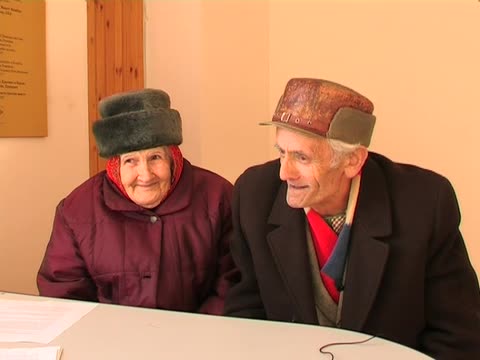
The tape is a formal interview with Meyer Khaimovich Furman, born 1925 in Bălți, and his wife Tsipora Yankelevna Furman, born 1934 in Serbeshty. Meyer provides personal information and talks about his family. His father Chaim was born in Yarmolyntsi*, Ukraine and worked as a contract laborer for leather workers. Meyer grew up with one brother and a sister. After the war, Meyer was a leather worker.
Furman answers Lemster's questions about his parents and siblings. His father Chaim came from a place that sounds like Yarmolyntsi and was a shoemaker or leather worker. His mother's name and the grandmother Rachel are mentioned, and he had a brother and a sister who was killed.
Names his mother and grandmother and says his sister was killed.
Meyer discusses his childhood memories and games. In particular, he explains the game with nuts. Meyer celebrated his Bar mitzvah at the Bălți synagogue. He then talks about his education. His parents hired the private tutor Arn Moyshe for his religious education. Meyer attended a Romanian school.
Furman recalls childhood games, including a game played with nuts, and his bar mitzvah at the Bălți synagogue, which no longer exists. He did not attend cheder but was taught privately at home by a rebbe (called R' Moshe). He also studied in a Romanian school and not in a Soviet one.
The tutor is a private rebbe, whose name is given as Moshe.
Furman describes prewar Sabbath observance: no work was done, and the family went to the synagogue. He talks about the food, kugel and the mother's candle-lighting, and mentions a non-Jewish neighbor who lit the stove. He says he read Yiddish, mainly the Pentateuch, and remembers no Sabbath songs.
A non-Jewish neighbor who kindled fire on the Sabbath is mentioned.
Meyer discusses prewar Jewish life and holiday celebrations, including food customs. He then briefly mentions prewar cultural life, in particular a Yiddish theater from Chişinău. When Meyer talks about Sukkot, he explains that they put up sukkah in the hallway of their home.
Furman talks about prewar synagogues in Bălți and holiday food: Passover honey cake, Hanukkah latkes, Purim pastries and Shavuot dairy. Lemster asks about Purim plays and a travelling Yiddish theater company from Chișinău. He says the sukkah was built in the hallway of the house, and he also answers about Tisha b'Av and gefilte fish.
Covers Passover, Hanukkah, Shavuot and Tisha b'Av foods as well.
Meyer talks about prewar Jewish life and occupations, as well as mentions non-Jews who spoke Yiddish. Meyer then discusses his profession as a leather worker. He learned and worked with his father before the war. Meyer describes how he made a cap with ear flaps. Meyer briefly addresses prewar cultural and Hasidic life, before he talks about how people went to see the rebbe of Stefanesti with a coachman. Meyer went to see the rebbe of Rîbnita Chaim Zanvil (ben Mosha) Abramowitz after the war. He also remembers postwar Yiddish theater.
Furman discusses prewar occupations, Jewish organizations and non-Jews who knew Yiddish. He describes learning the hat-making trade from his father and the parts of a cap with ear flaps. He recalls Yiddish entertainment, Hasidim, and travel to see a rebbe, including the Ștefănești rebbe by coachman. He visited the Rîbnița rebbe after the war.
Includes the terminology of parts of a cap and a Jewish bank and organizations.
Furman answers questions about terms and expressions, including a good place for burial and the use of the word Litvak. He explains that Bessarabian Jews were called Romanian Jews. He then talks about attending prewar Jewish weddings, with the groom's procession and klezmer musicians.
Tsipora sings a wedding song she remembers from her childhood, before Meyer continues talking about weddings. Meyer states that people would put up a wedding canopy after the war. Meyer and Tsipora then discuss food customs.
Tsipora recites a wedding verse she remembers, and Lemster asks about other songs. They discuss matchmakers, the writing of betrothal contracts and wedding customs. Then they turn to food terms such as kugel, stuffed dishes, sweet and sour dishes, horseradish and rye bread, and whether Jews drank brandy.
Meyer and Tsipora talk about folk remedies and recall sayings. They recall Chanukah celebrations. Meyer then answers questions about cultural terminology, before he talks about burial and other religious customs.
Furman and Tsipora discuss folk remedies and sayings, the evil eye and the use of coals, and Hanukkah customs such as the dreidel. Lemster asks about terms such as dybbuk and golem and about funeral and cemetery customs. They also talk about memorial days, grave visits and blessings for the dead.
Includes the terminology questions and sayings tied to cemetery visits.
Meyer talks about his life during the war. He evacuated near Rostov, Russia, and then to the Samarkand region in Uzbekistan. Meyer was drafted into the Red Army in Uzbekistan and went to different cities in Azerbaijan. Meyer returned to his home town Bălți in 1946.
Furman describes the war years: evacuation first to the Rostov region, then to Uzbekistan near Samarkand, where he was mobilized into the Red Army. He served in several places including Azerbaijan, and returned to Bălți in 1946.
Meyer talks about his return to Bălți in 1946 and explains that his house was entirely destroyed. Meyer’s brother-in-law received an apartment through his job and Meyer’s family moved in with him. It happened to be his grandmother’s house. He then discusses Jewish life after the war. According to Meyer, the community reopened the synagogue and it functioned until 1961. After the closure, the community rented an apartment to hold services. Meyer briefly mentions contemporary religious life.
Furman says he did not find his house on returning to Bălți, as it had been burned. The family lived in his grandmother's house through the state. He then describes the postwar synagogue, which operated until 1961, and a rented apartment used for services afterward. Today a minyan is still always present.
Notes that the grandmother's house was where the family lived.