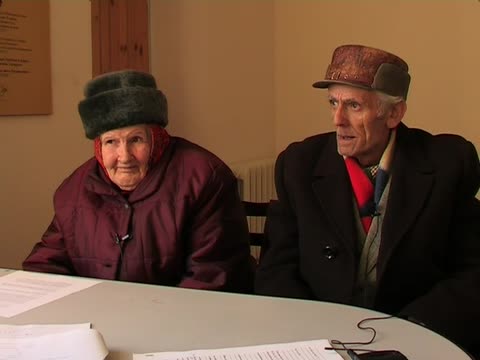
Lemster puts items from the dialectological questionnaire to the Furmans, often prompting in Russian. Items include bed, garden and small tree, vodka, 'in three days they will come', numerals, names for family and relatives, street and river words, parts of the body and clothing, flowers, the shop, a few adverbs and sentence constructions, and a request for proverbs. The Furmans answer in turn; the husband mostly answers and the wife adds corrections.
The wife also answers, and kinship terms, household words and sentence translations are covered.
Tsipora tells anecdotes about Hershl Ostropoler: when he stayed at married couple's house and when he celebrated Passover. She also tells other folk tales. Tsipora then recites a Purim shpiel.
Asked for anecdotes, the wife tells several stories about Hershl Ostropoler. In one he tricks a miserly aunt who is cooking for Passover; in another he deceives the community by claiming his wife has died so he can afford Passover. She tells others, one about him as a matchmaker earning kopecks. Lemster then asks for a Purim song, and she recites a short Purim rhyme. The husband says he cannot recall one.
Mirenburg, nee Grinman, provides personal information and talks about her return home to Sguritzy from the ghetto and life after World War II. Mirenburg finished her school education after seven grades and then moved to Soroca to become a nurse.
Mirenburg gives personal information. She was born in Sguritzy in 1928 as Dina Grinman, daughter of Avrom, and her married name is Mirenburg. She describes the family's walk on foot back to Sguritzy from the camp after liberation. After the war she finished the seventh grade and went to Soroca to train as a nurse. She also explains that she was called Dania at home, and her mother's pet name for her.
Gives her maiden and married names and the different names she was called at home.
Mirenburg talks about her family. Her father, who owned six hectare land, was also born in Sguritzy and traded in grains. Her mother was a homemaker and owned a small grocery shop. Three of Mirensburg's cousins live in Israel. She then recalls her paternal grandmother and how she inherited a pair of earrings from her.
Mirenburg describes her family. Her father, from Sguritzy as were his father and grandfather, traded in grain and the family owned about six hectares of field. Her mother had two names and kept a small shop. She says three cousins live in Israel, and that people in the family speak a mixture of languages rather than Yiddish. She recalls her two grandmothers, Rokhl and Etl, and how Rokhl's will left her a pair of gold earrings. She later bought similar earrings and gave them to a grandchild as a keepsake.
Covers the grandmothers' names and Rokhl's will in detail, and the family's mixed everyday language.
Mirenburg discusses about holiday celebrations, in particular Sabbath with her father. She then talks about prewar Jewish life in Sguritzy. According to Mirenburg, 15,000 Jews lived there before the war.
Mirenburg talks about her family's observance, including Passover and the writing of a Torah scroll funded by a great-grandfather's gold chain. She describes Sguritzy before the war, saying there were fifteen thousand Jews and at least three synagogues; one on her street later became a school. The family kept separate dairy and meat dishes. Kerler asks about the Torah scroll and the synagogues.
Adds the Torah scroll written with the family's gift and the three synagogues.
Mirenburg talks about her education at a Romanian school and her training at the medical institute in Soroca. Her father hired a private tutor from Soroca for Mirenburg's religious and Hebrew language education. Mirenburg grew up with two brothers and one sister.
Mirenburg describes her schooling in Sguritzy in a Romanian school and her later nurse's training in Soroca, taught by named local doctors. Before the war her father hired a tutor from Soroca who taught her the Hebrew alphabet at home. She remembers the letters but little of the lessons and says she learned no Yiddish reading. Kerler and Lemster ask about the teacher and the lessons.
Adds the doctors who taught her and the question of Yiddish reading.