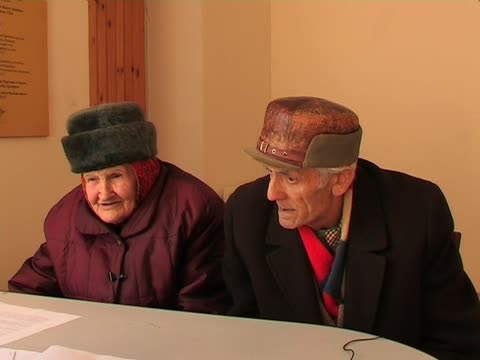
The tape is a continuation of a formal interview with Meyer Khaimovich Furman and his wife Tsipora Yankelevna Furman, nee Shtekhman. Tsipora provides personal information and talks about Jewish life in prewar Sîrbesti (Serbeshty) with roughly two hundred Jewish families. Tsipora explains that they set up a Jewish colony there in 1923. Tsipora then talks about her family. Her father, born in Capresti, was a merchant for wood 4:11. She grew up with one sister and three brothers. Her mother was born in Vadul-Rascov.
After opening talk about a television broadcast and where the couple live now (Bălți), Furman gives her personal data: her name and the surname Furman, with Shtekhman as her maiden name. She was born in Sîrbești (Serbeshty) in the Sîngerei district, which had about two hundred Jewish families and was a Jewish colony before the war, set up in 1923. She then talks about her family: her father was a merchant, her mother was named Hana, and she names her grandmother and grandfather. She was one of five children, with brothers and sisters including Sender, Esther and Mordkhe.
The father's birthplace and the number of siblings are unclear in the transcript; no sister-and-three-brothers split is clear.
Tsipora talks about her education. She only attended a Romanian/Russian school for two years before the war. After the war, Tsipora completed ten years of schooling and worked as a librarian 7:03. Tsipora discusses her childhood memories and holiday celebrations, in particular Sabbath and Chanukah. Tsipora then recalls Passover celebrations when she danced on the street with the religious teacher (melamed) Berl. Her brother studied with Berl in religious school (cheder). Tsipora maintains that studying with melamed Berl was more expensive than with melamed Hershl.
Furman says she finished two classes before the war, one year in Romanian and one in Russian, with no Yiddish, and ten classes after the war, then worked as a librarian. She recalls childhood games and sledding. She describes the Sabbath at home: her mother's candles, the oven-kept cholent and the baked bread. She recalls a spring outing with the melamed Berl, who danced with the children by the river. She explains that her brother studied in Berl's cheder, which cost more than Hershl's. She also describes Hanukkah dreidels, gifts, matzo brought from Capresti, and the turkey fattened in the attic from Purim until Passover.
The catalogue sentence misses the Hanukkah and Passover food customs and the two-language schooling, which the transcript shows.
Tsipora talks about her life before the war. Her family kept geese. She then talks about food customs, including recipes, as well as holiday celebrations. She then describes the Jewish colony in her home village. Tsipora lists the different agricultural products they grew, as well as addresses religious life with Rabbi Chaim Silverman and kosher butcher Hershl. Tsipora and Meyer recall chalutsim (early pioneers to Israel).
Furman talks about fattened poultry, holiday dishes, Shavuot food, Purim gift-sending and meat cutlets. She says few non-Jews spoke Yiddish. She describes the colony's farmers working the land, and the crops grown. She names the village rabbi Chaim (surname given as Feinzilber, then Zilberman) and the shoykhet Hershl, neither of whom returned from the war. She and her husband are asked about chalutsim and about collecting money for Palestine. She also talks about the cemetery in Capresti, where her father and grandfathers are buried.
Also covers non-Jewish Yiddish speakers, the Capresti cemetery and a question about theater, not only the colony and chalutsim.
Furman explains how she prepares gefilte fish: the stuffing, the cooking with potatoes, and the care she takes over the skins. She recalls helping her grandmother with this work. She is then asked for a favorite family recipe and describes beef cutlets with the ingredients and quantities. The passage is mostly fish and cutlets rather than tzimmes.
The passage mostly concerns the fish and beef cutlets; tzimmes is not clearly heard.
Furman answers a few questions about customs and terms: a word for the matzo eaten at the end of the seder (?), what is asked for at a holy place, and an expression about speaking at night. The answers are brief and partly unclear.
Tsipora talks about her life during and after World War II. She evacuated to the Rostov province first and then to Kazakhstan. Tsipora then talks about her return home after the war in 1945. They moved into her grandmother’s house. She and her sister continued working in agriculture on fields owned by non-Jews. They owned two hectare land and grew wine. They moved to Bălți in 1949 to live with her uncle and lived there for three months, before building their own house.
Furman recalls evacuation to the Rostov region and then Kazakhstan, and the return after the war. The family lived four years in her grandmother's house in the village. She and her sister worked for non-Jewish neighbors for pay and food; the family had had eleven hectares before the war, but took only two afterwards. Lemster asks for the Yiddish and Romanian words for vineyard and grapes. She says the father did not return. She also mentions relatives and a pharmacist in Capresti, and that they moved to Bălți in 1949 to her mother's brother, staying three months before buying and extending a small house.
The transcript also shows the questions about Romanian and Yiddish words for vineyard and grapes, and the pharmacist in Capresti.
Dialectological questionnaire with the couple, led by Lemster with Russian prompts. The items include greetings, 'please', 'thank you', congratulations and 'good luck', and words such as book, window and house. They also cover sour, cold, deaf, kiss, later, faster, near, believer, cross, peasant and mountain, plus short sentences to translate, such as 'he came today', 'in the beginning' and 'my head hurts'. The two informants often answer in turn, and Lemster checks whether both use the same word; the passage ends on where the couple come from.