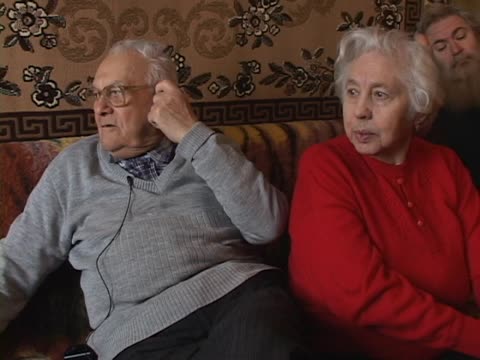
Semyon talks about prewar religious life, in particular his religious education at a cheder. Semyon attended cheder, before going to a Romanian school. He also addresses Sabbath celebration at home.
Katerberg answers questions about a rabbi's wife in the village and about cheder. He went to cheder every day except Sabbath, and afterwards to the Romanian school. Lemster asks how his mother blessed the candles on Friday evening and what she wore on her head. A concluding stretch is about the end of the Sabbath and the 'good week' greeting.
The passage also covers the rabbi's wife and details of the mother's Sabbath candle blessing.
Semyon talks about his work before the war. After graduating from school, Semyon worked at a mill until 1940. He then worked for the Executive Committee of the District Soviet of People's Deputies in Lipcani until 1941.
Katerberg talks about the ritual slaughterer, who came every week from Cotiujeni and served several villages, including a trip to Lipcani. Lemster and Kerler ask about rabbis and the 'good Jew' to whom people travelled. S3 tells the saying about a non-Jew who speaks Yiddish, and Kerler compares this with a Yiddish-speaking Ukrainian he met in Sharhorod. It ends as Lemster asks him a question about his time as a chairman.
The passage adds a saying about Yiddish-speaking non-Jews and talk of rebbes visited.
Semyon talks about his work as president of two kolkhozy (for four and sixteen years) after the war. Specifically, he addresses how he was accepted as a Jew and antisemitic stereotypes during the war.
Katerberg recounts being elected kolkhoz chairman in two villages, for four years in one and sixteen in the other. He tells an anecdote about a meeting where he answered a remark that there had been no Jews at the front. He says he spoke Moldovan in the Moldovan village and Russian in the Ukrainian one, names other Jewish chairmen, and tells of seminars at which he had to tell Jewish anecdotes. The talk ends with Lemster asking about awards.
The passage adds the language he used in the two villages, other Jewish chairmen and the seminars with Jewish anecdotes.
Semyon lists his military decorations. He states that the received sixteen different medals. He then talks more about his work on the kolkhoz. He graduated from an economic institute.
Katerberg lists his decorations, including the Order of Lenin and a number of medals. He says he was in the countryside but did not deal with agriculture itself, since specialists did that; he graduated in economics at Lipcani, a degree he completed in 1948 at the time of his wedding.
The passage adds that he finished the institute in 1948, the same year as the wedding.
The Katerbergs speak about their traditional wedding with a rabbi in Lipcani in 1948. Tatyana describes where they put the canopy and also addresses food customs.
The Katerbergs talk about their 1948 wedding in Lipcani, held under a canopy next to the house. They discuss the rabbi who spoke in Yiddish, the music at the wedding, a relative who stood in as a 'sitting' sponsor, the dancing and drinking, the small number of guests and the cake that was baked. Lemster and Kerler ask the questions.
The passage adds the language used at the wedding, the guests and the music.
Katerberg gives a recipe for flodn (a layered pastry with filling), from walnuts, honey and jam, baked in the oven and cut into pieces. They also discuss what Yiddish called the ingredients.
The Katerbergs discuss the bride's and the groom's guests at weddings and where the groom's guests sat. They say that after the wedding they lived with the wife's parents in Lipcani until 1959, when he left for a kolkhoz.
The passage adds the terms for the wedding guests and who lived with whom.
Tatyana briefly speaks about her life during the war. She evacuated with her mother. They then speak about Jewish life before the war, in particular occupational structure.
Katerberg says she spent the war in evacuation with her mother, while her father was in the army. She and Katerberg then talk about the few Jewish families in the village and its tradesmen, including a tailor and a furrier, and the terms for a stream and river. Kerler asks about folktales.
The passage adds the village's few Jewish families, tradesmen and words for river and stream.
The Katerbergs answer questions about terms: what 'getoyg' means and the folk cure of 'speaking away' illness by a Christian woman healer. The woman took coal and spoke words over the person, charging nothing. Lemster asks about doctors in the village.
The passage adds the healing practice and the terms asked about.
Semyon speaks about prewar Jewish life, including the local mohel and doctor. He then states that his son was circumcised in Chernivtsi in 1949. Tatyana then speaks about Yiddish books at home.
Katerberg says there was no doctor in the village, and the mohel and ritual slaughterer came from Cotiujeni. Their son's circumcision was done in Chernivtsi in the Soviet period, followed by a small celebration at home. Kerler asks about libraries and books at home; Tatyana says her teacher taught her at home from Yiddish primers and recalls a Russian rhyme.
The passage adds the lack of a village library, the home tutor and the mohel.
The Katerbergs recall the Yiddish theater of Sidi Tal in Lipcani and travelling troupes, and the question of film. Kerler asks about words such as dybbuk, golem, apostate and convert, and the Katerbergs say what they remember about them.
The passage adds the terms asked about and the travelling troupes.
Tatyana shares her recipe for kamish broit. They then talk about food customs in general and Tatyana explains how she prepares "esikfleysh" (meat in sweet and sour sauce). She then describes how she cooks stuffed goose neck.
Katerberg gives recipes for kamish bread and esikfleysh, the Jewish meat dish in sweet and sour sauce. She also describes filled goose neck and giblets, stuffed fish, kishke and potato latkes made for Passover. Kerler and Lemster ask which dishes were Jewish and what they were called.
The passage adds other dishes: esikfleysh, giblets, kishke and latkes.
Kerler and Lemster put questionnaire items to the Katerbergs: the words for 'earlier' and 'once', how to say them in Yiddish, and a song for Passover. They also ask about serenades before the wedding canopy.
The Katerbergs talk about how they met after the war. Tatyana's mother brought them together, she explains. Tatyana then talks about her parents. Her mother worked at a brick factory during the war in evacuation.
The Katerbergs tell how they met after the war: Tatyana's mother met him at the market and brought him home. Tatyana was sixteen and still in school, so her mother did not want her to marry yet; he returned a year later. She also talks about her parents: her mother was shot in the war, her father was an atheist who liked a drink, and her mother lit candles.
The passage adds Tatyana's account of her parents, which the catalogue places in evacuation.
The Katerbergs talk about contemporary life: they speak Yiddish together only a little, do not hear Yiddish broadcasts, and there are few Jews in Briceni. They say they have no contact with former residents, apart from a quarrel with a relative in Israel. Kerler and Lemster thank them and end the interview.
The passage adds the lack of contact with former residents and Yiddish broadcasts.