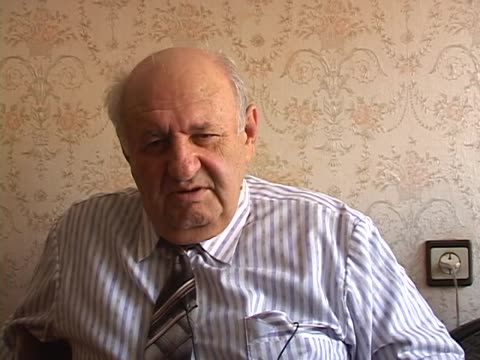
Roif talks about contemporary Jewish life and financial support. He also addresses his work in community service and the relationship between the community and the Romanian state.
Roif talks about the present day: speaking and losing Yiddish and Hebrew, his daily unpaid community work, help to sick and elderly Jews through a German sponsor, and payments made to homebound people. He then speaks about Romania's official recognition of the Holocaust, the denial of it by ordinary Romanians, and the estimated numbers of Jews killed in Bessarabia. Kerler asks which government recognised it, and a passage on Jews without citizenship follows.
The passage also covers the number of Jews killed in Bessarabia and the status of Jews without citizenship.
Roif speaks about the fate of regional communities during World War II. He then addresses his life during the war in the Obodivka ghetto. Roif explains how he was saved by a priest.
Roif speaks about the shooting of Jews from Bessarabia, Bukovina and Chernivtsi, and says he and his wife spent three years in the ghetto and camp at Obodivka. A priest and his wife saved them from being shot while they were locked in a small building. He describes the Jewish badges they wore. Kerler asks about the priest's name and where the ghetto was; Roif places it in Ukraine, near Bershad'.
The transcript also includes an exchange about Bershad' and Kerler's Moscow origin.
Roif speaks about contemporary Jewish life and presentations about life during World War II. He then speaks about his family and briefly touches upon his life during the war. Roif's father was an American citizen and worked there on a cow farm and sold products in the city for six years, until 1929. Roif grew up with one brother and his father was born in Pererita, Moldova. Roif's mother was also born in Duruitoarea. Roif explains that his family was well off with his father's earnings in America and they ran a family homestead farm.
Roif first mentions planned commemorative events, then answers questions about his family. His father Avrom worked in America for six years on a dairy farm outside New York and returned in 1929. His grandfather Khayim was a rabbi in the area of Briceni (Britshan) and Lipcani (Lipkan), and his mother Rive came from Duruitoarea. The family was wealthy from the father's American earnings and kept land, livestock and servants.
The passage also covers Roif's grandparents and his mother's family.
Roif speaks about prewar Jewish life in Duruitoarea, where Jews lived in a colony spread across three villages. He mentions that his father supported the village synagogue. According to him, 160 families lives there.
Roif speaks about prewar Jewish life in Duruitoarea: a commune of three villages with a single synagogue (klois) supported by his father, and about 160–170 families (the number is not fully clear). He begins to say that the Romanians started shooting from their first day.
Roif speaks about his family's life at the beginning of the war, when the Romanians occupied Duruitoarea. Roif recalls shootings upon arrival of the Romanian army and explains how his escaped with the help of a priest in 1940. He then describes how he went through various camps, including a camp, located twenty-five kilometers from Rîşcani (for three months), a cowshed in Transnistria (for two years), a cowshed on the Dubyna state farm as forced laborer (for two years). Roif remembers looting, but also mentions a Romanian soldier who brought food on a weekly basis to the first ghetto. Roif then describes the living conditions during the winter, as well as diseases in the cowshed. He then addresses life and starvation on the state farm.
Roif describes the arrival of the Romanians and how a priest rescued the family from a gendarme, then a camp near Rîșcani, the Transnistria cowsheds, and forced labour on the Dubyna state farm. A good gendarme chief who shared out food is mentioned, as are looting and the harsh winter, disease and death in the cowshed. He also speaks about hunger on the farm, Antonescu's order of 1943 to count the Jews, and the Jews who survived.
Roif speaks about his life in the Dubyna forced labor camp between 1942 and 1944. He describes religious life and his bar mitzvah in the camp. Roif mentions that he visited the camp and addresses memorialization.
In answer to Kerler's question, Roif talks about religious life in the Dubyna camp, where he turned thirteen and had his bar mitzvah, and about two rabbis there, a makeshift prayer room and a Torah scroll later in Israel. He says he laid tefillin and was called to the Torah, and that he still has the tefillin. He mentions plans to visit the camp and the importance of remembering.
Roif speaks about his family's fate during the war. His family was also imprisoned in the Dubyna forced labor camp. Roif remembers how his father snuck out from the camp at night to provide food for his family.
Roif says his wife and parents were in the same camp, with his wife's mother ill. His strong father crawled under the wire at night to find work in the village and bring food, and the family counted bones before eating them.
Roif describes sleeping on straw in the Dubyna camp and the singing there, including new songs composed about their sufferings. Kerler asks about the song "Oy vey, tsores". Roif says his wife may remember songs, and they briefly discuss how the recording will be archived.
Roif provides personal information. He then speaks about prewar Jewish life in Duruitoarea, as well as his education. Roif attended a Romanian school and religious school (cheder), which was located in the local synagogue. Roif learned in cheder, except for the winter months, until the outbreak of World War II.
Roif answers questions about his name Shabs and its variants, and about his prewar education: the Romanian school and a separate Jewish school (cheder) held in a rented house and supported by his father, taught by hired teachers. He did not attend in winter, studied Hebrew and the alphabet, and mentions the form of address to the teacher. He and Kerler also discuss the Hebrew of the region and Shraybman.
Roif addresses prominent Yiddish writers, including Yekhiel Shraybman, Yankl Yakir and Vaysman, and their persecution during the postwar Soviet period. His father subscribed to "Sovietish Heymland." Roif speaks about his encounters with Yakir and Vaysman.
Roif speaks about Yiddish writers who visited or came from the area: Yekhiel Shraybman, Yankl Yakir, who was arrested after the war in the campaign against Jewish writers, and Vaysman. His father subscribed to Sovetish Heymland. He describes Yakir's son visiting his kolkhoz, knowing Vaysman in Israel, and the shoykhet Ari Meir.
The passage also covers Roif's work as a kolkhoz chairman and the shoykhet of a neighbouring village.
Roif discusses his childhood memories. He explains how his father arranged transportation to the neighboring village, where Shraybman lived, to invite him for Sabbath celebrations at Roif's home. He then addresses his father's financial support of the local community and describes prewar Jewish life and occupational structure in Duruitoarea.
Roif recalls how his father sent a cart to a neighbouring village on Fridays to bring Shraybman for the Sabbath and helped him. He also describes his father's generosity to poor Jews, prewar poverty among craftsmen such as shoemakers and tailors, a Jewish tavern keeper and the rich Jew Tuve Vinkelshteyn, who with his father helped others.