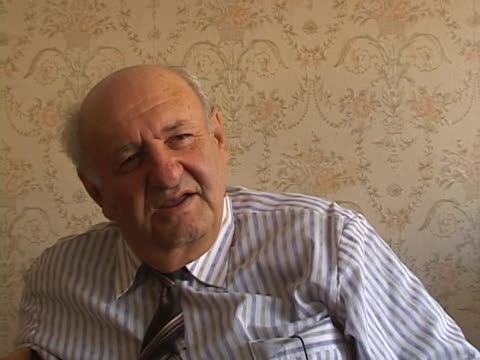
Roif discusses his life and work after the war. He ran a kolkhoz in Duruitoarea for twenty years, where he built a chicken factory. He talks about the workers and describes his achievements. Roif left the kolkhoz in 1976.
Roif talks about the years after the war, when he ran a kolkhoz for over twenty years. He describes choosing his own specialists, the workers' trust in him, building a processing and drying factory with technology he learned of in Bulgaria, and the profits and orders he received. He also recalls buying timber in Russia, the old Soviet prices, and how hard conditions are for farmers today.
Gives details of the factory built with Bulgarian technology, buying timber in Russia and today's farm hardship, beyond the chicken factory the catalogue mentions.
Roif says he no longer remembers the blessings he once learned, and Kerler asks about prayers. He then answers questions about prewar Purim, with baking, visiting and going to synagogue, and says holidays were kept before and after the war. He remembers Purim plays and house-to-house performances that lasted until the war.
Roif says he has forgotten the blessings; also covers Purim plays and house visits.
Roif speaks about his life during World War II. He explains how his family returned home and Romanian soliders already occupied their home. According to Roif, the soldiers permitted his family to live there as well. He then describes how the Romanians assembled local Jews for deportation to a camp near Rîşcani; before Roif addresses the living conditions in the camp. Roif continues by describing the journey to the Dubyna camp, via woods near Cosăuţi, Romania.
Roif describes his family's wartime ordeal. He mentions a wealthy local mill owner, Winkelstein (?), and his father's house built with money earned in America. The gendarmerie took over the house, then gathered the Jews of the village in the yard of a neighbor's house and took them to a camp at Rîșcani, where they spent three months. He describes the hunger, disease and lack of water, then the forced march toward Dubyna. Near Cosăuți the marchers were shot into pits, and Roif spent a night in a pit after falling in with a doomed group. He also recounts atrocities he witnessed, including the shooting of a pregnant woman.
Roif mentions the family home built with America money and the Winkelstein mill owners, and adds the shooting of a pregnant woman and a night spent in a pit.
Roif discusses his childhood memories of Jewish Duruitoarea. He recalls Hasidic visitors and describes how his father visited the Ştefăneşti rebbe when his mother was ill. Roif explains how the rebbe called for the doctor, who already gave up on his mother. The doctor eventually cured Roif's mother, according to him.
Roif answers Kerler's questions about prewar books and Jewish life in Duruitoarea, saying there were few religious books and no library before or after the war. He recalls Hasidim visiting the villages and his father's visit to the Ștefănești rebbe when his mother was gravely ill. The family doctor, also from Ștefănești, had given up on her; the rebbe summoned him and asked him questions, and she recovered and lived to ninety. Roif also mentions his father's work for the landowner Burski (?) before his emigration to America.
Roif adds that his father had worked for a landowner and the absence of a library or Yiddish books, and mentions the destruction of Torah scrolls; the family reached Yampil on the deportation road.
Roif continues the march toward the Dubyna camp, near Yampil. His mother, barefoot and exhausted, collapsed, and the family refused to leave her. They paid for a cart to carry her, and Roif and his brothers continued on foot, tied to a brother. Their father was briefly lost on the road and rejoined them to great joy.
Roif answers questions about cultural terminology. He then describes the living conditions in camp near Rîşcani during winter. Roif describes how people buried the corpses underneath snow and planned to bury them during spring. Roif recalls people savaging the corpses.
Kerler asks about the term for a good Jew and the Yiddish name of a cemetery, which Roif gives as a holy place; Roif describes the winter in the camp near Rîșcani. People froze, starved or died of disease. The bodies could not be buried in the frozen ground and were left under snow, where dogs ate them. He then recalls a nearby site at a station where a Russian colonel was friendly and thousands of Jews from Bessarabia and Bukovina were shot.
Begins with questions on the meaning of 'a good Jew' and the term for a cemetery, and adds a site where thousands of Jews were shot near a station.
Roif addresses regional Yiddish dialects. He also mentions Adrian Popovich, who rescued Jews from Chernivtsi, and historians of local Jewish history during the war.
Kerler asks whether Bukovina Jews spoke differently, and Roif says they spoke a Germanized Yiddish. He mentions Traian Popovici, the mayor of Czernowitz who kept some twenty thousand Jews from being sent to Transnistria. He talks about the Romanian historian Lya Benjamin, whom he met, and her volumes of anti-Jewish decrees, and says fewer were killed in Romania proper.
Roif adds the Romanian historian Lya Benjamin and her volumes of antisemitic orders, beyond Popovici.
Roif answers Kerler's questions about prewar weddings in Bessarabia. He stresses that Bessarabian Jews were strictly observant and ate only kosher food at weddings. He talks about wedding music, the master of ceremonies (a kind of guide), matchmakers and their fees, the engagement contract, and the difficulty poor girls had in marrying.
Gives details on kosher wedding food, music, the master of ceremonies and the engagement contract, which the catalogue does not list.
Roif speaks about his life after World War II. He served in the Red Army for five years. Roif then answers questions about cultural terminology. He then speaks about contemporary Jewish life and memorialization.
Roif jokes about his own wedding after five years of service in the Black Sea fleet, and says he has been married over fifty years. Kerler then asks about terms like the seven blessings, a Lithuanian Jew, dybbuk, golem, and about Hebrew in Yiddish. Roif talks about the decline of Yiddish among Ukrainian and assimilated Jews, intermarriage, and today's meetings and monuments to those shot. A Russian aside by another person intrudes.
Roif tells a comic anecdote about his marriage and describes the Joint-run community gathering, and the passage includes a Russian aside.
Kerler asks how Roif's Yiddish speakers talk about the dead, and Roif gives several set phrases for the deceased and for blessing. They discuss whether a grandfather is said to intercede with God on behalf of the living. Roif also remarks on troubles in Israel and tensions with Arabs.
Roif answers linguistic questions about his Yiddish, as well as dialectological questions from the AHEYM Yiddish linguistic questionnaire. They also discuss Jewish languages and linguistics.
Kerler puts questions on words Roif used, including some Moldovan-influenced words, and on terms for 'tied up' and 'rough', and some dialectological items. Roif says he is not confident speaking Yiddish, and they discuss Yiddish speakers in the area, Ukrainian Jews, the Hebrew and German components of Yiddish, and Ladino. Roif also mentions a Soviet dictionary from Birobidzhan. Lemster joins briefly to say that he and Roif came from neighboring villages.
Adds the discussion of Ladino and the Birobidzhan dictionary and Lemster's remark about neighboring villages.