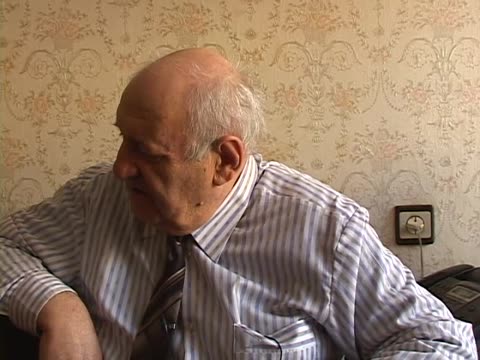
Opening exchange about a Soviet-era word list and the loss of Yiddishkayt, then Roif on his role as a patron for a community charity. He mentions sponsors, including one in Germany, and helping some forty-odd Jews. He also speaks of the writer Yankl Yakir, who visited the village before the war, and Yakir's son, an engineer who did practice in the kolkhoz and later published books in Israel. The talk moves to a writers'-union commemoration and to historians writing about a pogrom, with a death toll given as forty-nine (?). Much of this part is in Russian or garbled.
Adds Yakir's visits and his son, the writers'-union event and the pogrom death toll.
Discussion of the history of a pogrom and the Jewish hospital. Roif cites Slutski's booklet, written by an eyewitness, with a count of forty-three Jews killed (?). Lemster mentions a 1905 pogrom in a town whose name is unclear in the transcript, with fifty-two Jews affected (?).
Names the booklet by Slutski and the pogrom casualty counts.
Roif speaks about prewar Jewish life in Duruitoarea. In particular, he mentions a girl who converted to Christianity. He then remembers a Yiddish song about this topic and local Christians who spoke Yiddish.
Roif and Lemster discuss a Jewish girl who converted to Christianity, the Yiddish song about her, and the terms for a convert. Roif says his wife cannot sing it and instead retells it: the mother pleads with her daughter to come home. Kerler then asks about non-Jews who spoke Yiddish, and Roif recalls a Christian servant named Natasha who did. The talk turns to Jews as farm workers and to the humane side of relations with neighbors.
Adds the terms for a convert and Lemster's remark on Jewish farm workers.
Roif asks Kerler for a booklet and wonders whether Yiddish will die out or be strengthened. Lemster explains that Kerler is a professor at an American university, and Kerler asks Zelda to sit down and sing the song about a convert. This is conversation about the recording, not the questionnaire.
The transcript shows no questionnaire; it is Roif's question about the future of Yiddish and arranging for Zelda to sing.
Roif's wife Zelda joins the conversation and sings the earlier mentioned Yiddish song about a girl who converted to Christianity. She then explains where she learned the song.
Zelda sings the song about the girl Sanyele who converted. Her mother begs her to come home, while the Christian tempts her with shoes and dresses on condition that she wash Jewish linen. She says she learned it from a relative called Sroel/Israel from Edineț and remembers it from about seventy years earlier (?). Kerler and Lemster ask why the girl would wash the linen, and there is talk of Kerler's university in New York.
The song's performance and its source in a relative from Edineț.
Zelda sings a song urging people to be human, to live and let live, and to help the poor. Kerler asks her to repeat the first four lines and then asks whether such songs were sung in the camp. Roif and Zelda go on to relatives, a Beyle who was Mendl's wife, and an anecdote about Moyshe Vinkelshteyn the tailor and which Moyshe was meant.
Adds the repeat of the first lines at Kerler's request and the Vinkelshteyn tailor anecdote.
Roif describes the strong sense of community among Jews in prewar Bessarabia, contrasting it with Ukraine. He says that rich and poor met as equals at festivals and in the synagogue, and that a Jew was simply a Jew whatever his clothes or work. Lemster recalls a childless man from the village.
Zelda speaks about her family: a cousin or sister and her relatives who died in the camp, Feyge and Beyle, and Israel, who lived in Edineț and was in a different camp. Lemster and Zelda sort out Feyge's family, who lived in Beltsy, and how one of them died in an accident. Kerler asks about Purim plays, and Lemster asks whether she knows camp songs; she says she has not retained them.
Adds the names of relatives, Beltsy, and the Purim-play question.
Zelda sings a Yiddish song of the displaced and homeless, scattered through the kolkhozes and called Bolsheviks. It is a song about longing for home, mother and the old house. Lemster then asks whether she remembers anything else, but the passage does not show where she learned the song.
The transcript does not show the Dubyna camp as the source.
Zelda sings a Yiddish song about a bad pupil in religious school (cheder). She then sings a Yiddish song about a drunkard. Zelda then describes from whom she learned the songs in Edineț.
Zelda sings two songs. The first is about a cheder pupil, Motl, who is beaten by the rebbe and complains to his father; the second is about a drunkard in a tavern who threatens his wife. She says she learned them from Sroel/Israel of Edineț, a relative of Lemster's, but does not recall how they were taught. Lemster mentions that he held his bar mitzvah in Edineț, where musicians played.
Adds the identification of Sroel from Edineț as Lemster's relative.
Zelda recalls weddings in Edineț, including Israel's wedding at a house of someone named Luka, and Lemster and Kerler discuss a Romanian and a Russian term for the best man (?). She then tells about a relative in America who studied at a Jewish university, married a Belarusian-born man who is now a rabbi, and went through immigration paperwork. The woman is observant. Kerler adds his own airport baggage-search experience, and Lemster explains a word for the evening search.
Adds the relative in America, her marriage and the discussion of visas and a baggage search.
Lemster and Kerler ask about words, such as a measure, a coin name and mazl, before the talk turns to Passover before the war: storing and kashering vessels, and an attic chest. Lemster recalls his grandmother dyeing wool to fund his bar mitzvah. Zelda and Lemster then sort out relatives in Edineț, including a sexton and tailor, Abraham Gendelman, Malke, Shlomo and Grisha, some now in Israel.
Adds the Edineț relatives and Lemster's grandmother.
Roif and Zelda are teased by Lemster about how they met and why she chose him; Roif had served five years in the fleet. They go on to acquaintances and relatives, including people in Israel, a Rîșcani book in Yiddish by someone named Yozik (?) and a relative who left as a halutz in the 1930s. At the end Lemster and Kerler elicit a word of Moldovan origin (written as skapet) for something dropped or lost.
Adds the Rîșcani book, relatives in Israel and the word elicitation.
Roif and Lemster talk about Passover food: fattening geese, using goose fat, and potato dishes. Roif recalls his father making basturma and a visiting official who came to his kolkhoz to eat geese and fish. Roif was a kolkhoz chairman for many years. Lemster and Kerler ask how the geese were marinated and smoked, and Kerler asks for the Yiddish term for what is left after rendering fat, with griven and an unclear word offered.
Adds the kolkhoz chairman's guest and the terminology elicitation.