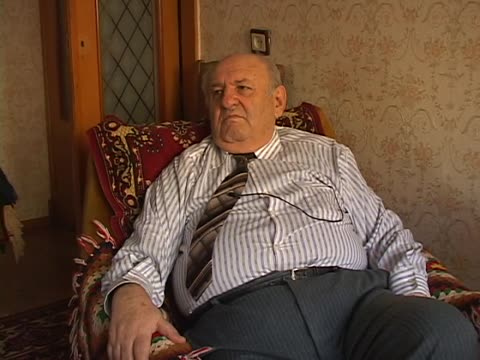
Roif speaks about life today. He then continues to answer dialectological questions from the AHEYM Yiddish linguistic questionnaire. Roif also briefly addresses his religious school (cheder) education.
Roif touches briefly on life today and on a radio presenter who asks him to speak Yiddish. He then answers a long run of questionnaire items from Kerler: everyday words, adjectives and adverbs, words for honest and religious, and Hebrew-derived words. He also gives cheder-related Hebrew phrases and speaks of knowing no Hebrew practice. A woman present joins in, and a charm against the evil eye comes up.
Includes talk of Hebrew words in Yiddish, a charm story and words for non-Jews and Christians.
Zelda and Roif talk prewar Jewish life in their hometown. In particular they recalls their homes. Roif then continues to answer dialectological questions from the AHEYM Yiddish linguistic questionnaire. Roif also speaks about his visits of the church on the kolkhoz, he ran.
Roif and a woman present describe the rooms of houses in their prewar home. Kerler continues the questionnaire with items such as numbers, vodka, tenses, and words for grandmother or midwife. Roif also says he used to visit a monastery or church and explains how Christian worship differs from Jewish prayer. He answers items on the street, lake and river, potato, flowers, and a family of seven.
Adds Roif's church or monastery visits, which the catalogue ties to the kolkhoz he ran, and the house-room descriptions.
Brief talk about life today, with a mention of food and the interviewers. The recording then moves to a second man, who mentions seven schools before the war and a large ghetto in which many thousands of Jews died.
Farber, who says he will show his shtetl and what remains of it, takes the interviewers to the Jewish cemetery. He recalls his part in clearing it in the 1990s (the year is unclear). He then discusses with Lemster the Yiddish and Russian songs he knows.
Adds the cemetery and the song discussion with Lemster.
Farber sings the wedding Yiddish song "Mekhutonim Geyn" (The in-laws are coming). He then speaks about his involvement in contemporary Yiddish festivals.
Farber sings the Yiddish wedding song about the in-laws coming, with a second person present. He then speaks about taking part in Yiddish festivals abroad, about Soviet-era censorship of Yiddish songs, and about his rewriting of an old Odessa song.
Farber sings a song about travelling to Odessa, in alternating Yiddish and Moldovan. It is a version he rewrote with verses in both languages and he says he put it on a disc.