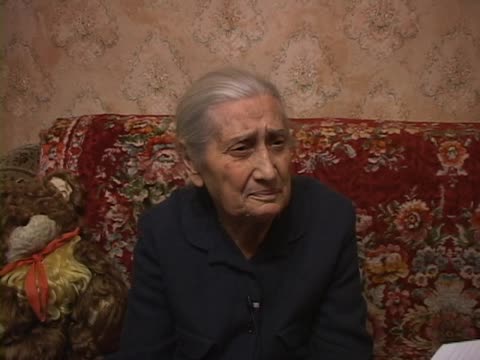
Shmid answers questionnaire items from Kerler and Lemster, with other voices repeating them. The items are sentences to translate and single words: street, road, river, water, shoulder, flower, potato and expressions like 'one and a half years' and 'various things'. They discuss variants such as plural forms and the word for 'mistake'. At the end she is invited to speak freely about her life and mentions her daughter and grandson.
Ends with a turn to her own life: daughter dead, grandson in Israel, son-in-law.
Shmid talks about her life today. After her daughter's death she has not sung, and she is alone all day, with her son-in-law as her only company. She was one of seven children and is the only survivor. A photograph made in Germany shows her grandson at his bar mitzvah. Asked about prewar photographs, she says none survive.
Photographs: a bar mitzvah picture and no prewar ones.
The interviewers thank Shmid and close the formal interview, and an informal chat follows. She says she is old and alone with her son-in-law, who lives with her, and the interviewers praise her answers and the good fortune of having him. They talk about housing and prices, America and New York, and the length of the visit. Russian passages and calling a driver occur, and the transcript is garbled in places.
The chat ranges over housing, America and the interviewers' own travels.
The formal interview with Shpitalnik begins. She provides personal information and speaks about her family. Her mother was also born in Chişinău and her father was born in the Jewish colony Dumbrăveni. Shpitalnik's father worked as accountant and was a member of the Yiddish organization Kultur-lige (Culture League). Her mother worked as cashier at a firm. Shpitalnik grew up as an only child.
Shpitalnik gives personal information and speaks about her parents and grandparents. Her maternal grandmother was widowed when her husband, from Staro-Konstantinov, fell in the Russo-Japanese War in 1905. Her mother finished a Russian gymnasium and worked as a cashier. Her father, from the Jewish colony Dumbrăveni, near Soroca, was an accountant and a member of the Yiddish Kultur-lige. She was an only child.
Details of the grandfather killed in 1905, the colony run by the Jewish colonization organization (JCA), and the parents' years.
Shpitalnik addresses her childhood memories and education. She attended a Romanian school at the age of six and took private French lessons. Her family evacuated to Bukhara, Uzbekistan. She then addresses her life after the war. Shpitalnik studied French philology at the Chernivtsi university and she was married in 1951. After Shpitalnik graduated from university, she worked at a village school, teaching English and French for five years. She then found a job in Chişinău as translator at the library of the Medical Institute, where she worked for 34 years. Shpitalnik then became the head of a department, where she published journals. In the last fifteen years, Shpitalnik has worked in the local Jewish library of the Kultur-lige. She has published several books on Jewish Moldova, as well as a calendar.
Shpitalnik talks about her childhood and schooling. Yiddish and Russian were spoken at home; she began a Romanian school at six and took private French lessons. The family was evacuated to Bukhara, Uzbekistan, and she began working at fourteen. She studied French at Chernivtsi, married in 1951, taught French and English in a village for five years, then translated medical literature at the Medical Institute library for 34 years. For fifteen years she has worked at the Yiddish library, publishing books and a yearly calendar of Jewish personalities.
Also covers her husband, a ghetto survivor from Balta, and the calendar and books she published.
Answering Kerler's questions, Shpitalnik speaks about her paternal grandparents in Dumbrăveni and her visits there. Her childhood home in Chișinău stood in a courtyard of Jewish families (the transcript reads twenty-six) with a small prayer room. The grandfather, aged 87, was killed in Dumbrăveni; her maternal grandmother ran a household and worked as cashier at a slaughterhouse. Her parents loved reading and Jewishness.
Covers the grandfather's death in 1941 and the maternal grandparents' meeting story.
Shpitalnik speaks about her visits to Dumbrăveni before the war. She also addresses prewar Jewish life in Chişinău and Dumbrăveni. Shpitalnik then talks about her father, who traveled to neighboring villages at the age of twelve and worked as private religious teacher.
Shpitalnik recalls childhood visits to Dumbrăveni, where local children gathered and a Rabbi Steinberg was arrested in 1940 and died. She describes prewar Jewish culture in Chișinău and Dumbrăveni: Yiddish and Hebrew reading and girls' professional schools. Her father, who knew Hebrew well, travelled to nearby villages from age twelve as a private teacher, was boarded by families, and later trained as an accountant.
Includes the library and rabbi of Dumbrăveni and the father's early earnings.
Shpitalnik says she learned Hebrew letters in courses about fifteen years ago, with thoughts of going to Israel. She then returns to her paternal grandfather Meir, who refused to leave and was killed, and to her grandmothers: one wore a wig and prayed in the Russian theatre building. Her maternal grandmother died in evacuation. She describes visits to Dumbrăveni as a child, travelling by horse from Bălți.
Starts with her Hebrew studies and learning to read.
Shpitalnik speaks about her education in Chişinău, as well as her mother's school education. She then addresses prewar holiday celebration (Purim, Hanukkah), including food customs. Shpitalnik recalls visiting her mother's cousin on holidays.
Shpitalnik tells of her schooling, starting a Romanian school at six without knowing the language, and of her mother's education at a Russian school and a private girls' gymnasium. She describes prewar celebration of Passover, Purim and Hanukkah at her mother's cousin Sonya Gershteyner's home. She remembers potato varenikes at Hanukkah, Purim gifts and filled pastries, and says Chișinău was a Jewish city. She did not see Purim plays.
Also covers her language difficulties at the Romanian school.
Shpitalnik speaks about prewar sports organizations, including Maccabi and Hakoach. She was a member of Hakoach. Shpitalnik recalls Yiddish apprentice schools for girls, which organized cultural evenings. Shpitalnik remembers when the Yiddish poet Yakov Shternberg visited her family and gave presentations at the apprentice schools.
Shpitalnik talks about the prewar sports clubs Maccabi and Hakoah in Chișinău. She was a member of Hakoah but not athletic. She describes Yiddish professional schools for girls, which held evenings of readings from Mendele, Sholem Aleichem and Peretz. She recalls the poet Yakov Shternberg, who visited her parents' home and taught her mother.
Details Shternberg's later imprisonment under Stalin.
Shpitalnik speaks about the prewar Yiddish press in Chișinău, including the daily 'Undzer tsayt', read by both Zionists and Communists. She says her father was somewhat left-leaning. She tells of learning Yiddish poems from a woman friend of her father's and of her father's role as a trusted mediator, and how he was broken under the Soviets.
Adds the father's social role and his fate under the Soviets.