Recordings › Chișinău

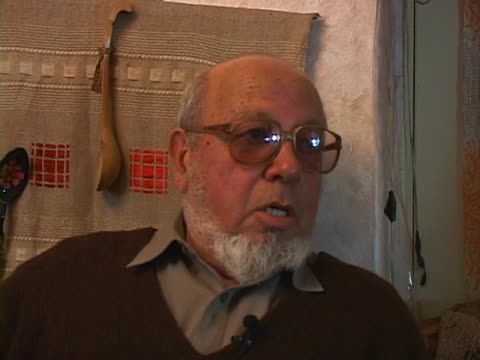
MDV 145 · Sergo Bengelsdorf

Chișinău, Moldova 20 December 2005 Interviewed by Dov-Ber Kerler, Moisei Lemster, Dovid Katz Part 2 of 3 62 min · 7 passages

One conversation with Sergo Bengelsdorf, continuing over MDV 144, MDV 145, MDV 146.

Loading the player…
Passages

0:00

Bengelsdorf speaks about his family and addresses Yiddish dialects. His mother was born in Sławatycze (Yiddish: Slovotitch), Poland and his father was born in 2:43, Poland. Bengelsdorf's father moved to Argentinia and did a tailor apprenticeship and also attended a local Yiddish drama circle. He then addresses his father's move to Birobidzhan in the 1930s and his involvment in the Birobidzhan Yiddish Theater. Bengelsdorf explains how his father went to study with Solomon Mikhoels in Moscow for four years, before returning to Birobidzhan in 1934. Bengelsdorf's mother moved to Palestine and worked as maid in a Jerusalem hospital. She then returned and studied at the Jewish workers' faculty at Moscow State University. Durin that time, Bengelsdorf mother met his father and they then moved to Birobidzhan together.

From the machine transcript

Bengelsdorf says his parents both spoke literary Yiddish at home, which his father had learned in Mikhoels's theatrical school. His mother came from Sławatycze on the Polish–Belarusian border near the Bug and his father from Łomża. His father went to Argentina, worked as a tailor and joined a Yiddish drama circle, then went to Birobidzhan in the 1930s and was sent to Moscow to train for the Birobidzhan theater. His mother had worked in a hospital in Jerusalem, was expelled by the British, and studied at the Jewish workers' faculty in Moscow, where she met his father. Both came to Birobidzhan in 1934, and Bengelsdorf was born in 1937.

Gives the Polish towns of origin (Sławatycze, Łomża) and the mother's work and expulsion in Palestine; the attribution of his Yiddish to Mikhoels's school is added.

8:04

Bengelsdorf provides personal information and talks about Stalinist persecution of the late 1930s. Bengelsdorf states that his mother evaded persecution due to her pregnancy and his father left Birobidzhan during this period.

From the machine transcript

Bengelsdorf recalls that in 1937 his pregnant mother escaped arrest while the authorities came for people each day, and that his father fled Birobidzhan for about a year, ending up on the Black Sea coast and in Odessa. He explains his first name: it was given in honor of Sergo Ordzhonikidze, who had just died. The editor of the Birobidzhaner Shtern, Kazakevich, urged the naming, and a notice appeared in the paper. His parents had intended a Yiddish name after his maternal grandfather.

Explains his name Sergo, after Ordzhonikidze, and the Birobidzhaner Shtern notice.

10:55

Bengelsdorf provides personal information and speaks about his education. He attended a music high school for seven years, until 1951, and learned how to play the piano. He also studied at a Yiddish school at the age of five until it was closed down in 1949. Bengelsdorf then attended a music institute in Chabarovsk, Russia, for four years. Bengelsdorf then began studying at the Sverdlovsk Conservatory in 1955. He also mentions that his mother was imprisoned in the early 1950s and released 1956.

From the machine transcript

Bengelsdorf talks about his schooling: a Yiddish school from the age of five, a seven-year music school where he studied piano, and four years at a music technical school in Khabarovsk, finishing in 1951 while his mother was in prison. He avoided applying to Sverdlovsk and hid his mother's arrest on the forms, and he began conservatory studies in 1955. His mother was released in January 1956. In 1949 the Yiddish theater and schools in Birobidzhan were closed and Yiddish books were burned.

Adds the closure of the Yiddish theater and schools in 1949, the burning of Yiddish books, and his concealment of his mother's imprisonment.

15:06

Bengelsdorf addresses the postwar Stalinist terror in the late 1940s. He recalls the burning of Yiddish books in 1949. Bengelsdorf then addresses his work after graduation from the conservatory. In Chişinău, he worked as pianist and concertmaster at the theater/ opera house. He then worked a instructor at the Chişinău music institute until 1991. After the collapse of the Soviet Union, Bengelsdorf began his activities in the advancement of Yiddish culture, together with Boris Sandler and Moisei Lemster.

From the machine transcript

Bengelsdorf continues on the late 1940s arrests, the murder of Mikhoels in 1948, and his mother's return in 1956. He recalls visiting a camp with his father and staying in Moscow with former fellow prisoners of his mother. He finished the conservatory and worked in Chișinău as a pianist and concertmaster at the opera theater and for many years as a teacher at the music school. With perestroika he joined Moisei Lemster and Boris Sandler (?) in reviving Yiddish culture. He then speaks of a composer acquaintance, Bitkin (?), who has become religious, and a kitchen-arrangements exchange.

Adds a digression about the religious composer Bitkin (?) and kitchen arrangements.

19:28

Bengelsdorf addresses his childhood and friends in Birobidzhan. He recalls spending time at the Yiddish theater. Bengelsdorf then talks about his contemporary work and performances. He also discusses Jewish and Russian composers. Bengelsdorf also addresses Tkach's compositions.

before the warlife today ChildhoodTheaterSongs and musicWork and trades · MCO
From the machine transcript

Bengelsdorf recalls spending his childhood with other actors' children at the Birobidzhan Yiddish theater, then speaks about his work as a pianist and music critic in Chișinău. He describes Yiddish concert life, including the compositions of Zlata Tkach and singers such as Eliashe, and a festival in Birobidzhan with guests from Moscow, Israel and America. He also discusses Russian composers' interest in Jewish music and Shostakovich's Jewish song cycle. Interviewers ask about Prokofiev, the performers and the Russian texts. The passage ends with preparations for filming music, with Russian talk about microphone placement.

Adds his own work as music critic, the Birobidzhan festival, and the discussion of Shostakovich and Prokofiev.

38:15

Bengelsdorf accompanies professional Yiddish singers on piano.

Singing Songs and music · MCO
From the machine transcript

A filmed music session in which Bengelsdorf accompanies Yiddish singers on piano. The speech in this stretch is mostly garbled and covers a Yiddish song text, a remark about Kvitko's poetry (?) and Russian talk about the microphone.

57:41

Bengelsdorf speaks about Yiddish music, before he continues the concert. They also perform "Am Yisroel Khay" (The People of Israel live), written by Yosef Kerler.

Singing Songs and music · MCO
From the machine transcript

Bengelsdorf remarks that real music can be shown on any stage, in a large hall or a chamber hall, to an audience that understands music. Singing follows, with repeated sung syllables and verses, and at the end a short exchange about music for a cabaret-type piece (?) and about someone's songs, for which the transcript is unclear.

The transcript shows the singing but does not identify the song named in the catalogue.