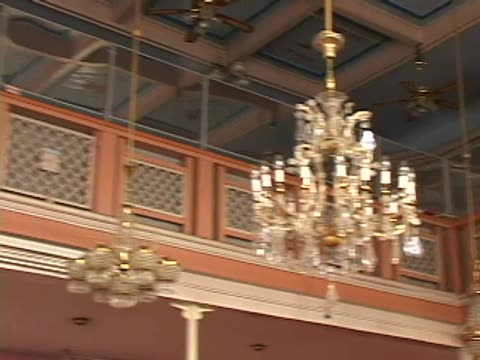
Abelsky addresses Lubavitch-Chabad religious customs. The team then concludes the interview with Abelsky and the camera collects footage of the synagogue.
Discussion with the rabbi about messianic belief, the succession of Lubavitch rebbes and resurrection of the dead. Abelsky says he can read Hebrew-language articles but not Russian. Kerler asks for an address to send material, and the interview closes.
The talk is largely about messianic belief and resurrection.
The camera cuts to the interview with Shpitalnik. She addresses contemporary Yiddish cultural life, as well as the library's Yiddish book collection. Shpitalnik then speaks about contemporary religious groups in Chişinău.
Shpitalnik answers Katz's questions about the future of the Yiddish books in her library and the interest in them, and the attitude of the authorities toward Yiddish. She mentions a helpful reader and a woman who cares for him, and the few people who study Hebrew. She regrets the possible loss of Yiddish, expects the Hasidim to preserve it, and talks about the synagogues and yeshivas of various groups in Chișinău. Katz speaks of his mother's age and illness.
Katz also tells of his mother's illness and the camera notes the Agudas Yisroel group.
Shpitalnik says her father died young in Chișinău. She gives her views on whether Jews will remain in Chișinău, noting that mainly old people are left and some return from abroad. She tells of a young Yiddish singer whose parents opened a restaurant, and describes her monthly Yiddish radio program about Jewish personalities and anniversaries.
The camera cuts to the continuation of a formal interview with Lipovetskiy. He talks about his life and family before the war. His father owned a horse and wagon and then worked at a wheel factory. Lipovetskiy's great-uncle moved to Eretz Yisrael.
Lipovetskiy talks about his family and the street in Chișinău where they lived before the war. His father had horses and a wagon and then worked at a factory (name unclear). He names his mother and her father, a rabbi, and recalls a great-uncle who went to Eretz Yisrael in the 1880s (?) and died there, and his grandmother, who sent him to talmud torah.
The passage also covers his mother's and grandmother's names and his great-uncle's emigration.
Lipovetskiy speaks about his prewar education at a Yiddish school and religious school (talmud torah). He attended Yiddish school until 1940. He also speaks about his and his family's life during World War II. His mother worked at a cotton factory during Soviet occupation. Lipovetskiy's family evacuated together with factory workers to Chechnya, where they stayed for two years. His father was drafted into the Red Army. He then describes the evacuation experience working on kolkhozy in different places, including Kizlyar, Dagestan and Kazakhstan. In Kazakhstan, Lipovetskiy stayed until 1944.
Lipovetskiy describes his Yiddish school and talmud torah education and the closing of the talmud torah under the Soviets. His father worked at a leather factory and his mother at a cotton-wool factory. He recalls evacuation with the factories to the Caucasus (Chechnya), a kolkhoz near Kizlyar and then Kazakhstan, where they stayed until 1944; his father served as a soldier. He mentions an encounter with Kazakhs who did not know what a Jew was.
Also mentions his father serving first in the Romanian and then in the Red Army.
Lipovetskiy speaks about his return to home to Bessarabia in 1944. He then addresses prewar religious life, including synagogue structure. He describes how the cook's synagogue offered meals and gave out food on Passover. He then recalls the rabbi of this synagogue and his visits to the talmud torah school.
Lipovetskiy tells of his return to Chișinău in 1944 and the end of the war. He describes the many prewar synagogues by trade, including the cook's synagogue that gave out food on Passover. He recalls Rabbi Tsirelson, his visits to the talmud torah and the gifts of clothing he brought. He describes a ritual slaughterer's street and the yeshiva.
Also describes Rabbi Tsirelson, a shoykhet and the yeshiva on the street.
Lipovetskiy talks about his education at the talmud torah school. He then speaks about postwar religious life and the restoration of the former bookbinder's/glazier's synagogue. Lipovetskiy also addresses local emigration.
Lipovetskiy describes the seven-class talmud torah, which was closed when the Soviets arrived. He explains that the synagogue where they sit was a shared glaziers' and bookbinders' prayer house. Jews returning after the war collected money and restored it, and he says it is now the only synagogue. He mentions the emigration of many Jews to America and Israel and speaks bitterly about the killers of Jews.
Adds the shared glaziers'/bookbinders' synagogue and the postwar Jewish emigration.
Answers Kerler's questions about his Yiddish school, which is called Vaysman after its director. Instruction was in Yiddish apart from one lesson in Romanian. The school and the talmud torah gave meals, kosher and paid by rich people. He explains the Romanian-derived word for money and its Hebrew equivalent, and cannot recall the poems studied.
Lipovetskiy touches upon his life in evacuation during World War II. He evacuated to the Kostanay district in Kazakhstan. He then returns to his Yiddish school education, as well as his Russian-language education in evacuation.
Lipovetskiy briefly mentions evacuation to Kazakhstan, in the Kostanay district. He returns to the Yiddish school, where Romanian was also taught, and describes the Russian-language lessons in evacuation with a German teacher. After the war he finished school and became a teacher.
Lipovetskiy speaks about his life and work as school teacher after the war. He then discusses contemporary religious life and his family, before talking about his life today.
Lipovetskiy says he became a physical-education teacher after the war. He talks about prayer, noting that he attends the synagogue daily, that few Jews come, and about his health. He mentions that his children live in Israel, his pension, and the cost of housing and heating today.
Lipovetskiy discusses prewar Jewish life, including institutions, in Chişinău. He also mentions the support of the Joint Distribution Committee before the war. Lipovetskiy then talks about life today.
Lipovetskiy recalls prewar Jewish life in Chișinău: shops and factories, rich Jews helping the poor, and the institutions of a burial society, a mikveh and the large synagogue. He describes the Joint-supported Jewish hospital and clinic. He then talks about postwar shortages and rationing, and about where he lives now and the young people's lack of work.
Lipovetskiy discusses his childhood memories and games with Rabbi Yehuda Leib Tsirelson. He then addresses different Jewish groups and dialects, as well as contemporary religious service.
Lipovetskiy recalls childhood games with Rabbi Tsirelson, the reading of the Shema at a newborn's bedside, and his bar mitzvah. He discusses how Yiddish differs among Jews of Russia and the local Jews, as well as Bukharan, Georgian and Lithuanian Jews. He talks about the Russian-speaking rabbi's Sabbath sermons and says he understands Yiddish. A Russian-speaking woman briefly takes part and the interviewer hears a Hebrew-Yiddish exchange.
Adds a discussion of Yiddish dialects and the rabbi's Russian sermons.
Lipovetskiy remembers childhood games such as hiding games with a ball. He recites or sings a Yiddish song about a tailor and a Romanian cap. He then speaks about Jewish trades before the war, mentioning tailors' and butchers' synagogues and the difference between a butcher and a shoykhet for poultry, and the kosher marking of meat.
Lipovetskiy explains how his mother salted meat to draw out the blood. He talks about his grandmother, daughter of a rabbi, who studied in Yiddish and died in the 1940s, and about visiting the graves of his relatives. He gives the names of his parents' siblings and grandparents; his parents and grandparents were born in Chișinău.
Lipovetskiy talks about his family. He grew up with two sisters and one brother. He also touches upon prewar Passover celebrations and his talmud torah school education.
Lipovetskiy talks about his siblings (a sister, a brother and another sister who died) and says he was the youngest of four. He recalls the Passover seder and the four questions asked by his father and grandfather. He tells how the talmud torah taught in Yiddish and Hebrew and the melamed spoke Yiddish.
Lipovetskiy talks about the contemporary community. He then speaks about the relationship between Jews and non-Jews before the war, before addressing his life during the postwar Soviet period.
Lipovetskiy remarks that today's Jews in the community do not know Yiddish. He describes prewar relations with non-Jews, with Romanians calling Jews by a Romanian word and not allowed into the synagogue. He then speaks of postwar hunger, Stalin's rationing and cards, and the cosmonaut Gagarin.
Lipovetskiy lists the Jewish holidays and answers questions on food customs, such as dairy dishes on Shavuot and cheese pastries and blintzes, and on the Purim headgear, gifts and shalakhmones.