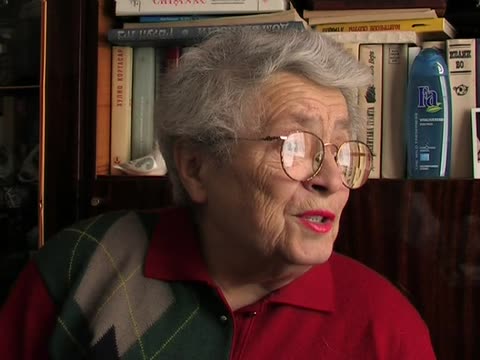
Roif speaks about a relative's fate in the late war period of World War II. Her cousin was saved by the Red Cross in 1943. She then speaks about her family.
Roif tells how a young female cousin, a daughter of her father's sibling (an uncle in America), was taken to Romania by the Red Cross in the war. The girl went despite the family's reluctance, and the family later wrote to Romania and to a television search programme without answer. Katz asks for names, her birth year, the girl's father in America and an address, so that an appeal can be placed.
Katz questions her about the cousin's name, the father in America and a search appeal.
Roif and Katz continue about the missing cousin, who was apparently born in Brichevo (?), Moldova. She was taken out of a camp by the Red Cross, probably in 1943, to Romania. Roif says the girl's father in America wrote asking about his wife, and says Russian-sunk ships carried other children away. Katz promises to place an announcement and asks about ghetto songs.
The passage turns to the cousin's birthplace and rescue and to a plan to search for her through the press.
Roif sings a lullaby-like song of a dying boy and his mother that she learned in the camp from a woman from Soroca, and a tale song of a shepherd boy who forgot to shut the door. She says it expresses the Jews' dispersal across the world, and she sings a verse of the Bessarabia song. Katz asks for more and she offers to sing another.
The shepherd song and the interpretation of dispersal are added.
Roif sings a love song about a girl abandoned by the lover who gave her a ring, and says her husband stopped her singing in the car. After declining to sing more, she tells Katz that Passover was the best holiday, with dishes brought down from the attic. She says she and her father went to the kloyz on Yom Kippur and Sabbath. She begins to say that her mother was ill and died, and her father remarried.
The prewar family detail about her father's kloyz attendance and the mother's death is added.
Roif talks about her family. She has a half-sister and half-brother. She then returns to prewar holiday celebration. Roif also speaks about her life after the war. She speaks about the relationship between Jews and non-Jews on the kolkhoz, which her husband ran. Roif explains how she and her husband traveled to the neighboring village for kosher slaughter.
Roif mentions a half-sister and a half-brother from her father's second marriage, and that the brother died of cancer at thirty-five and had a diploma from a polytechnic institute. Katz returns to Rosh Hashanah and Yom Kippur, and she remembers prewar Jewish life as good, with Jews living on good terms with Moldovan neighbours in a village. Her husband worked for twenty years as chairman of a kolkhoz, and she says there was no shoykhet in the village, so they travelled to one in a village seven kilometres away.
The passage adds the half-brother's death, the husband's kolkhoz post and the shoykhet in the neighbouring village.
Roif addresses prewar religious life, particularly how her family sent flour to the Ştefăneşti community for matzo baking. She also touches upon Jewish and non-Jewish relations before the war. Roif then talks about the Ştefăneşti rebbe.
Roif says they went to the Ştefăneşti rebbe, and that her father-in-law and her mother's grandfather were rich and sent wheat to Ştefăneşti for flour for matzo baking. She stresses good relations with the villagers before the war and contrasts them with camp experiences. Katz asks about the rebbe's standing, and she says he was known across Romania and Bessarabia. She then turns to how she keeps Purim and Hanukkah today.
The wheat-for-matzo detail and her contemporary Purim and Hanukkah observance are added.
Roif tells how non-Jews also went to the Ştefăneşti rebbe for help, such as her grandfather's neighbour. She says all Bessarabia, Bukovina and Romania knew of him. She says her husband has a small book about the Ştefăneşti rabbis at home, and Katz asks to see it.
Non-Jewish visitors to the rebbe and the book at home are added; the holiday talk is brief.
Roif answers questions about cultural terminology and Yiddish dialects. She also briefly recalls prewar traditional weddings, before addressing folk customs. Roif remembers Christian Moldovans practicing healing customs.
Roif answers terminology questions about the word Litvak, differences among Yiddish dialects and what a dybbuk and a golem are. She briefly recalls Jewish weddings, a Jewish woman's spoken charm and Moldovan women who healed. She describes taking her child to such a healer. Katz also tells her where he comes from, and she mentions a BBC interview of her husband. She ends by saying she became a mathematics teacher.
The charm and Moldovan healers, the dybbuk and golem terms, and the postwar teaching career are added.
Roif speaks about her life and work after the war. She worked as mathematics teacher. She then speaks about her family. Roif's half-brother lives in Israel.
Roif tells how she became a teacher of mathematics after the war and gives the family structure. She was the eldest born before the war, and a half-sister (called Sima) was born in 1946 and a half-brother in 1950. The half-brother's wife and daughter live in Israel.
The siblings' birth years and the half-brother's family in Israel are added.
Roif addresses prewar Hasidism. She remembers stories from her mother-in-law. She then speaks about her life during World War II, imprisoned in the Dubyna forced labor camp. Roif mentions that her husband would frequently leave the camp, whereas she stayed inside. Roif also addresses her husband's business travels.
Asked about Hasidim, Roif says she remembers only her mother-in-law's talk of the lamed-vovniks. She then tells how her husband recognised a woman from the camp at a sanatorium in Odessa, by asking where she had been in the war, and she says the boys could slip out of camp while she stayed inside. She also mentions in Russian her husband's invitations to various cities from prisoners' associations.
The sanatorium encounter and her husband's trips to prisoner associations are added.
Roif cannot say anything about Zionists or Bundists. She says her husband was a gifted son whom his father wanted to send to study, but the war destroyed that. She says some non-Jews who worked for or traded with Jews spoke good Yiddish, and she adds that mixed marriages are common now but were not before the war.
The passage adds the husband's education plan, and mixed marriages before and now.
Roif sings a Yiddish song about a Jewish girl from Edineț who converted. The song is from the viewpoint of the girl's mother and Roif remembers the song from her childhood. Roif then talks about her family.
Roif hesitates, then sings a song she remembers from childhood before the war about a Jewish girl in Edineț (?) who converted and married a Moldovan shepherd, in which the mother seeks her. She says the song is based on a true story, and Katz asks about other songs. Roif says the missing cousin's mother was her father's sister, Rivke, and her father was called Dovid or Dudl.
The family relation of the missing cousin is added, along with the singing about the conversion song.
Roif sings the song of the Jewish girl who converted a second time. Katz asks for another Yiddish song, one sung by girls before the war or in the camp, and she says she knows only Russian and Romanian songs and only snatches of Yiddish ones. Katz then announces lighter dialect questions with a Russian word to translate.
Roif answers dialectological questions on everyday words, with Russian prompts and help from a second person. She gives greetings for morning, day and evening, and the words for please, thank you, book and the sense of mazl (luck, or in her usage a mouse).
Roif continues the dialect questionnaire, with Russian prompts from S2 and Katz. Items include 'I have no luck', belly, house, groats, skin, mouse, window, to build, and the stone building, as well as ear, deaf and kiss. Words for mouse and mazl are discussed again.