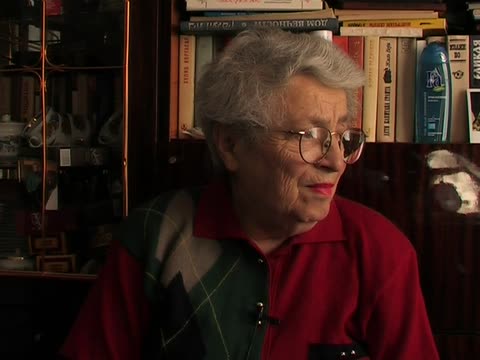
Roif answers dialectological questions, with a second woman prompting in Russian and Ukrainian-sounding forms and Katz asking in Yiddish. The items cover adverbs and comparatives, words for 'very', 'barely' and 'pious', a Christian and a convert, a farmer, the stairs/ladder and the like. She also gives the word for 'bed', other household words and the numbers. Further items cover 'where are you from?', the midwife, taste, 'on the street', water and the river, the shoulder, potatoes and roses, 'room', 'suddenly' and 'various', plus several sentences to translate. At the end Katz thanks her and invites a message for the archive.
The questionnaire is interspersed with a second woman's Russian/Ukrainian prompts and some personal remarks, such as where she lived before.
Katz asks Roif for a last message for the archive and for future students. She answers that people coming after should be honest and not worse than we were, and complains that today there are only thieves, pickpockets and rising prices. She says she and her husband could have built a house when they were young, unlike the luxury houses built now.
Roif goes on with her message about honesty, helping others and not stealing. She recites a Yiddish poem about human greed and the need to live and let live, which she says she once sang to an uncle who was a miser and had no children. She then begins to speak about her husband's work as a kolkhoz chairman in Moldavia.
Roif talks about her and her husband's life, specifically their apartment, after the war. Roif also mentions that her husband often intervened as mediator in court cases.
Roif talks about her husband's twenty years as kolkhoz chairman and the apartment that the authorities gave them, which they renovated and furnished. She says her husband often spoke up for prisoners in the local court, and many were released early or sent to work elsewhere. She stresses that they only ever did good and that their faith in God is about doing good. Katz explains that she is speaking to the archive and not to the others present.
The husband's mediation in court cases and the help he gave to prisoners are in the transcript, along with the furnishing of the flat.
Roif talks about a family tragedy involving two girls, one of them a Raya Bronshteyn (?), whose mother Rivka and brother Shike (?) died in a camp, and a ship on which many children were drowned. They came to Iași (?). Katz then asks what name to use for her: she gives it as Zelda (Zina in daily life), with the family name Roif. She also says she wrote to a Romanian organisation seeking information and got no answer.