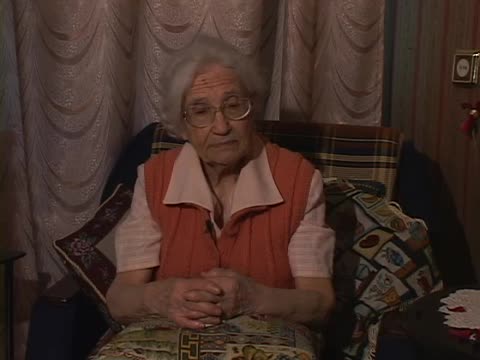
The formal interview with Mitlaeva begins. She provides personal information and talks about her family. Mitlaeva's father was born in Tiraspol and passed away in 1936. He was a merchant. Her mother was born in Novoselytsia, Ukraine. Mitlaeva grew up with two brothers and one sister.
Kerler asks Mitlaeva for her family details. She gives her birth year as 1915, says she lived in Chișinău until the war, and names her father Shmuel, a merchant who died aged 56 (the year is given by helpers as 1936). Her mother Rivke came from Novoselytsia in Bukovina and was a housewife who died aged 65. She names her brothers, mentions her paternal step-grandmother Alte, and recalls the grandmother as a pious woman.
Gives the mother's death date and age and names the brothers and the step-grandmother; a helper supplies the father's death year.
Mitlaeva shares stories about Hershl Ostropoler, she remembers from her mother. The stories are about Hershl and the diamond and Hershl looking for work.
Mitlaeva retells stories about Hershl Ostropoler that she heard from her mother. In one he buys a chicken and his wife cooks it, and a friend is frightened away. In another he stays in a rich house promising to show a diamond, and a third has him claim his wife has died before Passover. Kerler asks about the details.
Asked what her mother used to sing, Mitlaeva recalls Yiddish songs and sings parts of one about rain and a road and one about the road to Bethlehem and Mother Rachel's grave. She cannot recall others, including one about a cheder corner, and the singing is partial and broken off. Kerler then turns to her earliest childhood years.
Mitlaeva speaks about her life, including education, before the war. Her mother taught her how to write and read in Yiddish. She then attended a Yiddish school for six months, which was run by a female principal. Mitlaeva maintains that there was a Romanian and a Yiddish school in the same building and the Jewish students would learn in the afternoons. She then describes her teachers and recalls the switch to the Romanian school. Mitlaeva then describes her education and teachers at the Romanian school and shares an episode about three priests coming to school and blessing the school.
Mitlaeva describes her early schooling. Her mother taught her the Yiddish alphabet, and at seven she went to a Yiddish school with a woman director, named Rezhnik (?). The school shared a building with a Romanian one, and she attended the afternoon Yiddish classes for about half a year until the school was made Romanian by decree. She names her Yiddish and Romanian teachers. She also recalls a ceremony with three priests who came to bless the school.
Adds the switch to Romanian and the blessing by three priests; the teacher names are uncertain.
Mitlaeva talks about local Jewish schools before the war. She then speaks about her childhood home and describes locals. Mitlaeva remembers how neighboring boys sang Hebrew and Yiddish songs in a choir. Mitlaeva was a French-language teacher.
Mitlaeva names three Jewish schools left in the town, two vocational schools and Magen David. Both Yiddish and Hebrew were taught in them, and there were Yiddishists among the teachers. She gives her childhood street as Balanovski (?) and says she lived as a lodger with a landlord. His sons sang Yiddish and Hebrew songs in a choir, and some of them emigrated. She also mentions teaching a girl French.
Adds the choir of neighbouring brothers and the postwar emigration of a family.
Mitlaeva speaks about life before the war and recalls a Romanian family that spoke Yiddish. She then addresses childhood games and touches upon prewar Sukkot and Simchat Torah celebrations. Mitlaeva also lists different local synagogues; e.g. cook's, baker's and glazier's synagogues.
Mitlaeva describes her mixed Jewish and non-Jewish street. She tells of a Romanian family whose mother was a converted Jewish woman who still spoke Yiddish and had a Jewish woman read to her from the siddur before she died. She answers Kerler's questions about children's games, including one played with nuts, and about Sukkot and Simchat Torah in her youth. She then lists local synagogues, including those of the cooks, bakers and glaziers.
Adds the Romanian family with the convert mother, children's games and the synagogue names.
Mitlaeva returns to speaking about non-Jewish neighbors. She then talks about the local Yiddish professional school and then addresses her education. Mitlaeva lists languages she studied and describes how she took the baccalaureate exam in 1936, as well as rewards from her family and friends. Mitlaeva attended secondary school between 1928 and 1934.
Mitlaeva talks about another non-Jewish neighbour, a Romanian woman of Jewish origin, and about a vocational Yiddish school where Yiddish and world literature were taught. She lists the languages she knew, attended a French lycée and describes taking the baccalaureate in 1936 with several hundred candidates. A Karaite friend paid the fee, and she was rewarded with gifts and a dress. She describes the written and oral exams.
Adds the French lycée and the 1936 baccalaureate; the catalogue's 1928–34 period for secondary school is only roughly supported.
Mitlaeva talks about her Karaite friends from Crimea, the Aivaz family, who kept Jewish holidays but not Christian ones. Lemster then asks about Yiddish books she read before the war. She recalls an alphabet primer, names Sheynberg (?) as an author, and mentions Poale Zion as a Zionist organization she attended.
Mitlaeva talks about prewar organizations, including Hashomer Hatzair and Poale Zion. She attended meetings, organized by Poale Zion. Mitlaeva also recalls prominent guests. Mitlaeva then speaks about the prewar local Yiddish press.
Mitlaeva talks about the Zionist organization Poale Zion, whose chief figure was a woman lawyer, and a lawyer named Reytekh (?) who attended. She says they sang Yiddish songs there. Lemster asks about Yiddish newspapers; she says her father read them without naming one, and she mentions Rozental and another prominent person.
Mitlaeva addresses prewar religious life and describes how her mother went to see a rebbe for advice in the 1920s. She then addresses folk and healing customs, before addressing prewar Passover celebrations; including how to kasher dishes. In particular, Mitlaeva recalls how her mother practiced healing customs.
Mitlaeva says that in the 1920s her mother travelled to a rebbe in Chernivtsi (?) and Novoselytsia for advice in hard times. She answers questions about folk healing, such as pouring coals against the evil eye. She then describes Passover customs, including removing and burning the chametz, koshering dishes, the seder and Elijah, and her older brother asking the four questions.
Adds the visits to a rebbe and the mother's healing; the Passover and seder details also come in.
Mitlaeva recalls Purim customs before the war. She talks about the baked treats, including filled hamantaschen, and the gifts of food. She mentions masquerades and children going from house to house with a greeting, and says klezmer musicians came to play on Purim. She also says she learned about Esther in French at the gymnasium.
Mitlaeva talks about food customs and Sabbath celebrations at home, before addressing prewar cultural life. Mitlaeva recalls local klezmer musicians. Mitlaeva then describes how her mother koshered meat and returns to describing her mother's cooking.
Mitlaeva says her mother made gefilte fish for Sabbath and holidays. She speaks about the Jewish klezmer musicians she knew, including a neighbour. She then describes how her mother salted meat and washed it, and recalls going to the shochet. She also talks about her mother blessing the Sabbath candles, and recalls her mother's matzo dishes.
Mitlaeva recalls her mother's sayings about Jesus on a Christian holiday. Lemster and Kerler ask for proverbs, jokes and curses, and she gives a couple of blessings and curses. Kerler then asks if she took part in any movement; she answers in Russian and Yiddish that she attended Zionist meetings.
Adds the mother's sayings and her attending Zionist meetings, which comes after the proverbs.