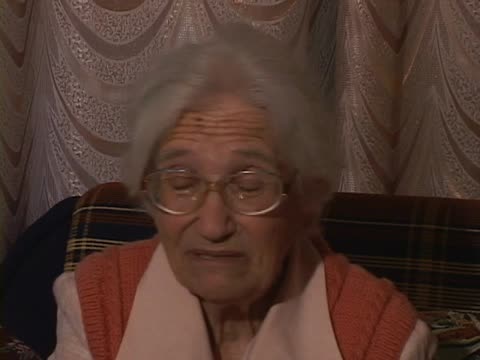
Mitlaeva shares Yiddish sayings and proverbs. She then speaks about her life before the war, particularly meetings at Poale Zion and a Baptist organization. Mitlaeva also recalls a local Zionist school and kindergarten.
Mitlaeva and Kerler discuss Yiddish sayings, including one about the length of the Jewish exile and expressions with 'Jewish' and 'gentile' (luck, head). She says she was active in Poale Zion, where there was singing, dancing and plays in Yiddish. She recalls a rich synagogue and Zionist library and kindergarten on Nikolaevskaya Street. She also remembers a Baptist circle where a Jew spoke Yiddish, which she once attended with a friend's mother.
Kerler's questions about the meaning of 'goyish' idioms precede the Zionist material.
Mitlaeva speaks about her life after the war. She taught at a school in Chudei, Ukraine, for ten years. She recalls Baptist locals. Mitlaeva worked in Varenikovsky, Kuban region, and then received a work assignment for Velikaya, Russia. She was married to a non-Jew.
Mitlaeva recalls the Baptists in the village of Chudei in the Chernivtsi region, Bukovina, where she taught for ten years after the war. She says the Baptists were Romanians who sang Christian hymns in Yiddish, and Kerler asks why. She then tells of being sent to a village among Kuban Cossacks and of a Russian man who spoke against Jews until she told him she was Jewish. The passage ends with an anecdote about her grandson.
Adds the Bukovina Baptists singing in Yiddish and the antisemitic remark episode in the Kuban.
Mitlaeva talks about her family. She then addresses her educaton and work before the war. Mitlaeva was trained as language teacher for Russian, Romanian, French and German at the local French lyceum. She also recalls a Latin proverb. Mitlaeva taught Romanian at a private Yiddish school, owned by the Vakhman family.
Mitlaeva says she was a teacher before the war of French, Russian, Romanian and German, after studying at the French lyceum, and mentions Greek, Latin and Old Church Slavonic. She recites a few Greek words and a Latin saying. She taught Romanian at the private Yiddish school of the Vakhman family. She also describes the pupils and how her teaching documents were lost in a bombing during the war.
Adds the Greek and Old Church Slavonic study and the loss of her documents in a bombing.
Mitlaeva speaks about her life during World War II. In particular, she remembers the year 1942, when the German army moved closer to the Kuban region and she had to evacuate. Mitlaeva then describes how she evacuated by train passing the Sea of Azov, Baku, Azerbaijan, Krasnovodsk, Turkmenistan and Severodvinsk, Russia. She then speaks about her school education and encounters with fellow Jews in Severodvinsk.
Mitlaeva recalls 1942, when German forces approached the Kuban and she and her mother evacuated. She describes how border guards told locals not to leave, a bombed train split in two, and the journey by the Sea of Azov and onward. The route continues through Baku, Krasnovodsk and the Urals. She then talks about working in a school in the Urals where the director and a Jewish administrator helped her with documents and food.
Adds the Jewish shop owner's family and the Jewish official who helped her at the school.
Mitlaeva recalls the beginning of the war, including bombing, in Chişinău in 1941. Mitlaeva describes in Russian her evacuation, via Dnipropetrovsk and Varenikovsky, Kuban region. She then talks about her work as teacher in Varenikovsky.
Mitlaeva recalls the first day of the war in Chișinău in June 1941, with the bombing and Molotov's radio speech, and their evacuation about two weeks later. She describes the flight by cart to the Dniester and Bender, a night in a synagogue and a bridge that was bombed. The route then goes by train via Dnipropetrovsk to the Kuban, where she taught in Varenikovsky. She speaks of colleagues there, including a German teacher and a Jewish woman teacher who had been saved from a pogrom.
Adds the Dniester crossing, the night in the Bender synagogue and the Jewish colleagues in Varenikovsky.
Mitlaeva and Kerler discuss Polish and Lithuanian Yiddish and how Litvaks were regarded in Chișinău, including a Lithuanian-Jewish neighbor. They go on to terms such as golem and dybbuk. She recalls a Yiddish poem about Galitsyaner and Litvaks being equal before God.
Adds the golem and dybbuk terms and the recited saying on Galitsyaner and Litvaks.
Mitlaeva answers Kerler's questions about prewar holiday food at home: Hanukkah gelt, latkes made from buckwheat flour, potato pancakes and Passover dishes such as matzo kugel. They discuss tsimes and its varieties, fruit compote and the plum-based drinks. She says children were not given brandy except for a taste of wine at Passover.
Mitlaeva answers terminology questions, including the old and new cemetery fields in Chișinău and the meaning of tsadik. Kerler then asks about traditional Jewish weddings, who spoke to the bride and groom, the covering of the bride and women's crying. She recalls little of the details.
Mitlaeva talks about prewar religious customs and synagogue services. She also touches upon Sabbath celebrations and remembers family friends before the war.
Mitlaeva speaks about the women's section of the synagogue, her mother's mikveh visits and her Sabbath headscarf, and her mother's Sabbath reading of the prayer book and Yiddish books. She recalls a Jewish family, Mordechai and Leike and their children, and another very religious family named Stapudis who lived on Nikolaevskaya Street. She also talks about Rabbi Zirlson, who she says was educated and known to the Romanian authorities, and Kerler quotes a 'When in Rome' saying.
Adds the mikveh, the rabbi Zirlson and the Stapudis family.
Kerler shows old photographs of Chișinău from around 1900 and Mitlaeva identifies buildings and streets. These include the main Aleksandrovskaya street, now Ștefan cel Mare, the Savoy and Bristol hotels, the fire brigade and the city bank. She also names the town hall, where King Carol II and Prince Mihai appeared, and the Passage, and mentions local theaters such as the Orfeum and a Romanian national theater. She also recalls her self-taught English and a merchant named Katarzhil (?).
Adds identification of photographs of city buildings and the royal visit.
Mitlaeva talks about prewar Jewish cultural life, particularly Yiddish theater. She then returns to describing city buildings, as well as the central market.
Mitlaeva talks about the Yiddish and Hebrew theater in Chișinău, including the Reidl Zal hall, and visiting actors and directors, with Kerler and others. The photographs then continue with a villa and the New Market. She describes the market's sections and Jewish shops, including a Litvak's store, the kosher butcher Grabois, and a non-kosher shop. A confectionery on the central street is also mentioned.
Adds the market and Jewish shops, the kosher butcher and the Litvak store.