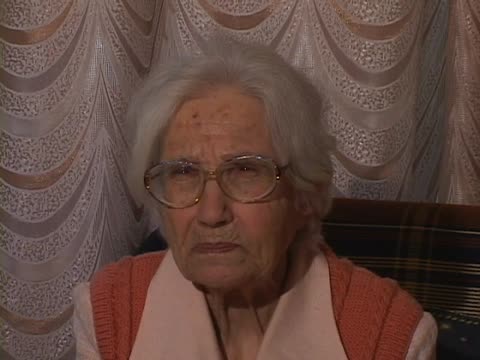
Asked by Kerler what films were shown in Chișinău before the war, Mitlaeva names several Soviet films, among them adaptations of Tolstoy and Ostrovsky and a comedy, and recalls a Jewish film shown around Passover or Purim. They also touch on the circus and theatre and on the barracks and other buildings of the Romanian-era town, and Kerler asks her to recall verses she learned at school.
also covers the barracks and streets of the Romanian-era town and a request for verses learned in school
Mitlaeva speaks about her two brothers and her sister. The elder brother was last reported digging trenches near Stalingrad. A second brother worked in Murmansk and visited her once, and she has had no news of him since. Her sister and son live in Israel, and she expects the sister to visit.
also covers the brothers' fates (Stalingrad, Murmansk)
Mitlaeva addresses her life and work after the war. Among other places, Mitlaeva taught at a school in Străşeni for approximately thirty years. She then mentions Jewish locals in Străşeni.
Mitlaeva says that after Bukovina she worked as a teacher in Străşeni, a large town with several schools, including Russian and Romanian ones. She recalls a pogrom there in tsarist times, a conflict with a colleague who was dismissed, a Jewish surgeon and Jewish veterans working in the town. She also says she knew Romanian well and speaks it today, though she has never been to Romania.
also covers a pogrom, a dispute with a colleague, a Jewish surgeon, and her knowledge of Romanian
Mitlaeva's sister is expected to visit in summer, and she says her son, a painter, lives in the same flat. The talk turns to the Yiddish and German words for 'artist' and to Yiddish words with two origins. Kerler asks her to speak Yiddish, and she mentions two Yiddish professional schools, her work years and not having studied Russian formally. She also recalls Yiddish words in English and a few Yiddish phrases.
also covers a discussion of the Yiddish and German words for 'artist' and her languages
Mitlaeva answers dialectological questions from the AHEYM Yiddish linguistic questionnaire. She also shares episodes from her daily and political life in Chernivtsi.
Kerler asks how to say 'come here' and 'go there' in Yiddish, and Mitlaeva gives forms and says she has not heard others. She mentions a stay in Chernivtsi and an episode involving antisemitic abuse, then answers questions about God and religion. She says she was an atheist and a Communist Party member and describes being valued as an honest communist. Kerler then begins a question about postwar prayer in Chișinău.
Mitlaeva recalls the small synagogue where her father took her before the war and some holiday customs. Asked about postwar Jewish prayer in Chișinău, she says she does not know how those who wanted to pray managed. She also comments on Soviet policy and says antisemitism existed, though the Soviet authorities also made evacuation possible.
Asked about Yiddish writers visiting Chișinău, Mitlaeva says there were Yiddish writers, Yiddish books and a small Yiddish library before the war. The library was on a street whose name is unclear in the transcript.