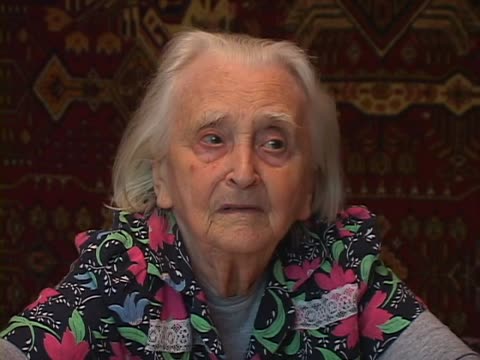
After a short exchange about a photograph, Goldman tries to recall the name and location of a big kosher butcher shop and sausage store in prewar Chișinău, on a street she names as Aleksandrovskaya (formerly Lenin Street), which operated until about 1940. She and Kerler discuss the quantities bought, the shoykhet and home kosher slaughter. Kerler asks whether there were Lithuanian Jews, and Goldman says many Polish Jews came, and describes how the Yiddish of Polish Jews and of Caucasus Jews, who have no Yiddish, differs from the local speech. They also compare local usage with Galician, Polish and Lithuanian Jews and touch on the word for Passover, before Kerler begins asking about the place of the cantor in the synagogue.
The passage also covers the Yiddish of Polish and Caucasus Jews and the question of Lithuanian Jews in Chișinău, and opens with a photograph.
Goldman answers Kerler's Yiddish dialectological questionnaire. The items include words for the rich man and the dead (a blessing for the deceased), man and boy, table, plug/fire extinguishing, vehicle terms (wagon and plural forms), 'on the road' and 'on this road', and everyday phrases and greetings (good day, pleased to meet you). They also cover Hanukkah dreidels, Tisha b'Av and the burrs thrown then, verbs like leave/abandon, ill and sleepy, and 'back'. Further items are room, suddenly, the difference between 'honest' and 'pious', enemy, the cross, plural nouns such as shoykhet and matchmaker, and what to say at different times of day.