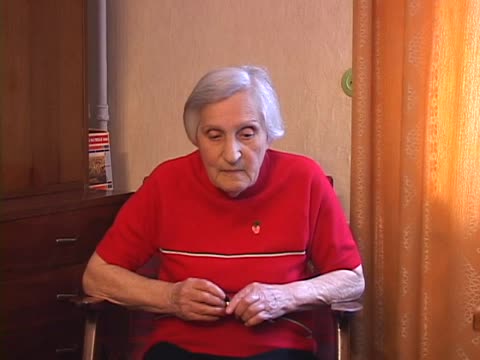
Rotner provides personal information and talks about her family. Her father worked at a bank and then as merchant.
From the machine transcript
Rotner gives her Yiddish name and maiden name and says she was born in Chiperceni. She names her mother and her maternal grandfather, who lived with the family, and talks about her father, who worked first at a bank and then as a merchant. She says her grandfather was killed during the war because he could not flee.
Shows the date of the interview, Rotner's naming after her grandmother and the death of her grandfather.
Rotner talks about her family's life during World War II. She describes her evacuation through Balta, Ukraine. Rotner then speaks about her family. Her sister moved to America. Rotner grew up with one sister.
From the machine transcript
Rotner describes how her family fled the advancing front and crossed the river by boat to Balta, then was evacuated three times. She says her elder sister later went to America with her children and died there. She was born in 1921, three years after her sister.
Rotner speaks about her life before the war. She worked as operator at a train station. Rotner then addresses prewar Jewish life in Chiperceni. According to her, approximately four hundred families lived there.
From the machine transcript
Rotner says she and her sister finished the gymnasium before the war and wanted to study further. After the war she worked for about forty years as an operator at a telephone exchange. She says Chiperceni was a large village with a synagogue, a shochet and a rabbi. She estimates about four hundred Jewish families.
Rotner speaks about her life and education before the war. She attended a Romanian secondary school and studied at a religious school (cheder) beforehand. She also addresses the relationship between Jews and Christians. Rotner then recalls prewar religious life and observance within her family.
From the machine transcript
Rotner talks about her schooling in Chiperceni, a Romanian school plus a cheder that she and her sister attended with a small group of Jewish children. She says she played with Christian neighbours, with whom relations were good. She also remembers Jewish life in the village as good, with weddings and synagogue attendance.
Rotner talks about prewar holiday celebration and food customs, particularly Sukkot, Passover, Sabbath, Hanukkah and Purim. She recalls how her grandfather prepared food for neighbors on Passover and her father bought matzo in Orhei. Rotner also speaks about her life before the war and explains how her mother koshered meat.
From the machine transcript
Rotner recalls prewar holidays: the sukkah her grandfather built, the Passover seder led by him, and the four questions. She mentions the charoset her grandfather had the children make for neighbours. Her father bought matzo in Orhei because no one in the village baked it. She describes her mother's Sabbath candles, her mother koshering meat with salt and soaking, and children's play at Hanukkah and Purim, with a second woman adding some Purim recollections.
Adds the grandfather's role at the seder, the sorting of chametz and the second woman's contributions.
Rotner speaks about prewar holiday celebration, specifically Tisha B'Av, Rosh Hashana and Yom Kippur practices.
From the machine transcript
Rotner and a second woman answer questions about Tisha B'Av, sitting on the floor and children's mischief, and about fasting and synagogue attendance on Yom Kippur. They also recall Rosh Hashanah, when people went to a stream, and Kerler asks about kapores and the shochet.
Rotner talks about prewar Jewish life, including occupational structure. Rotner's father owned a vineyeard and she recalls harvesting grapes in the summer time. Rotner remembers young chalutzim in town. Rotner then talks about her family and briefly addresses her leisure activities.
From the machine transcript
Rotner discusses the occupations of the Jews in Chiperceni, merchants, tailors, shoemakers and vineyard owners. Her father owned a vineyard and the family helped with the grape harvest each summer. She says there were no Jewish organisations or clubs, though a few young chalutzim left for Palestine. She describes her leisure as reading, helping at home and helping her grandfather in the shop, and says she read Romanian but not Yiddish. There was no Yiddish theatre, but her parents travelled to Orhei.
Adds the absence of mixed marriage and of Jewish clubs, the library question and language of reading.
Rotner speaks about prewar cultural life and mentions a local Jewish musician. She also describes a local traditional wedding.
From the machine transcript
Rotner says there were no klezmer musicians in the village, only a Jew who played guitar, usually in Orhei. She remembers watching traditional weddings from a distance as a child, the chuppah and the breaking of a glass, with non-Jewish music. She says she did not attend weddings herself.
Rotner speaks about her family, as well as prewar Jewish institutions. She then addresses her childhood memories of her father traveling to Orhei.
From the machine transcript
Rotner answers Kerler's questions about her father's bank in the village and the Jewish cemetery, which was in Orhei. She describes Orhei as a large, beautiful town with a Jewish gymnasium and Jewish doctors and lawyers, where she and her sister studied and boarded during the week while their father drove them there by horse.
Adds the cemetery in Orhei and the Jewish gymnasium.
Rotner answers questions about cultural terminology and addresses prewar drinking customs. She then remembers how her mother baked challah.
From the machine transcript
Rotner answers questions about idioms and terms, including a phrase involving a good place and the term for a good Jew (a rebbe visited), and says there was no rebbe in the village. She says Jews in the village did not drink heavily and describes her mother baking challah and the village having a bakery. She also names a Jewish doctor, Yigilski (?).
Rotner discusses folk customs and answers questions about cultural terminology. Rotner then speaks about her family. She raised a daughter.
From the machine transcript
Rotner answers questions about folk-belief terms such as a gesture against the evil eye, a dybbuk and a golem, and says she does not recall such customs. She says that as an adult she concentrated on bringing up her daughter and her husband's return from the war and did not think about her youth.
Rotner talks about her life during World War II. She describes the evacuation journey from Balta, Ukraine to Rostov, Russia. Rotner worked on a kolkhoz in Rostov for one year. They then evacuated further, Rotner explains, to Kazakhstan. Rotner worked odd jobs including loading train cars, and was able to continue her education in Kazakhstan and Volgograd province, Russia. In Russia, Rotner worked in a clinic, after taking courses with the Red Cross.
From the machine transcript
Rotner tells of the war years: after Balta the family fled, worked about a year on a kolkhoz near Rostov, and travelled through the Kalmyk steppe to Kazakhstan. There she did odd jobs including loading railway wagons, took courses and earned a diploma, and later worked in a polyclinic as a nurse's aide. She describes hearing of the German retreat after Stalingrad and deciding with her father to go home.
Gives the detail of the Kalmyk steppe, the courses and diploma, and the polyclinic work.
Rotner speaks about her return home and life after the war. She moved to Chișinău in 1945, after staying in her home village for two days. She also addresses her family's fate during the war and mentions how Rotner's father gave her grandfather a proper burial in Orhei. Rotner's family moved in with an acquaintance for one year. Rotner also addresses her work during evacuation.
From the machine transcript
Rotner describes the return home in 1945: the house was gone and nothing remained. Her grandfather had been killed by neighbours the day after they left, and her father found the grave, reburied him in Orhei and visited every year. The family went straight to Chișinău, rented lodging and stayed with an acquaintance from the evacuation for a year before starting work and rebuilding their lives. She also recalls the hard work on the kolkhoz.
Adds the grandfather's killing by neighbours, his reburial in Orhei and the lodging with an acquaintance.
Rotner speaks about Jewish life in Chiperceni before the war. She particularly describes the local synagogue. She then answers dialectological questions from the AHEYM Yiddish linguistic questionnaire. Rotner then recalls how she collected charity for a poor local family.
From the machine transcript
Rotner talks about the synagogue in Chiperceni, a converted house that held about four hundred Jewish residents only partly. She says her father prayed at home and with her grandfather and that she was not taught to pray. She answers questions on terms for common or simple people and on Romanian equivalents, and recalls collecting charity with her sister for a poor family before holidays. Kerler and Lemster also ask about Romanian songs.
Adds the dialectological questions about terms for common people and the charity collection.
Rotner talks about her family. She also discusses newspapers and books, she remembers from her childhood.
From the machine transcript
Rotner says her father and grandfather read Yiddish books, including Sholem Aleichem, at home, and her father received Romanian newspapers. Rotner says only one grandmother was known to the children, named Pava like her; her maternal grandparents came from Rybnitsa and she never knew them because the border closed. She also answers a question about the term for ancestral graves.
Adds the maternal grandparents from Rybnitsa and the term for visiting ancestors' graves.
Rotner recalls childhood games and describes her father's vineyard.
From the machine transcript
Rotner recalls childhood games with walnuts that her father bought and sold, and the cellar and storeroom in the yard. She says her father made and sold wine from the vineyard, but not to customers visiting the house. She answers questions about songs connected with wine and about interest in the village's earlier inhabitants.
Rotner speaks about her life after the war and how she met her husband. She was married in 1946.
From the machine transcript
Rotner recalls how she met her husband, who returned from the war and had been called up from Chișinău, in the family's first postwar months. They married in 1946, after returning in 1945, and describe their poverty and housing difficulties.
Gives the marriage year 1946 and the housing difficulties.
Rotner speaks about life before the war, including fashion. She also returns to her father's vineyard and addresses her school education. Rotner then speaks about her family. Her sister moved to America.
From the machine transcript
Rotner speaks about clothing before the war, fabrics brought from Orhei and village tailors and shoemakers. She says life in the village was good until the war and Christians worked their own land. She answers questions on terms for peasants and repeats that her sister moved to America. She says Yiddish was spoken at home, Romanian at school and Russian after the war.
Adds the language questions at home and school and the Yiddish terms for peasants.